Curtain Puddle Length Calculator
Find the finished panel length, cutting length, and floor puddle allowance for curtains that skim, break, drape, or train on the floor.
🎯Real Curtain Presets
📏Puddle Length Inputs
Curtain Length Results
🧵Puddle Style Comparison Grid
📊Common Puddle Lengths
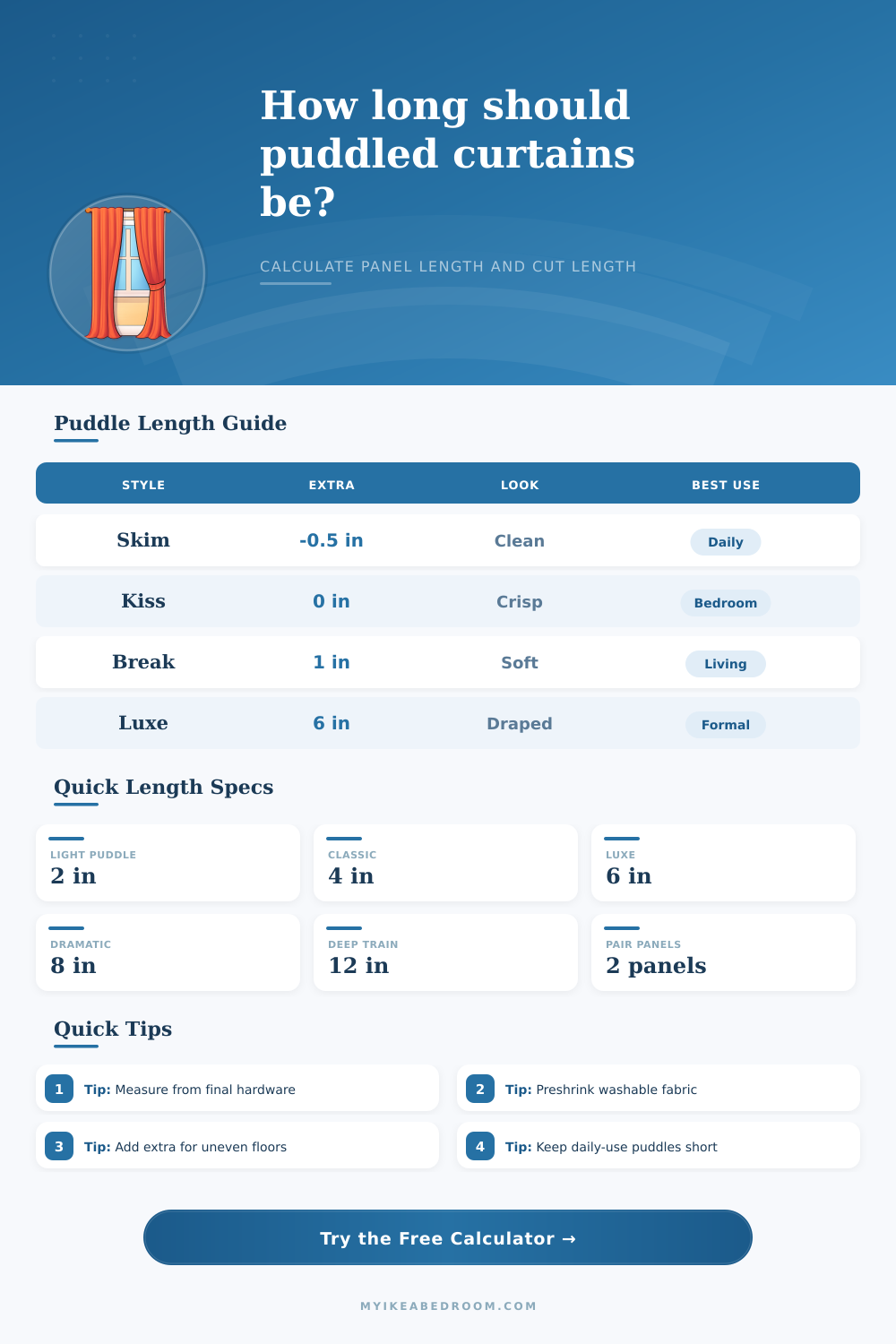
📐Puddle Length Reference Table
| Floor Finish | Extra Length | Movement | Best Fabric Weight |
|---|---|---|---|
| Floor skim | -0.5 in / -1.3 cm | Opens fastest | Washable cotton, kids rooms |
| Kiss the floor | 0 in / 0 cm | Very easy | Most everyday panels |
| Trouser break | 1 in / 2.5 cm | Easy | Linen, cotton, light velvet |
| Light puddle | 2 in / 5.1 cm | Moderate | Linen, sheers, soft blends |
| Classic puddle | 4 in / 10.2 cm | Mostly stationary | Decorative bedroom drapes |
| Luxe puddle | 6 in / 15.2 cm | Stationary | Velvet, lined drapery, formal linen |
| Dramatic puddle | 8 in / 20.3 cm | Stationary | Heavy drapes and photo styling |
| Train puddle | 10-12 in / 25-30 cm | Rarely moved | Display panels and staged rooms |
🪝Heading Adjustment Table
| Measurement Reference | Typical Rise | Use With | Calculator Note |
|---|---|---|---|
| Ring eyelet or clip bottom | 0 to 0.5 in | Clip rings, sewn rings | Measure where panel hangs |
| Ceiling track glider | 0 to 1 in | Ripplefold, pinch pleat track | Add heading above hook if visible |
| Rod top for grommets | 1 to 2 in | Grommet panels | Fabric usually rises above rod |
| Rod underside for pocket | 0.5 to 1.5 in | Rod pocket, back tab | Depends on pocket depth |
| Drapery hook point | 0.5 to 2 in | Pinch pleat, goblet pleat | Set by hook insertion height |
✂Cut Allowance Table
| Construction Detail | Typical Allowance | Why It Matters | When To Increase |
|---|---|---|---|
| Double bottom hem | 3 to 5 in | Adds weight and clean fall | Use 5 in for heavy drapes |
| Top heading fold | 2 to 4 in | Forms pocket, tabs, or pleats | Use more for buckram headings |
| Fabric shrink | 0 to 3% | Protects finished length | Use for washable cotton or linen |
| Floor unevenness | 0.25 to 1 in | Balances small slope changes | Use in older rooms or wide windows |
| Final trimming reserve | 0.5 to 1 in | Allows last fitting adjustment | Use for custom sewn panels |
🖼Preset Comparison Table
| Preset | Measure To Floor | Puddle Style | Best Use |
|---|---|---|---|
| Bedroom Kiss | 84 in | 0 in | Panels opened daily |
| Linen Soft Break | 96 in | 1 in | Relaxed bedroom curtains |
| Velvet Classic Puddle | 108 in | 4 in | Decorative side panels |
| Dining Luxe Drapes | 120 in | 6 in | Formal stationary drapery |
| Rental Floor Skim | 83.5 in | -0.5 in | Easy cleaning and moving |
| Studio Photo Train | 96 in | 12 in | Styled photography panels |
💡Measuring Notes
Finished length is the visible sewn panel length. Cut length includes top construction, bottom hem, shrink allowance, and panel count totals.
To determine the length of the curtains, a person must take into account many different measurement for the curtains. The length of the curtains will determine not only how the curtains looks in the room, but also how the curtains will function in that room. If the length of the curtains is too short for the window in the room, the windows will look unfinished.
However, if the length of the curtains is too long for the windows in the room, the curtains may interfere with the function of the floor in that room. The curtain calculator helps to determine the length of the curtains that are apropiate for a room by taking into account the hardware height of the room, the chosen puddle style, the heading construction of the curtains, and the hem allowance for the curtain panels. To measure the length of the curtains, one may start by measuring the distance from the curtain rod (or curtain track) to the floor in the room.
How to Measure Curtain Length
This measurement from the floor to the rod is the most important measurement to be taken in the room. The curtain calculator will ask for this measurement, and it will add the heading rise to this measurement. The heading rise is the distance from the rod to the curtain panel for certain types of hardware.
Such as grommet panels versus pinch-pleat hardware. Additionally, after measuring from the rod to the floor, the curtain calculator will ask for the allowance of the bottom of the curtain panels. For example, curtain panels with a negative allowance will be designed to stay a certain distance from the floor to allow for easy vacuuming of the floor.
A zero allowance will create a kiss length curtain panel that allow the curtain to almost touch the floor. A one-inch allowance will allow the curtain panels to create a trouser break at the floor. A four-to-six inch allowance will allow the curtain panels to puddle on the floor.
The curtain calculator will add this allowance to the drop measurement of the curtains (from rod to floor), and it will additionally ask for the construction of the curtain panels. The construction length of the curtains is the length of the fabric that will be used to construct the hem and the heading of the curtains. For instance, a double-fold hem at the bottom of the curtain panels will require four to five inches of fabric for the curtain panels to have proper weight.
The width of the panels will need to be ordered to cover the bottom hem and the top heading, the top heading will cover the rod pocket, back tab, or buckram-stiffened pleat. For fabrics like cotton or linen, the curtain panels may need to be ordered with a certain percentage provided for potential shrinkage of the curtain panels when the fabric is washed. Thus, the curtain calculator will provide both the panel length of the curtains (after adding the floor-to-rod length, heading rise, hem length, and shrinkage percentage to the panels) and the cut length for the curtain panels.
Additionally, with the curtain calculator, one may be able to see how certain depth of puddles will impact the yardage (amount) of curtains that will be needed in the project. The length of the curtains can also impact the amount of dust that the curtains will collect. For example, floor-skim curtains will typically gather less dust than puddle curtains.
This is due to the fact that puddle curtains will touch the floor more frequent. Additionally, puddle curtains will experience more wear than floor-skim panels because they are in constant contact with the floor. Thus, many people may prefer puddle curtains for applications such like dining rooms or master suite in the house.
However, one should choose the length of the curtains according to both the way that the rooms will be used, as well as the type of fabric that will be used to make the curtains. When measuring the length of the curtains, care must be taken to ensure that the floor in the room is even. Floors can be sloped such that one side of the window may be higher than the other side of that window.
In this case, one may enter the shortest measurement of the windows into the curtain calculator to ensure that the curtains will have a consistent kiss length throughout the window. However, an additional length of fabric (small amount) may be purchased for the curtains to puddle evenly in these sloped floor. Additionally, in many older homes, the windows may have wide sill or deep baseboards that may cover the hem of the curtain panels.
Thus, one may order an additional half-inch to the length of the curtain panels to prevent the curtains from catching on the baseboards. The weight of the curtain panels may also have an impact upon the way in which the length of the curtains appears in the room. For instance, heavy velvets hold a fold well, so they will look well with a large puddle of fabric at the bottom of the curtains.
Lightweight linens, in contrast, may exhibit wrinkles in the panels of the curtains if the length of the curtains is too great for the linens. Sheer fabrics will not puddle well at the bottoms of the curtains because of the lack of weight of the fabric. Many mistake occur when determining the length of the curtains due to measuring from the wrong starting point in the room.
For instance, the distance from the top of the rod may not be the correct starting point to measure the curtains if the curtains will incorporate rings or clips to the rod. Furthermore, tracks mounted to the ceiling are higher than rods, which will change the length of the curtains when hung from the ceiling track. Thus, the curtain calculator may ask for the reference point of the curtains separately so that mistakes made at the top of the curtains will not impact the length of the curtains at the bottom of those panels.
Finally, the curtain calculator will provide two different measurement for the curtains. The finished length of the curtains will be the length of the curtains that are visible in the room after the hanging of the curtains. The cut length of the curtains is the total amount of fabric that must be cut to create the curtains.
The cut length will always be longer than the finished length because it includes the length of the fabric required for the hems of the curtains. Knowing the cut length of the curtains will allow a person to calculate the total yardage that will be required for purchase for those curtains.