Curtain Panel Quantity for Window Calculator
Estimate panel count from rod span, side returns, center overlap, fullness, panel width, opening style, and pack size.
🏠Window presets
📏Window and curtain inputs
Curtain panel result
🧵Header and fabric comparison grid
📚Curtain sizing reference tables
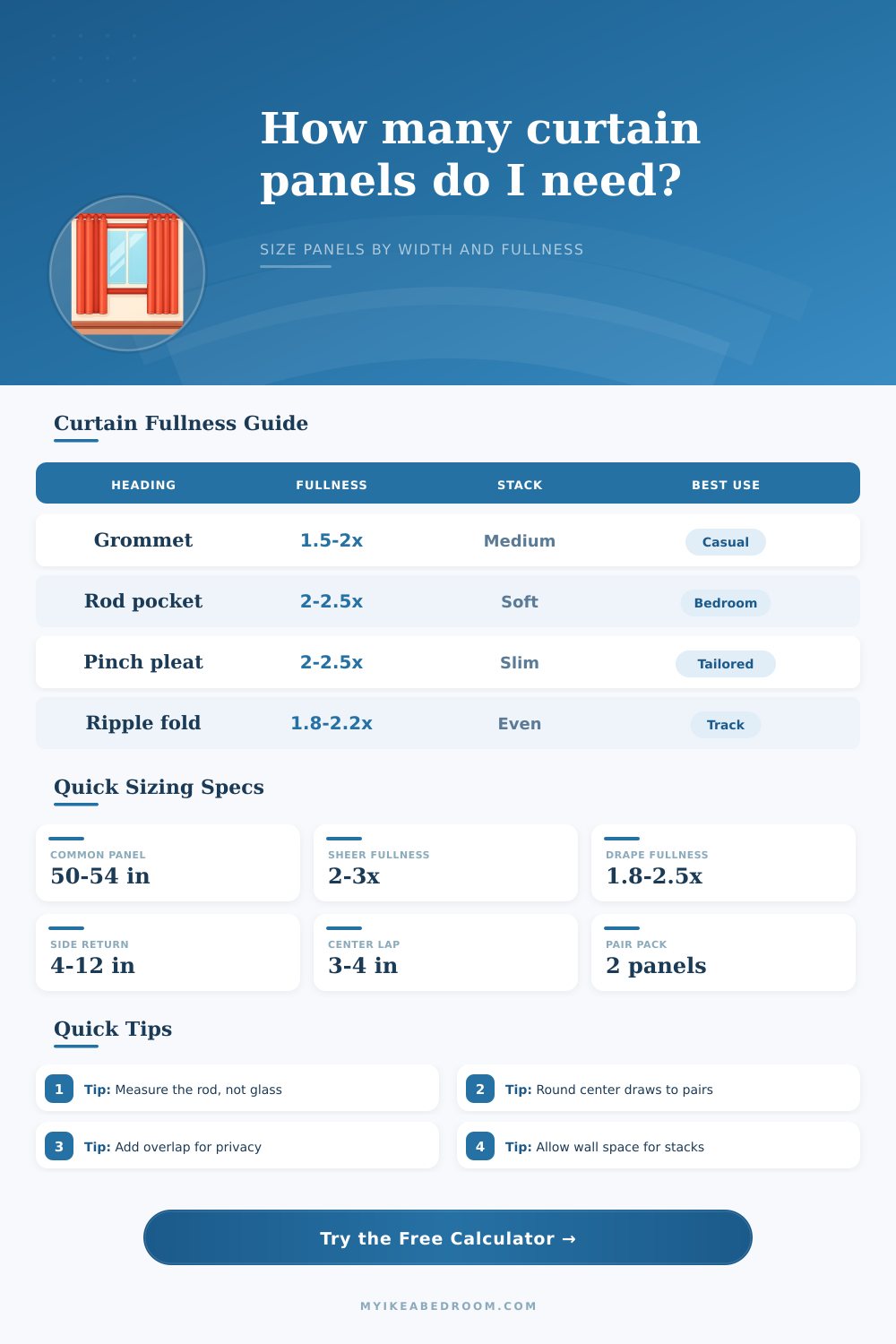
| Header style | Typical fullness | Quantity note | Best fit |
|---|---|---|---|
| Grommet or eyelet | 1.5x to 2.0x | Round to even panels for center openings | Casual bedrooms, easy sliding |
| Rod pocket | 2.0x to 2.5x | Higher fullness prevents a stretched look | Soft decorative panels |
| Back tab | 1.8x to 2.2x | Works well with standard 50 inch panels | Neat folds on a rod |
| Pinch pleat | 2.0x to 2.5x | Count flat panel width before pleating | Tailored full-height drapes |
| Ripple fold or wave | 1.8x to 2.2x | Keep panel counts symmetrical on split tracks | Ceiling tracks and wall spans |
| Finished panel width | Width in cm | Use with | Counting note |
|---|---|---|---|
| 50 in | 127 cm | Most ready-made panels | Two panels give 100 in flat width |
| 52 in | 132 cm | Blackout and thermal panels | Good for fuller medium windows |
| 54 in | 137 cm | Decorative drapery panels | Slightly more forgiving than 50 in |
| 57 in | 145 cm | Metric ready-made panels | Common for track and rod curtains |
| 59 in | 150 cm | Sheers and wide ready-mades | Useful when aiming for 2.5x fullness |
| 100 in | 254 cm | Extra-wide single panels | Often works for one-way draws |
| Fabric weight | Approx stack factor | Clearance behavior | Planning cue |
|---|---|---|---|
| Sheer voile | 12% to 16% | Compresses tightly | Prioritize fullness over stack |
| Light cotton or linen-look | 16% to 20% | Moderate folds | Works with 6 to 8 in side return |
| Medium lined drape | 20% to 24% | Noticeable stack | Use wider rods for clear glass |
| Blackout or thermal | 24% to 30% | Bulkier when open | Allow wider side extensions |
| Heavy velvet or dense weave | 28% to 34% | Largest stack | Consider fewer wider panels |
| Window scenario | Span before fullness | Common fullness | Typical panel result |
|---|---|---|---|
| 36 in narrow bedroom window | 48 in with returns | 2.0x | 2 panels at 50 in |
| 60 in standard double window | 80 in with returns | 2.0x | 4 panels at 50 in |
| 72 in balcony door | 92 in with returns | 1.5x | 3 panels at 50 in |
| 96 in picture window | 116 in with returns | 2.2x | 6 panels at 50 to 54 in |
| 120 in wall span track | 120 in measured track | 2.0x | 6 panels at 50 in |
💡Panel quantity tips
The calculator estimates panel quantity from finished panel width. Custom sewn panels, deep pleats, and hardware-specific carriers may need a workroom or track-system check before final ordering.
Calculating the correct numbers of panels require taking specific measurement of your space and the curtains. By calculating the correct number of curtain panels, you can ensure that your curtains dont leave a gap in the middle of your window or make a lump on the side of your window. Often, people will make mistake when calculating the number of panels because the fabric will behave differently when it is hanging from the window.
To calculate the number of panels correctly, you must first determine the measurement of your span, side returns, center overlap, and fullness to order the correct amount of fabrics for your desired curtains. The span is the measurement of your rod and is required to be entered into the calculator. The side returns are the amount that the curtains should extend beyond the window frame when open.
How to Calculate the Right Number of Curtain Panels
The center overlap is the amount of width that one curtain should extend past the other curtain so that the light dont pass through the center of the window. Fullness is the ratio of the width of the curtain panels when laid flat compared than the span that it should cover. A fullness of 2.0x means the flat width of the panels should be twice the width of the span.
The type of header style that you choose for your curtains will affect the amount of fabric that you need and the way that the curtains will appear when open. For example, grommet tops allow the curtains to slide easy on the rod and can take a lower fullness ratio than other header styles. Rod pockets gather at the top of the rod and will require more fabric for the curtains to not appear flat when drawn open.
Pinch pleats allow for more control over the way that the fabric falls and provide for the flat width of the panel to be more important then the way that the curtain will look when hung. Ripple fold and wave curtains create the same depth in the folds of the fabric for the curtains to look even when hung and you can easily calculate them with the number of panels needed. The weight of the fabric that you choose will impact how much space that the curtains will take up in your room.
For example, sheer voile fabrics are lightweight and will compress when drawn open. On the other hand, heavier lined drapes and blackout panels will take up more space on the side of the window. The curtain panel calculator will use this information to determine how much space you will need to allow for the curtains to cover the window properly.
Commonly made mistakes with curtain calculations include measuring the wrong dimensions and rounding to the wrong number. For example, it is common for people to measure the width of the glass in the window rather than the span of the rod. Using only the width of the glass will result in your curtains looking too small once hung.
It is also common for people to purchase an odd number of panels for a curtain panel pair that opens in the center. An odd number of panels cannot be divided evenly between the two curtains. The even-pairs option will ensure that you have an even number of panels that will look balanced when hung.
All variables in the room that the calculator cannot calculate will have to be accounted for in your drawings or design of the curtains. For example, if you have crown molding above the curtains, this will reduce the amount of space for the curtains to gather. Similarly, a deep windowsill will reduce the amount of space between the curtain rod and the glass.
If the window is close to a corner in the room, the corner may impact the amount of space available for the curtain panels. Once you have the calculation of how many panels you need, you must compare this with the available size of the panels that are available from the retailer. Most retailers will sell curtain panels in pairs.
In this case, you may need to round your calculations to the next even number to ensure that you have enough panels. Buying an extra panel can help your curtains look better in the window and provide the space needed when the curtains are open. If you are using multiple layers of curtain panels, you will need to consider the fullness of each layer.
For example, if you have a sheer curtain panel behind a heavy drape curtain, the sheer panel could have a higher fullness (due to the lightness of the fabric) compared to the heavy drape curtains. The outer drape may require less fullness than the sheer curtain. Each layer should be calculated separately to determine the fullness of each layer.
Additionally, you should compare the calculations with each other to ensure that the window does not appear overloaded by the window treatments. The use of curtain panel calculators will ensure that your window closes fully and opens cleanly. These calculators will eliminate the need to perform calculations in your mind.
Instead, you can focus on choosing the color of your curtains as well as their texture.