Crown Molding Height Calculator
Estimate crown wall drop, ceiling projection, cabinet or door reveal, room linear footage, order length, piece count, and scarf-joint spacing from real molding geometry.
Load a realistic crown condition, then adjust the values to match your ceiling, cabinet, tray, door, or perimeter layout.
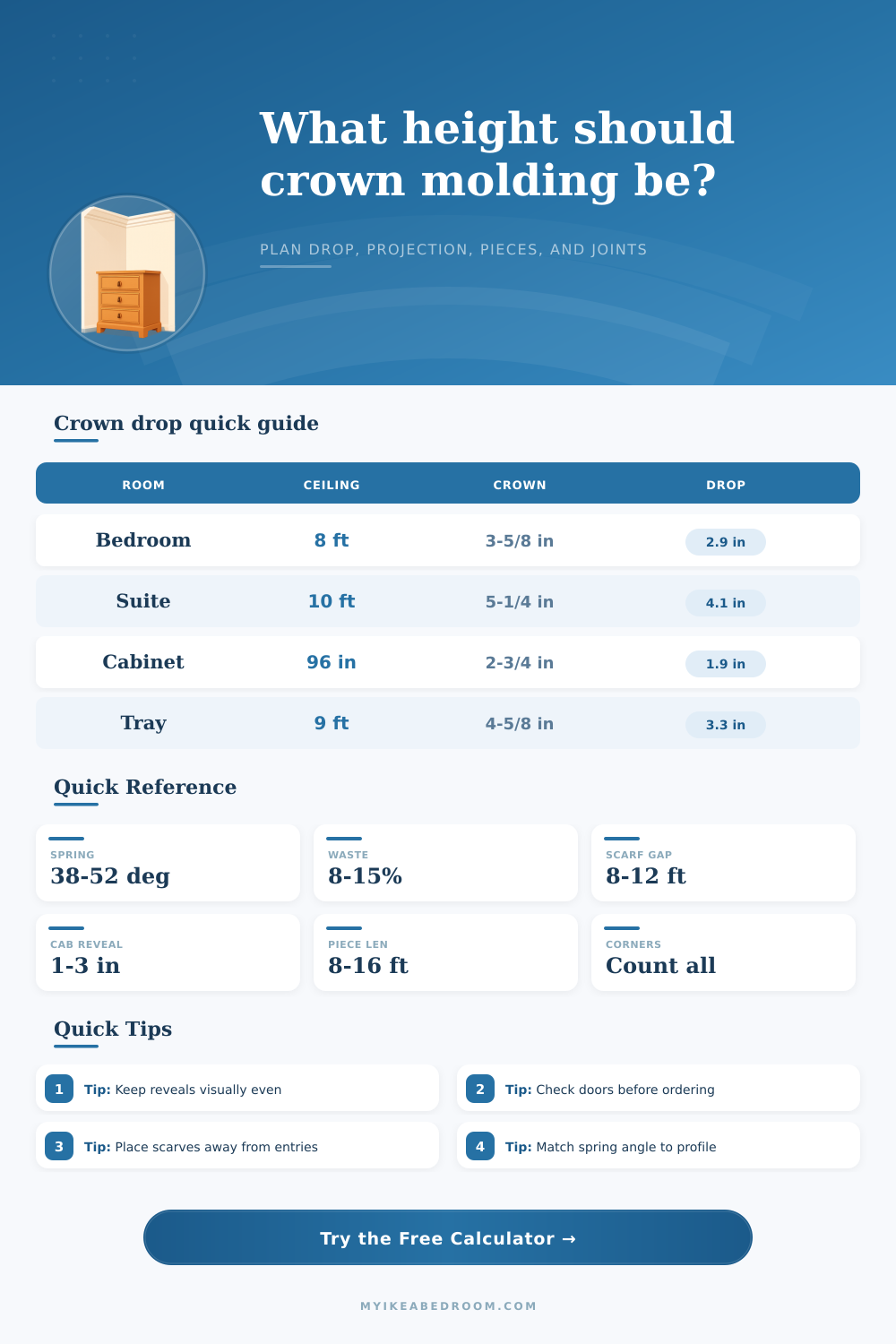
Face: 2-5/8 to 3-1/4 in
Use: Low bedrooms, closets, and small alcoves.
Visual: Adds a finished edge without crowding door heads.
Face: 3-5/8 to 4-1/4 in
Use: Most 8 to 9 ft bedrooms and sitting rooms.
Visual: Balanced drop, projection, and reveal.
Face: 5-1/4 to 6-1/2 in
Use: Primary suites, taller ceilings, and tray borders.
Visual: Creates a heavier architectural top line.
Face: 2-1/4 to 4 in
Use: Wardrobes, built-ins, and cabinet runs.
Visual: Works best with a deliberate reveal above doors.
When you choose crown moldings for a room, you must understands the width of the crown molding is not the same than the space that the crown molding will occupy in the wall and ceiling. The width of the crown molding is the width of the face of the wood. However, the molding will sit against the walls and the ceiling at an angle.
The angle of the crown molding against the wall and ceiling are called the spring angle. Based off the spring angle of the molding, the molding will create two measurement within the space in the room. The drop of the molding against the wall is called a wall drop.
How to Measure and Buy Crown Molding
The projection of the molding is the extension of the molding beyond the ceiling. If the spring angle feature a steep angle for the molding to sit against the wall, the molding will have a larger projection and a smaller wall drop. Conversely, if the spring angle features a shallower angle for the molding to sit against the wall, the molding will have a smaller projection and a more larger wall drop.
Another reason to calculate the wall drop is to ensure that there is an apropriate amount of space between the molding and other objects in the room. The objects in the room may includes door frames, cabinets, or window casings. The space between the crown molding and these objects is called the reveal.
If the wall drop features too large a drop for the molding to sit against the ceiling, there will be too small of a reveal between the molding and the door frames or other objects. If the molding appears to be too close to other objects in the room, the room may appear cramped. Additionally, it may appear as though the ceiling in the room is lower than it actualy is.
Thus, calculating the drop help ensure that there is an apropriate reveal between the molding and other objects in the room. When you purchase crown molding for a room, you must purchase more of the molding than the perimeter of the room. This is because you must purchase the molding in length that allow for the molding to form compound miter cuts at the corners of the room.
Compound miter cuts require more of the molding than cuts that does not feature compound angles. Corners where the molding will join the wall outside the house will require more of the molding than inside corner. When purchasing molding, it is tempting to simply calculate the perimeter of the room to determine the amount of molding needed.
However, you must factor in a waste percentage for the molding to allow for extra molding to be used during the cutting process. Additionally, because molding cannot be purchased in lengths that are as long as the perimeter of the walls in the room, scarf joint will be required to join two lengths of molding together on a long wall. Scarf joints will be placed in locations where the molding will not be seen to maintain the professionally look of the installed molding.
The scale of the room will determine the profile of the crown moldings to be purchased for that room.