Conference Table Size Calculator
Estimate a meeting table length and width from room dimensions, seat count, table shape, chair size, aisle clearance, screen or whiteboard space, door swing, power module spacing, and table edge allowance.
Pick a room scenario, then adjust the inputs for your exact chairs, screens, doors, and seat count.
Best for: 4 to 6 seats in a small room.
Watch: Door swing and wall monitor depth.
Best for: 8 to 14 seats with balanced side aisles.
Watch: Long end clearance near screen walls.
Best for: Camera sightlines and easier corner movement.
Watch: Wider center may reduce side clearance.
Best for: Laptops, rows, and teaching rooms.
Watch: Aisles between rows and front screen space.
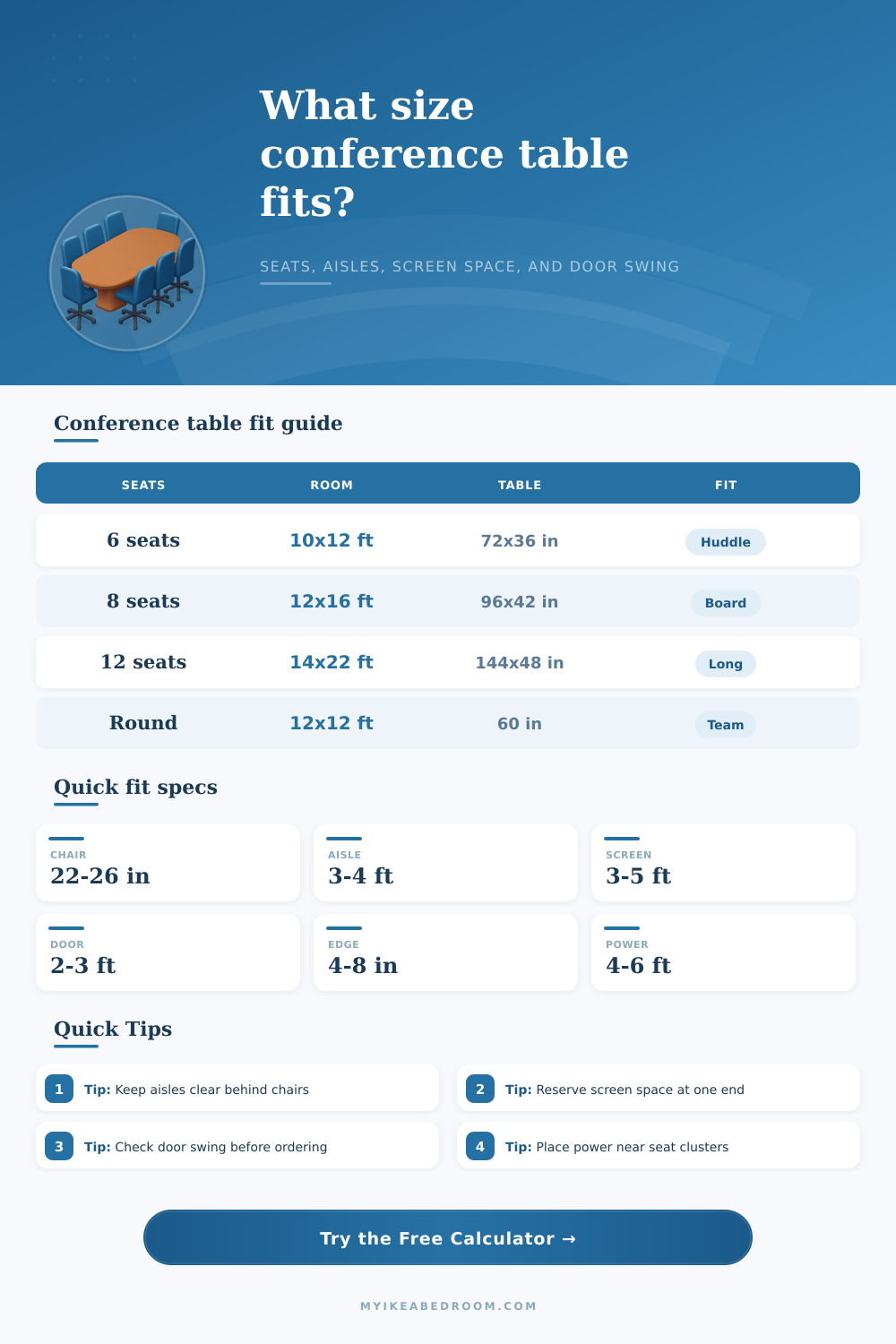
| Seat count | Rectangle length | Suggested width | Typical room size |
|---|---|---|---|
| 4 seats | 48 to 60 in | 30 to 36 in | 9 x 10 ft or larger |
| 6 seats | 72 to 84 in | 36 to 42 in | 10 x 12 ft or larger |
| 8 seats | 96 to 108 in | 42 to 48 in | 12 x 16 ft or larger |
| 10 seats | 120 to 132 in | 42 to 48 in | 13 x 18 ft or larger |
| 12 seats | 144 to 156 in | 48 to 54 in | 14 x 22 ft or larger |
| 16 seats | 192 to 216 in | 48 to 60 in | 16 x 28 ft or larger |
| Allowance | Compact target | Comfort target | Where it applies |
|---|---|---|---|
| Seated chair depth | 24 to 30 in | 30 to 36 in | From table edge to chair back |
| Walking aisle | 30 to 36 in | 36 to 48 in | Behind pulled-out chairs |
| Screen or board zone | 36 in | 48 to 60 in | At the presentation end |
| Door swing buffer | 24 in | 30 to 36 in | Near entry doors and storage doors |
| Edge allowance | 4 in | 6 to 8 in | At table ends and rounded corners |
| Preset | Room footprint | Seats | Planning emphasis |
|---|---|---|---|
| 6-seat huddle room | 10 x 12 ft | 6 | Compact table with screen reserve |
| 8-seat boardroom | 12 x 16 ft | 8 | Balanced side clearance |
| 12-seat rectangle | 14 x 22 ft | 12 | Long table with door buffer |
| Boat-shaped table | 13 x 19 ft | 10 | Presentation sightlines |
| Training room rows | 18 x 24 ft | 16 | Forward-facing screen layout |
Clearance tip: Measure the room with chairs pulled out, not just the bare table footprint. The aisle score drops quickly when chair depth and walking clearance compete for the same space.
Presentation tip: If a screen, camera bar, whiteboard, or credenza sits at one end, keep that buffer separate from the normal chair aisle so presenters can stand and move.
When choosing a conference table, there is more to consideration than the number of individual who are to sit at the conference table. Other considerations include the amount of space for individuals to move within the room, the space required for the screen in the room to be visible by all individuals, and the space required for a door to open from the area of the conference room. Many people will attempt to determine the size of the conference table by measuring the conference room in which the conference table is to be placed.
However, this strategy is generaly ineffective in arriving at the proper conference table size because the guessing factor does not account for all of the variables of the conference room. For instance, chair take up additional space when the individual sits back in their chair, additional space is required for aisles in the conference room for individuals to walk behind the chairs, and additional space is required for presentation equipment that may be located in the conference room. A conference table size calculator allow individuals to input the dimensions of the conference room and the requirements of the conference to remove the guesswork involved in determining the appropriate size for the conference table.
Choose the Right Size Conference Table
The various inputs into the conference table size calculator include the width and depth of the chairs in the conference room, the size of the aisles in the conference room, and the size of the space between the conference table and the screen in the conference room. Each of these measurements must be accurate and reflect the actual size of the elements in the conference room. For instance, wide chairs that contain armrests will require more space within the conference room than slim chairs.
Furthermore, the depth of the chairs will be greater when the individual is leaning back in their chair. If the dimensions of the chairs in the conference room are under estimated, the chairs will take up the aisle space during the meetings between the individuals who are to attend the conference. Aisle space is the space in the conference room behind the conference room chairs.
Aisle space is required in the calculation for the conference room because the goal is to provide space for an individual to walk past the other individuals in the conference without having to touch their chair. Additionally, if conference rooms are to be used for training individuals with presentation equipment, the aisle space must also allow for the presenter to move between the conference room and the screen. The calculator allow individuals to test various aisle widths and to see how that change in width will impact the calculation.
Screen space is the area between the screen in the conference room and the conference table. In addition to the depth of the screen, the space required for the presenter to stand in the conference room is also a consideration in the calculation. If the screen is placed at the end of the conference table, screen space will protect the view of individuals who are sitting at the end of the conference room table.
A low score for screen space will result if the screen is too close to the end of the conference table due to the area being claimed by both the screen and the individuals who are sitting at the conference table. Door swing is the arc that is created by a door as it opens into the conference room. The swing of the door in the conference room must be taken into account in determining conference table size.
For instance, if the door opens into the conference room, it may interfere with the conference table or the placement of the conference chairs. The buffer for the door swing in the conference table size calculator provides for extra space for individuals to enter or exit the conference room. This factor is especially important to consider in small conference rooms.
Power module spacing is the distance between power access points in the conference table. Although many people may consider this as an optional input into the conference table size calculator, it is actualy an important measurement. For instance, if individuals are to sit at the conference table and use electrical devices, it is necessary to ensure that the conference table does not have a cable that crosses the conference table.
The power module spacing will allow the calculator to determine how many power access points will be located in the conference table. This can help to indicate whether the conference table will use power grommets or floor boxes to provide power to the individuals who are to sit at the conference table, and whether the distance between the individual and the power point is too great for the individual to have to travel long distance to reach the power point. In addition to determining the size and shape of the conference table, the conference table size calculator indicates possible tradeoffs between the different prioritized variables in the conference room.
For instance, the margin in the conference room may be relatively tight in relation to the size of the conference table. However, the tight margin does not necessarily indicate that the conference table is too large for the conference room. Rather, it may indicate that the seating and movement priorities for the conference room may be too great for the space within the conference room.
If individuals change from a generous priority to a compact priority, the size of the conference table seats will be reduced. By reducing the size of the seating and the allowance for each individual at the conference table to move, the positive clearance will be restored without the need to change the dimensions of the conference table. The shape of the conference table will impact how the individuals are to be distributed within the conference room.
Round conference tables will allow for each individual to have the same amount of space around the conference room table. Round conference tables are effective if the individuals are to be discussing the same topic. Rectangular conference tables allow for individuals to be seated along the long sides of the table.
Additionally, rectangular conference tables allow for the additional seating of individuals at the end of the table. Boat and racetrack shapes allow for additional space in the middle of the conference table; however, if the conference room is narrow in size, these conference tables can reduce the amount of space available to the individuals who are sitting along the side of the conference table. When these shapes are selected, the conference table size calculator will automatically account for the changes in the length and width dimensions of the table.
In addition to the conference table, there are various obstacles within the conference room that must be accounted for. The dimensions of the room should be measured twice to account for the obstacles in the room. These obstacles may include columns, window sills, and other built in furnitures.
The space for the conference table will be calculated with these measurements removed from the size of the conference room. This measurement will indicate how much space will remain in the conference room after the placement of the conference table. If there isnt much space left in the conference room, there may not be enough space to place other items in the conference room.
Common mistakes include underestimating the size of the movement that is required within the conference room. For instance, individuals may measure the size of the conference room based off the area that is to be covered by the conference table. However, they may not account for the space that will be taken up by the individuals who will sit in the conference room.
Additionally, individuals may account for the space that will be taken up by the screen in the conference room, but they may not account for the space that will be required for the presenter to stand in the conference room. Finally, individuals may not account for the swing of the conference table when measuring the conference room; they may think that the conference table will fit into the space when the conference room is empty, but the door swing may prevent the conference table from being placed correctly in the conference room. These mistakes will be reflected in the calculation of the conference room size; therefore, running the calculations prior to ordering the conference table will save the organization time.
The goal of calculating the size of the conference table is to ensure that the conference room can support the function that is to be held within that conference room. The conference room is considered to be a successful layout for the individuals who are to attend the conference if there is enough space for the individuals to sit and to move within the conference room.