Slab depth, volume, and bag planning
Concrete Slab Thickness Calculator
Estimate slab thickness, concrete volume, bag equivalents, and weight using the footprint, load class, support condition, and mix type.
Choose a real slab project to load the footprint, depth, and material setup fast.
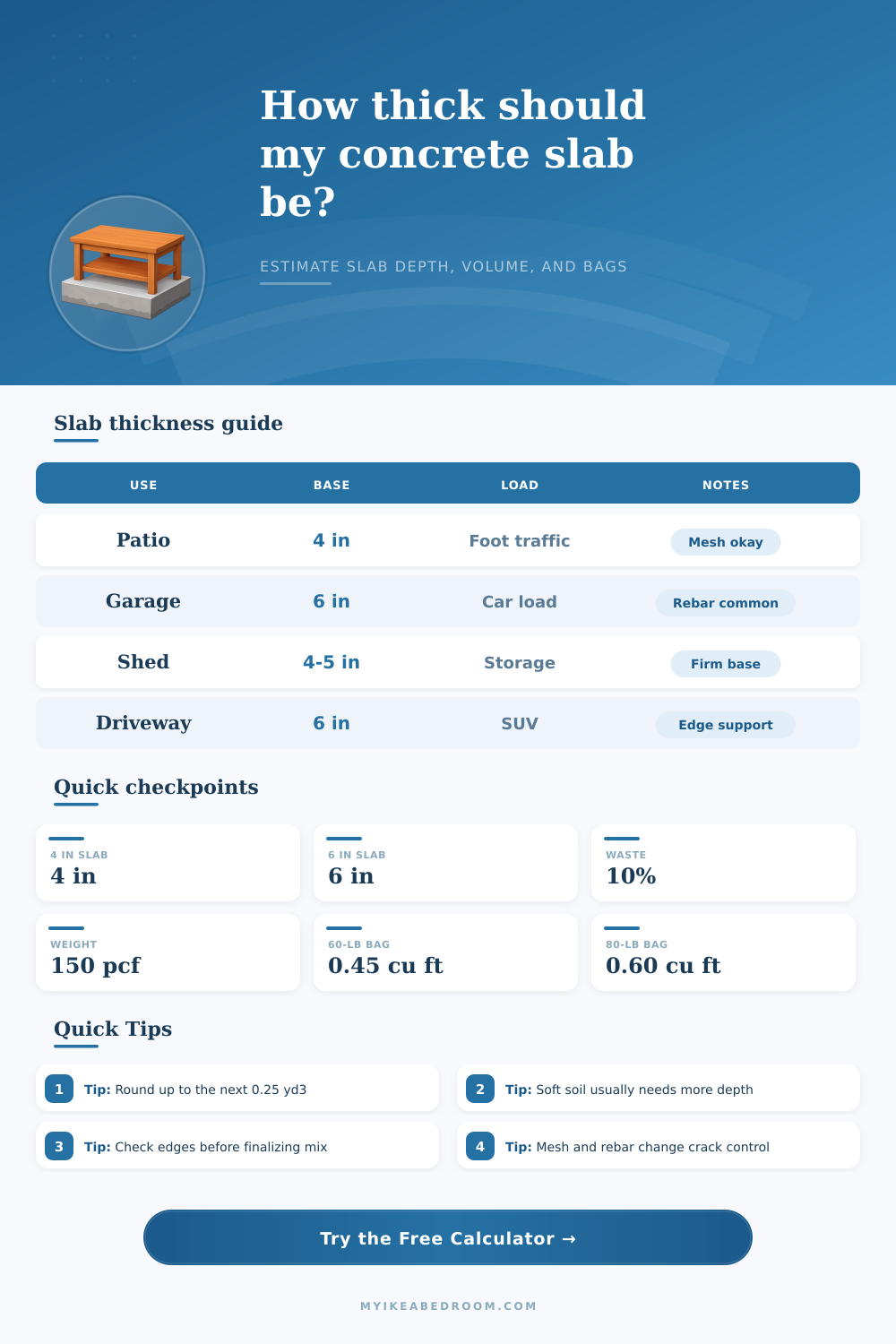
| Use case | Normal thickness | Common load | Planner note |
|---|---|---|---|
| Patio / terrace | 4 to 4.5 in | Foot traffic | Mesh or fiber is usually enough. |
| Walkway / sidewalk | 4 in | Foot traffic | Keep edges tight and joints regular. |
| Shed slab | 4.5 to 5 in | Storage load | Firm subbase helps keep settlement low. |
| Garage slab | 6 in | Car and SUV | Rebar is common where wheel loads land. |
| Condition | Add to depth | Where it fits | Planner note |
|---|---|---|---|
| Well-compacted base | 0 in | Firm subgrade | Lowest extra depth in the set. |
| Typical subgrade | 0.25 in | Most projects | Small cushion for normal site variation. |
| Soft fill or clay | 0.75 in | Variable soil | Depth adds help offset settling risk. |
| Freeze-thaw edge | 0.5 in | Outdoor slabs | Useful when moisture and cold cycling matter. |
| Thickness | Sq ft per yd3 | m2 per m3 | Planning note |
|---|---|---|---|
| 4 in | 81 sq ft | 10.5 m2 | Good for patios and walks. |
| 5 in | 65 sq ft | 8.4 m2 | Steadier for sheds and light loads. |
| 6 in | 54 sq ft | 7.0 m2 | Common for garages and driveways. |
| 8 in | 41 sq ft | 5.3 m2 | Used for heavier pads and equipment. |
| Measure | 60-lb bags | 80-lb bags | Weight note |
|---|---|---|---|
| 1 cu ft | 3 bags | 2 bags | Good for quick bag math. |
| 1 cu yd | 74 bags | 56 bags | Rounded up for planning. |
| 4 in over 100 sq ft | 75 bags | 56 bags | Thin slabs still add up fast. |
| 6 in over 100 sq ft | 112 bags | 84 bags | One extra bag can matter. |
The thickness of a concrete slab depend on several factor. The thickness of a concrete slab depends on the load that the slab must support and the type of soil that support the slab. If a concrete slab is too thin, it will crack under heavy loads.
However, if a slab is too thick, it will use more concrete than it needs for the foundation. The best way to determine the thickness of a concrete slab is by calculating how much weight will be placed on the slab and the stability of the ground that will support the foundation. The weight that people will place on the foundation will have a significant bearing on the thickness of the foundation.
How Thick a Concrete Slab Should Be
The heavier the objects that will use the foundation, the thicker the foundation will need to be. For instance, the thickness of the foundation of a walkway that people will use will be less than the thickness of a driveway that vehicles will use. Four inches may be enough for a walkway, but a driveway may need six inches to support the weight of a car.
Foundations that need to support heavy equipment such as shed or hot tubs will need to be thicker to support the weight. The type of soil that will support the foundation will also determine the thickness of the foundation. If the soil is compacted gravel, it will be stable.
However, if the soil is soft clay, it might shift under the weight of the foundation. The shifting of the soil may result in the foundation cracking. In such cases, its best to increase the thickness of the foundation.
Adding crushed stone under the foundation site will aid in the stability of the soil. Another option is to use geotextile fabric to prevent the mud in the soil from mixing with the crushed stone. Another factor that affect the thickness of a foundation is the type of reinforcement materials that people use.
Using wire mesh will prevent the foundation from cracking during the curing process. Using wire mesh is enough for walkways. For foundations that will support heavy vehicles, using rebar will provide greater support for the foundation.
Adding fiber reinforcement to the foundation will help prevent micro-cracks in the foundation. Using fiber reinforcement will allow the foundation to be thinner. The weather in which the foundation will be constructed also affect the durability of the foundation.
Using air-entrained concrete will allow the foundation to withstand the freezing of water in cold climates. The freezing of water in the foundation create micro-cracks in the foundation, which is known as the freeze-thaw cycle. Using air-entrained concrete will prevent the foundation from sustaining damage from the freeze-thaw cycle.
Additionally, increasing the thickness of the foundation on the edges will provide the foundation with more protection from the weather. When constructing a foundation, the volume of the foundation will determine the number of bags of concrete or the number of cubic yard of ready-mix concrete that are needed. In adding extra concrete to the foundation, you can purchase extra concrete to account for spillage of the concrete during placement.
If using bags of concrete, each 80-pound bag of concrete contains a specific volume of concrete. By multiplying the volume of the bag of concrete by the number of bags needed, one can determine how much concrete is needed for the foundation. When ordering ready-mix concrete from a concrete truck, the order will need to have the cubic yardage of the foundation calculate to meet the minimum order requirements of the ready-mix concrete supplier.
Finally, ensuring that the foundation is cured correctly will allow it to reach its full strength. To cure the foundation properly, you will need to moisten and cover it. If the foundation isnt cured correctly for at least seven day, it may crack.
Therefore, by ensuring that the thickness of the foundation is correct, the soil is prepared apropiately, and the foundation is cured correctly, the foundation will remain strong and durable for a long time.