Concrete Mix Ratio Calculator
Estimate wet concrete volume from length, width, and depth, then split dry material volume into cement, sand, aggregate, and starting water by the selected mix ratio.
🏗Concrete project presets
⚙Mix inputs
Your concrete mix result
Calculation breakdown
📐Formula used
wet volume = length × width × depth
planned wet volume = wet volume × (1 + overage)
dry material volume = planned wet volume × wet-to-dry factor
cement volume = dry material volume × cement parts / total parts
water weight = cement weight × water-cement ratio
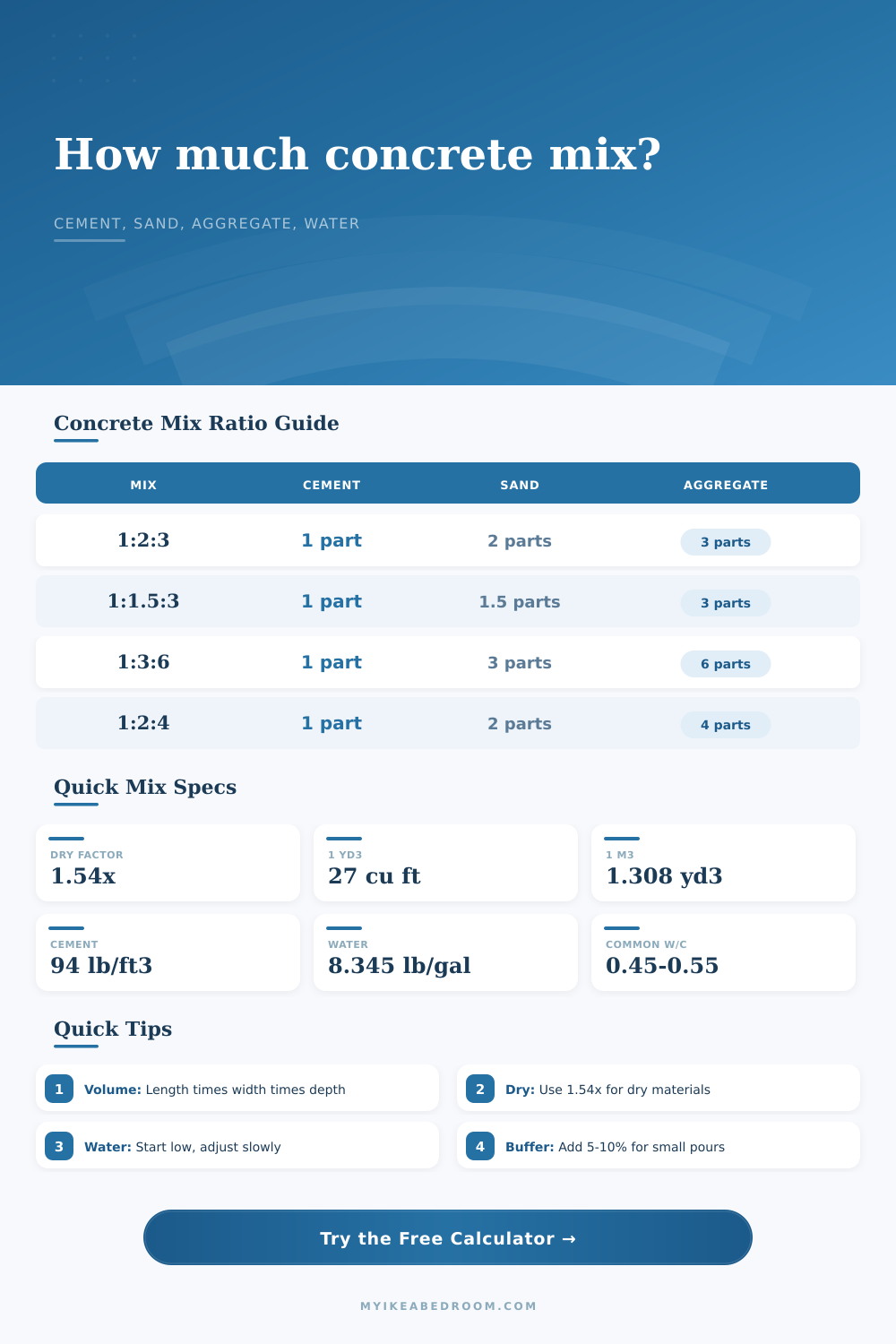
🧱Quick concrete specs
📊Concrete mix ratio reference
| Mix ratio | Parts by volume | Common planning use | Water-cement start |
|---|---|---|---|
| 1:2:3 | 1 cement, 2 sand, 3 aggregate | General small slabs, pads, and walkways | 0.45 to 0.50 |
| 1:1.5:3 | 1 cement, 1.5 sand, 3 aggregate | Denser slab mix where more cement paste is desired | 0.40 to 0.48 |
| 1:3:6 | 1 cement, 3 sand, 6 aggregate | Lean fill, blinding layer, bedding, non-structural base | 0.50 to 0.55 |
| 1:2:4 | 1 cement, 2 sand, 4 aggregate | Paths, light-duty slabs, and utility pads | 0.45 to 0.52 |
| 1:1:2 | 1 cement, 1 sand, 2 aggregate | Small repair batches needing a richer paste fraction | 0.38 to 0.45 |
| 1:4:8 | 1 cement, 4 sand, 8 aggregate | Mass bedding and low-strength leveling concrete | 0.52 to 0.58 |
📏Ingredient split for 1 yd³ wet concrete
| Mix ratio | Cement volume | Sand volume | Aggregate volume |
|---|---|---|---|
| 1:2:3 with 1.54 dry factor | 6.93 cu ft, about 6.9 bags | 13.86 cu ft | 20.79 cu ft |
| 1:1.5:3 with 1.54 dry factor | 7.56 cu ft, about 7.6 bags | 11.34 cu ft | 22.68 cu ft |
| 1:3:6 with 1.54 dry factor | 4.16 cu ft, about 4.2 bags | 12.47 cu ft | 24.95 cu ft |
| 1:2:4 with 1.54 dry factor | 5.94 cu ft, about 5.9 bags | 11.88 cu ft | 23.76 cu ft |
| 1:1:2 with 1.54 dry factor | 10.40 cu ft, about 10.4 bags | 10.40 cu ft | 20.79 cu ft |
| 1:4:8 with 1.54 dry factor | 3.20 cu ft, about 3.2 bags | 12.79 cu ft | 25.59 cu ft |
💧Water-cement ratio references
| W/C ratio | Water per 94 lb cement | Water per 50 kg cement | Practical note |
|---|---|---|---|
| 0.40 | 4.5 gal | 20 L | Stiff start; often needs careful placement and vibration |
| 0.45 | 5.1 gal | 23 L | Common controlled starting point for hand batching |
| 0.50 | 5.6 gal | 25 L | More workable, but avoid adding water beyond need |
| 0.55 | 6.2 gal | 28 L | Wetter placement start; check finish and strength needs |
📘Coverage by depth
| Concrete depth | Area from 1 yd³ | Metric equivalent | Common project fit |
|---|---|---|---|
| 2 in | 162 sq ft | 15.1 m² at 5.1 cm | Thin topping or leveling layer |
| 3 in | 108 sq ft | 10.0 m² at 7.6 cm | Light-duty pad with good base |
| 4 in | 81 sq ft | 7.5 m² at 10.2 cm | Walkway, patio, utility slab |
| 5 in | 65 sq ft | 6.0 m² at 12.7 cm | Shed base or thicker home slab |
| 6 in | 54 sq ft | 5.0 m² at 15.2 cm | Apron, heavier pad, reinforced slab |
| 8 in | 41 sq ft | 3.8 m² at 20.3 cm | Footing strip or deep small pour |
🗂Preset project table
| Preset | Dimensions | Mix ratio | Wet volume before buffer |
|---|---|---|---|
| Stepping pad | 3 ft by 3 ft by 4 in | 1:2:3 | 3.0 cu ft |
| Walkway section | 8 ft by 3 ft by 4 in | 1:2:4 | 8.0 cu ft |
| Small patio slab | 12 ft by 10 ft by 4 in | 1:2:3 | 40.0 cu ft |
| Shed base slab | 10 ft by 8 ft by 5 in | 1:1.5:3 | 33.3 cu ft |
| Garage apron | 16 ft by 8 ft by 6 in | 1:1.5:3 | 64.0 cu ft |
| Strip footing | 20 ft by 1.5 ft by 10 in | 1:2:4 | 25.0 cu ft |
| Lean fill layer | 12 ft by 4 ft by 3 in | 1:3:6 | 12.0 cu ft |
💡Mixing tips
A bag of concrete seems like an obvious answer to all our sloppy issues; we buy one, drop it on a shed base or driveway patch job, and walk away. But all too often, we pick up whatever is available at the store without considering what’s in the bag, and end up with a weak slab and a lot more wasted dollars then we had hoped. Knowing how much you need, and what’s inside the bag can make all the difference between a permanent solution and just another temporary patch.
It is not just about volume. It is about proportion.
Why the Mix and Water Matter
It’s the math: Once you input your dimensions, the calculator does all the work for you; and spares you the guesswork over whether a cubic yard of material will be enough to cover a twelve-by-ten patio. But even better, it teaches you why these numbers is important. If you input three measurements (length), width, and depth; you’re describing the wet volume, or the amount of space that will be filled by concrete when it’s poured and has had time to settle into position. The problem is that there are air gaps between stones and sand, so the dry materials takes up more space than the wet ones. That missing space must be factored in, so this tool uses a dry factor.
And most folks merely want to know: How many bags should I order? They tend to overlook one thing. The mix ratio determine durability and strength, but it is also what makes the cement what it is. The secret is in the mix ratio. The mix ratio is kind of like your recipe.
One part cement, two parts sand, and three parts coarse aggregate are a workhorse mix (one-to-two-to-three). There is just enough paste to bind the ingredients. This avoids wasting expensive cement on filling spaces that do not realy need binding. To make it stronger, such as with a heavier load bearing slab, you might move toward a one-to-one-and-a-half-to-three mix. More cement paste hold things together better but costs more. A leaner mix is appropriate for bedding material under pipe or a blinding layer. This means using less cement, such as a one-to-three-to-six mix, which is good for places where strength isn’t the main issue. So knowing what recipe to use is half the game.
Water’s the second half. The great variable? Water. Too much makes for weak spots. Water turns powder and gravel into stone, but too much of it create weak spots. In this case, the most important part is the water-to-cement ratio. Ideally, you have enough water to be able to spread it around, yet not so much that it shrink and bleeds excessively during curing time. A lower initial ratio (such as zero point four five) makes a denser finished product. If your mix is stiff, add a bit of water. Can’t take it out if it’s already in there. That’s why the tool says start low. Easier to adjust on site than redo a pour cuz ya made it too wet.
Finally consider the buffer. In the real world the pour won’t be perfectly cubic. Some will stick to wheelbarrow or the mixer. Some of the subgrade will change shape, the edges will become lopsided. Ten percent overage isn’t wasteful, it’s realistic. It makes sure that you don’t run out three feet away from the end of the pour, which in the absence of a time machine to go back and make more concrete, is hard to repair.
The calculator lays all of this out simply, breaking the aggregate, sand, and cement requirements into easy-to-order chunks.
In conclusion: Concrete is unforgiving yet forgiving. If you nail down the details it won’t mind hiding your flaws. If you skimp on the ratio, it’ll mock you with cracks. Drown it in water, and it’ll make you cry. Measure twice, mix once, no broken slab heartache. The math’s easy; its application needs some material love. Nail the ratios, control the water, and you’ve got yourself a slab for the ages.