Concrete Curing Time Calculator
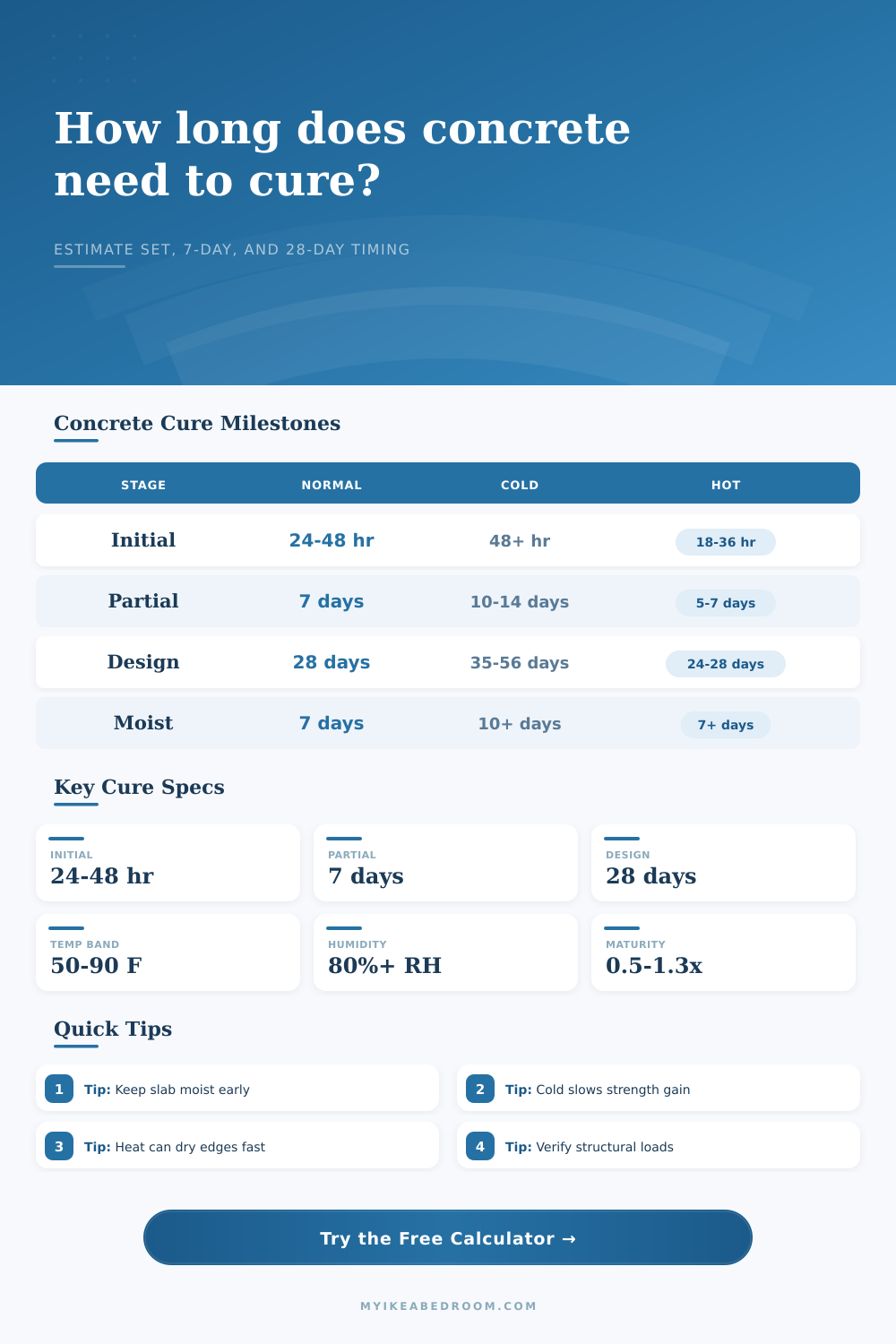
Estimate curing milestones from slab temperature, humidity, thickness, cement type, exposure, and curing method, including a simple maturity adjustment against normal 70°F conditions.
1Slab and weather presets
Load a practical slab/weather scenario, then adjust the numbers to match the pour, curing cover, and expected site conditions.
2Curing inputs
Calculation breakdown
3Milestone reference cards
4Curing reference tables
| Average concrete temperature | Maturity effect | Initial set tendency | Planning note |
|---|---|---|---|
| Below 40°F / 4°C | Very slow | Often delayed beyond 48 hr | Protect from freezing and verify strength before loading. |
| 40-49°F / 4-9°C | About 0.45x | Slow set | Expect longer moist curing and delayed strength gain. |
| 50-59°F / 10-15°C | About 0.65x | Moderately slow | Useful with protection, but 7 days may stretch longer. |
| 60-79°F / 16-26°C | About 0.85-1.00x | Normal | Good curing band when the slab stays moist. |
| 80-90°F / 27-32°C | About 1.10x | Faster set | Watch evaporation, plastic shrinkage, and edge drying. |
| Above 90°F / 32°C | Fast early, risky surface | Fast set | Use evaporation control and avoid letting the surface dry. |
| Cement or mix type | Early gain factor | Set factor | Typical planning behavior |
|---|---|---|---|
| Type I/II normal portland | 1.00x | 1.00x | Baseline for ordinary slabs and pads. |
| Type III high-early | 1.25x | 1.18x | Shortens early-strength waiting, but still needs moisture. |
| Blended slag/fly ash cement | 0.82x | 0.86x | Often slower early, especially in cool weather. |
| Rapid-set repair mix | 1.45x | 1.35x | Fast early set for small repairs; follow product data. |
| Type V sulfate-resistant | 0.90x | 0.92x | Moderate early gain; exposure durability still matters. |
| Low-heat mass concrete | 0.75x | 0.80x | Designed to reduce heat buildup, so early gain is slower. |
| Humidity and curing method | Moisture factor | 7-day impact | Surface risk |
|---|---|---|---|
| Wet cure / wet burlap, 80%+ RH | 1.05x | Best chance to stay near reference | Low if kept continuously damp. |
| Curing compound, moderate humidity | 1.00x | Good when membrane is applied evenly | Moderate at edges and saw cuts. |
| Plastic sheeting | 0.95x | Good moisture hold with sealed laps | Check wrinkles and dry gaps. |
| Uncovered air cure | 0.70x | Often delays effective curing | High in wind, heat, or dry air. |
| Insulated blanket | 1.12x | Useful in cold weather | Low when edges are covered well. |
| Slab thickness | Thermal behavior | Moisture behavior | Planning note |
|---|---|---|---|
| 3-4 in / 75-100 mm | Cools and dries faster | Edges need early care | Common for patios and walks. |
| 5-6 in / 125-150 mm | Holds heat better | Surface still needs curing | Common for driveways and garages. |
| 7-8 in / 175-200 mm | More heat retention | May dry unevenly at exposed faces | Good for heavier pads. |
| 10 in+ / 250 mm+ | Mass concrete behavior | Temperature gradients matter | Use project-specific thermal checks. |
| Slab/weather preset | Typical condition | Likely maturity range | Best practical reminder |
|---|---|---|---|
| Mild patio slab | 70°F, damp, 4 in | Near 1.0x | Keep moist for the first week. |
| Cool garage floor | 50°F, sheltered, 5 in | About 0.6-0.8x | Delay loading and protect edges. |
| Hot dry driveway | 92°F, dry, 6 in | Fast set, lower moisture | Start curing immediately after finishing. |
| Cold morning pour | 42°F, cool, 4 in | About 0.4-0.6x | Use blankets and verify strength. |
| Blended cool slab | 55°F, blended cement | About 0.5-0.7x | Expect slower 7-day progress. |
| High-early repair | 68°F, Type III | About 1.1-1.4x | Do not skip early moisture protection. |
5Practical curing tips
Pouring concrete seems simple, mix cement, some water, add in aggregate, then voila! A formful goop. But that’s where most folks believe it ends.
Now comes the hard part: as soon as the finisher walk away, the chemistry kicks in…and fights the weather. Unlike paint which dries, concrete hydrates. Cement particles binds themselves to other ingredients (and each other) only when there’s water present. As that happens, it transform from a gooey mess to rock-hard stone.
How Concrete Gets Strong
When all that water is sucked out of the mix before this reaction are complete, you’re left with cracks, dust, and a weakened surface. The calculator crunches these number for you after you input your site details, no guessing required regarding rate of moisture loss.
The cause is temperature. Cold slows water’s absorption; heat speeds it along. By nightfall you could walk across that hot July driveway, but the March patio pour might remain soft for days.
The tool take the variance into account and converts the local air temperature into a rate of cure. It cures slower in the fifties and faster when it hits ninety, but it is also more likely to get shrinkage cracks. You’ve got to factor in trade-off between fast and stable. Sounds nice, fast setting. But frequently the surface will harden before the inside have had time to hydrate, resulting in a weak surface.
Wind & humidity take your money back. Wind will suck water out of a shallow slab in hours (even if the air temp is warm). That’s why curing method and exposure matter here. If you use wet curing. Say, with plastic sheeting or burlap, that’s a microclimate; it retains some moisture and continues the hydration process. This calculator compares those processes.
Plastic sheeting seals moisture in place but also traps heat which may skew the curing profile if the sun warms it. Insulation blankets help keep the heat inside during cold so the chemistry can still proceed even if outside air freezes the reaction.
The timeline also shifts based off cement type. Normal Portland cement (Types I & II) has a known timeline and gets gradually stronger as days pass. High-early Type III mixes gain that same strength faster so you can remove forms earlier. However, it create more curing heat in the meantime. Slower-blending cements incorporating fly ash or slag typically takes longer at first but tend to end up being stronger overall.
The chart accounts for those material variations, so you’re no longer relying on a “normal” timeline for a different-timing mix. That’s important if you’re planning trade finishes or heavy equipment usage.
Seven days in? Seems like a magic number. It’s not; it’s simply a checkpoint. If the concrete stayed wet, it should of been about seventy percent hard by then. Use the calculator and see where your conditions line up, does it have enough time to get to that level by the time? In cold or dry air, it may require an extra day (or ten) to reach that level of strength.
You don’t want to wait around based off calendar days. You want to know what condition of the material actualy is.
Thickness matter for thermal mass. Yes. A thin slab of concrete on a patio will lose its hydrating heat to the air. A thick foundation wall retain heat within its core, giving it strength but risking crack formation as the core heats up. The thermal mass here is included in the tool, expect that your slab is retaining heat or releasing it to the air.
There is no getting around curing; it’s a dance between weather and time. The only things you can control are the cover and the mix. Remember that this also means you can’t control the wind. Because of this, it pays to monitor rather than try to memorize the rules.
Treat the estimates as guidelines, not guarantees. Maintain a moist surface, shield from extremes, and check for strength prior to loading.
Don’t rush concrete; it doesn’t forgive much. But it does reward patience with a durabel, decades-long surface.