Cocktail Table Linen Size Calculator
Find the right round cloth diameter, drop, overlay, pooling allowance, tie-back height, and linen count for highboy, lowboy, bistro, and cafe cocktail tables.
Choose the closest real table setup, then adjust the size, drop style, overlay, tie, and spare linen settings.
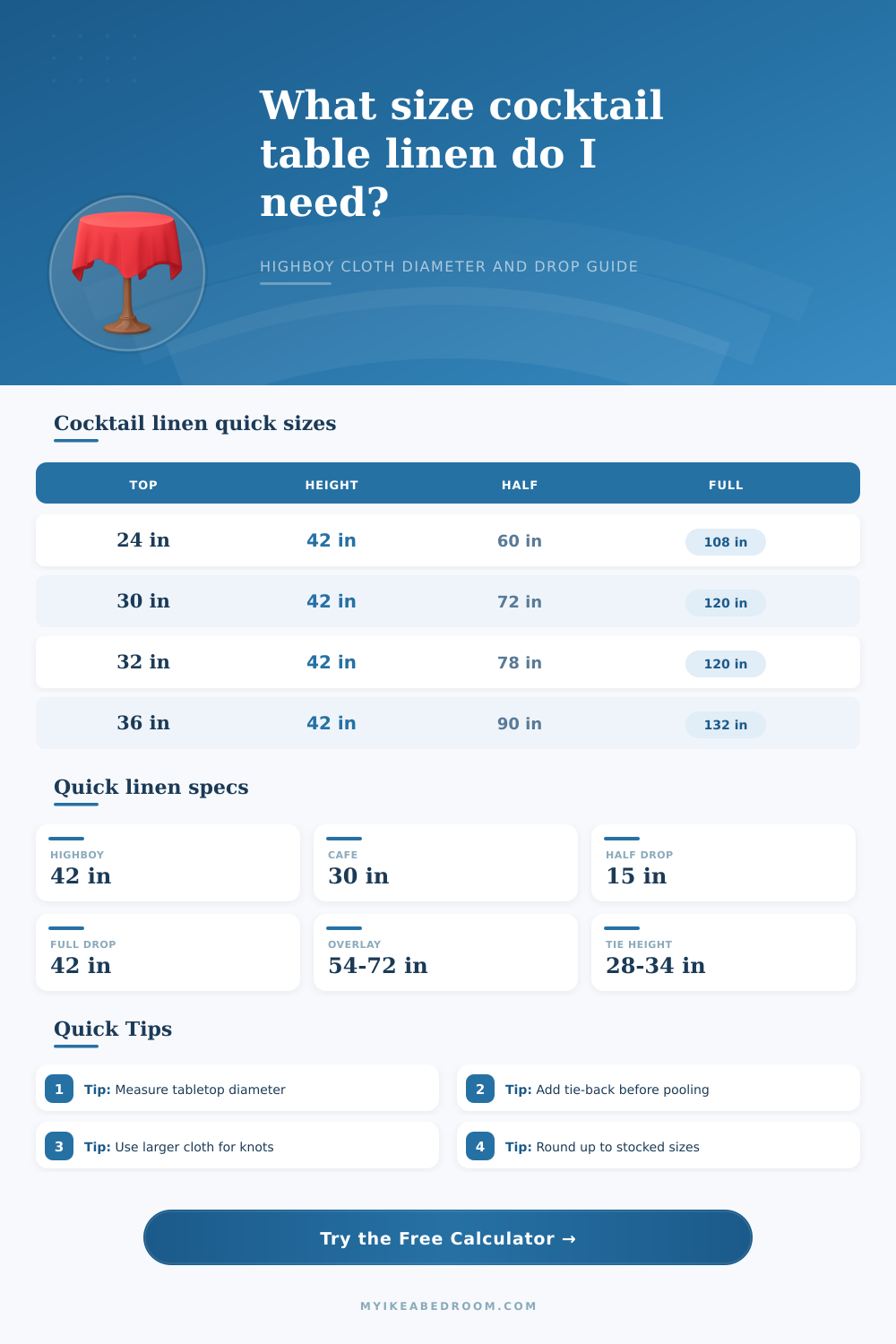
| Table top | Table height | Clean full drop | Common cloth | Typical use |
|---|---|---|---|---|
| 24 in round | 42 in | 42 in | 108 in round | Slim highboy, tight floor plan |
| 30 in round | 42 in | 42 in | 120 in round | Standard reception highboy |
| 32 in round | 42 in | 42 in | 120 in round | Slightly wider cocktail top |
| 36 in round | 42 in | 42 in | 120 to 132 in round | Wide highboy or display table |
| 30 in round | 30 in | 30 in | 90 in round | Low cocktail or cafe table |
| Drop style | Drop range | Visual result | Best for | Watch point |
|---|---|---|---|---|
| Lap drop | 8 to 12 in | Topper look | Bistro seating, quick resets | Table legs remain visible |
| Half drop | 14 to 24 in | Casual cocktail | Open rooms, casual parties | Can look short on highboys |
| Near floor | Height minus 1 in | Clean straight hem | Service aisles, high traffic | Requires accurate height |
| Full drop | Table height | Classic formal linen | Receptions and events | Rounding may add extra drop |
| Pooled | Height plus 2 to 6 in | Soft puddle at floor | Photo areas, lounges | Not ideal near walk paths |
| Overlay size | On 24 in top | On 30 in top | On 36 in top | Use case |
|---|---|---|---|---|
| 45 in round | 10.5 in drop | 7.5 in drop | 4.5 in drop | Small color accent |
| 54 in round | 15 in drop | 12 in drop | 9 in drop | Standard topper |
| 60 in round | 18 in drop | 15 in drop | 12 in drop | Visible contrast layer |
| 72 in round | 24 in drop | 21 in drop | 18 in drop | Bold overlay color |
| 90 in round | 33 in drop | 30 in drop | 27 in drop | Deep overlay or low table cloth |
| Table count | Base linens | 5% spare | 10% spare | 15% spare |
|---|---|---|---|---|
| 6 cocktail tables | 6 | 7 | 7 | 7 |
| 12 cocktail tables | 12 | 13 | 14 | 14 |
| 18 cocktail tables | 18 | 19 | 20 | 21 |
| 24 cocktail tables | 24 | 26 | 27 | 28 |
| 36 cocktail tables | 36 | 38 | 40 | 42 |
24 in highboy
Use 108 in round for a true floor-length drop. A 90 in round leaves about 9 inches above the floor.
30 in highboy
Use 120 in round for the classic event look. A 132 in round creates a 6 inch pool.
36 in highboy
Use 120 in round for near floor coverage. Choose 132 in round for a fuller formal drop.
30 in low table
Use 90 in round for full drop. A 60 or 72 in overlay gives a lighter cafe look.
Measure from the tabletop edge. Round linen diameter is table diameter plus twice the desired drop. If the table has a thick rim, use the widest visible diameter.
Round to actual inventory. Rental cloths are usually stocked in fixed diameters, so the calculator shows both exact math and a practical size to pull.
Geometry, not decoration, is key to linen math. You can tell when a planner is stumped by tablecloths that only reach three inches from the ground on tall tables (highboys). That little detail becomes glaringly obvious as people stumble over fabric bunches or spot exposed table legs.
Getting the drop right, knowing your table heights in relationship to cloth diameter… Adds polish to a reception, which is why you should of know it before ordering rentals. Once you know size of your table, put those numbers into the calculator above and it will do the work for you. After all, who wants to guess if a standard round are going to get to the floor on a forty-two inch tall table?
How to Measure Your Table Linens
For most cocktail tables, the height is around forty-two inches and the width is typically around thirty inches. This means that it require a one hundred twenty inch round for a nice clean full drop. However, if you just order by width of the table top, you will have what we call a lap drop; where the bottom of the round cloth expose the pedestal base. That look is not usually desirable unless you are aiming for a more casual bistro vibe.
The tool takes all of those factors in account and allows you to see just how much more fabric you’ll need to cover the vertical space while avoiding any tripping hazards or exposed gaps. Keep in mind that you are getting the finished drop, not the actual table itself. To calculate your needed diameter (width) you must account for the top width + 2 times the height of the drape desired.
For example: if you wish your linen to pool softly off the floor then include additional inches above the normal floor length. With a pooled drape there will always be extra inches included above table, creating a rich puddle effect. Just beware of pooling in heavy traffic zones as it can becomes a trip hazard in no time.
The tables on the page break it all down and give a good idea of how much fabric you’ll need for a given top size. Even two tops that may initially appear to be the same length, such as a thirty inch or a thirty-two inch top, will require a little bit more linen. A slight variation in measurement leads to a tremendous variation in fit.
Keep in mind: Tie-backs can throw everything out the window. If you’re using a band of some stretchy material (think spandex) or a sash to cinch a piece of linen around your waist, all that fabric gets bunched away from the vertical drape and somewhere else on rest of cloth. You need a bigger diameter one if you don’t want to lose it off the fall of the cloth. Use the calculator to account for the amount of space the knot takes up so you don’t end up with a cloth that look too small once it is tied.
It’s also helpful when considering overlays. You want to add color or texture without covering up the main cloth, but you still want the overlays to be the right size so they look intentional instead of messy. Overlaying something that doesn’t fit creates a whole other effect that makes a table appear dressed in the dark.
Finally, always include a buffer. There will be spills, there may be linens caught on chairs, there might even be a cloth you don’t love when it’s on the table. It happens. In the industry, it’s standard practice to order ten percent more then what you think you’ll need. Replacing soiled linen in the middle of an event is basically out of the question, and it’s bound to interfere with the guest experience.
With this tool, they does all the counting so you can account for exactly how many linens are required as a base, and then add a nice little cushion of spares to ensure you’re covered. That means you won’t have to second-guess if you have enough to cover your bases. You can stop worrying about inventory planning and focus only on how the event flows.
One measure is worth a thousand words… and you won’t find yourself looking down at the floor during cocktail hour. Doing things right from the beginning guarantees that each table help set the scene, and never takes away from it by being a mismatched drape. Naturaly, you want to make sure everything looks perfect. It can be moddern and luxurius if done right!