Coat Hook Quantity Per Person Calculator
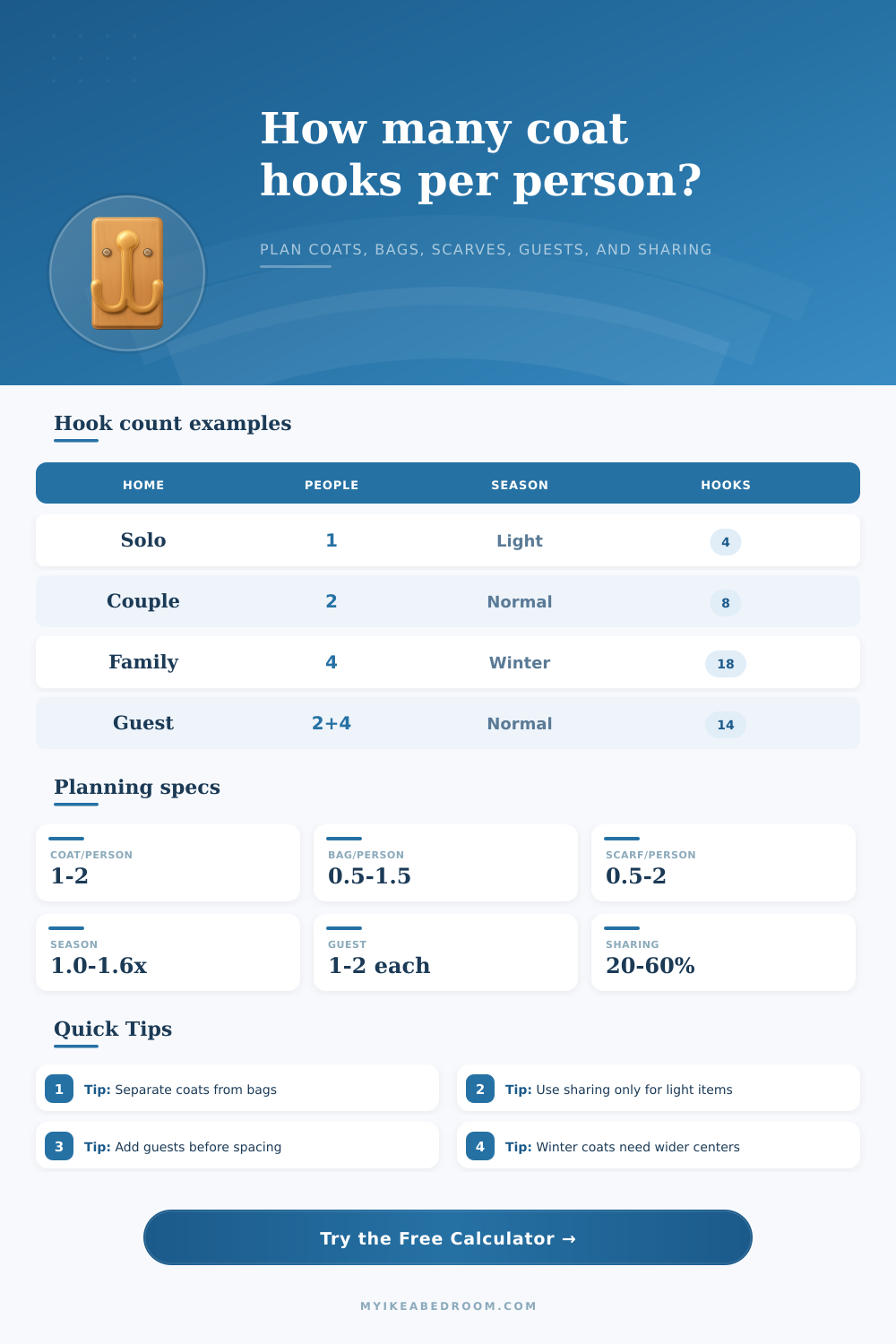
Estimate hook quantity from the people who use the space, daily coats, bags, scarves, seasonal bulk, guest buffer, and the shareable hook ratio for lighter accessories.
Choose a household pattern, then fine-tune the people count, coat load, bag load, seasonal multiplier, guest buffer, and shared hook ratio.
| User or item | Low use | Typical use | Heavy use |
|---|---|---|---|
| Adult coat hooks | 1 per adult | 1.5 per adult | 2 to 2.5 per adult |
| Child coat hooks | 1 per child | 2 per child | 2.5 per child |
| Bag hooks | 0.5 per person | 1 per person | 1.5 to 2 per person |
| Scarf or hat hooks | 0.5 per person | 1 per person | 1.5 to 2 per person |
| Season setting | Multiplier | Best for | Hook planning effect |
|---|---|---|---|
| Light season | 1.0x | Thin jackets and occasional coats | Counts entered daily items directly. |
| Mixed weather | 1.15x | Jacket plus rain layer overlap | Adds a small outerwear cushion. |
| Jacket overlap | 1.30x | Cool seasons with two layers rotating | Adds several extra coat positions. |
| Winter coats | 1.45x | Bulky coats and scarves | Raises coat count and suggests wider spacing. |
| Heavy winter | 1.60x | Puffer coats, snow gear, and bags | Plan more hooks or a second row. |
| Sharing ratio | Use it for | Avoid using it for | Practical note |
|---|---|---|---|
| 0% | Every item gets a hook | Very tight walls | Most organized, but uses the most positions. |
| 20% | Light scarf and cap sharing | Backpacks | Good default for neat bedroom hooks. |
| 35% | Mixed bags and scarves | Heavy winter coats | Balances capacity and access for many homes. |
| 50% | Accessory-heavy households | Wet coats | Use a separate shared accessory zone. |
| 65% | Compact scarf and hat storage | Daily school bags | Only works when items are light and small. |
| Usable rail span | 6 in centers | 8 in centers | Best use |
|---|---|---|---|
| 24 in | 4 hooks | 3 hooks | Solo coats, guest overflow, or closet side rail. |
| 36 in | 6 hooks | 4 hooks | One or two people with light accessories. |
| 48 in | 8 hooks | 6 hooks | Couple or small family with bags nearby. |
| 60 in | 10 hooks | 7 hooks | Family daily coats with shared accessory hooks. |
| 72 in | 12 hooks | 9 hooks | Winter load, guest buffer, or two-row planning. |
Best for: coats, backpacks, work bags, and anything bulky.
Use a low shared ratio when everyone needs a clear personal hook.
Best for: scarves, hats, caps, and light totes.
Increase shared fill only when items stay light and easy to see.
Best for: visitor coats, overnight stays, and holidays.
Guest hooks are counted separately so daily hooks remain usable.
Best for: narrow bedroom walls or closet sides.
If capacity is short, add a second row instead of crowding coat spacing.
Keep coats mostly dedicated. Coats and backpacks create the bulk, so apply the shared hook ratio mainly to scarves, hats, and light bags. That keeps the final number realistic without turning every hook into a pile.
Check width after the count. The calculator gives the hook count first, then compares it to the rail capacity. If the rail is short, use another row or a separate shared accessory strip.
To organize a coat hook system effective, you must determine the correct number of coat hook you need based off the specific need of the household. A successful coat hook system will ensure that coats is placed on the hooks, bags is placed on the hooks, and scarves is placed on the hooks. If there are not a correct number of coat hooks in the system, it is possible for coats to end up on the floor, bags to end up on the floor, and scarves to end up on the doorknobs.
Each item that is to be hung on the coat hooks does not necessarily require its own coat hook. For instance, items such as scarves may share a coat hook with another item. To determine the correct number of coat hook for a system that humans will use in a dwelling, it is important to consider the number of adult and children that will use the coat hooks.
How Many Coat Hooks Do You Need
Adults and children may have different requirement for the coat hooks based upon the types of items that they carry. For instance, adults may have a need for one coat hook for their daily jacket and another coat hook for their heavy outer coat. Children, however, may require two coat hook for the layers that they wear to school.
Bags and scarves may require different amount of space on the coat hook system then other items. For instance, a backpack may require a significant amount of width along the coat hook, but a scarf may require very little width along the coat hook. Therefore, it is necessary to decide how many light item will share a coat hook so that the coat hook system does not become too disorganized.
For instance, many household may permit scarves to share a coat hook with another item, but they may not permit bags to share a coat hook with another item. This determination will ensure that the coat hook system isnt too difficultly to use every morning to hang all of the item that are owned by the household members. The number of coat hooks that you determine for the system should also take into account seasonal change.
For instance, during the winter months, the coats that are hung on the coat hooks will be bulkier than the light jackets that may be hung out during other seasons of the year. You must plan for these type of coats to ensure that the puffy shoulders of the winter coats do not impact the use of the adjacent coat hooks. Therefore, you should adjust the math that was performed for determining the number of coat hooks to account for these seasonal changes.
In addition to the members of the household who will use the coat hooks, it is also necessary to account for the coats of the guest that may come to the home. Guests often have coats that must be hung on the coat hooks, and these coats will take up some of the coat hooks that are provided for the household members. Therefore, it is important to provide an extra few coat hooks for these guest.
While the additional coat hooks are not necessary in large numbers, they will ensure that the system can handle the coats of the guest. Depending upon the length of the coat hook system and the spacing of the coat hooks, the coat hooks may need to be installed in different way. For instance, if there is a significant amount of space between each coat hook along the system, it will allow for the hanging of the bulky coats.
However, if there are narrow space between each coat hook, the system can save space for small accessory for the household members. Furthermore, you may need to determine the total number of coat hooks in relation to the total capacity of the coat hook system. For instance, if there are too many coat hooks for the system, a second row of coat hooks may need to be installed to accommodate the coats rather than allowing them to become hung on the first row of coat hooks.
Finally, if the coat hook system is too crowded after the installation of the coat hooks, it is important to analyze which item are causing the crowding of the coat hooks. For instance, the coats or bags may be taking up too much space along the coat hooks. In these instances, the solution may be to adjust the ratio of how many item will share a coat hook, or the installation of an accessory strip for small item for the home.
By determining the number of coat hooks to match the movement of the item of the household, the coats and bags will stay on the coat hooks, rather than ending up on the floor. You should of checked the rooms size before starting. It could of helped to recieve a second opinion.
Its best to have alot of hooks.