Closet Shelf Depth Calculator
Find a shelf depth that fits the closet, door action, hangers, folded stacks, rail offset, shelf thickness, and aisle clearance without wasting reachable storage.
① Closet presets
Pick a starting layout, then adjust the measurements to match the actual inside depth and shelf material.
② Shelf and clearance inputs
③ Fit view
What the result means
Enter the closet measurements to compare shelf depth, folded stack fit, hanger swing, and bracket spacing.
Recommended depth is capped by door reserve and front clearance, so it may be shallower than the item depth in tight closets.
Storage efficiency compares useful shelf projection against total closet depth while penalizing blocked door and aisle conditions.
④ Shelf and material comparison
⑤ Reference tables
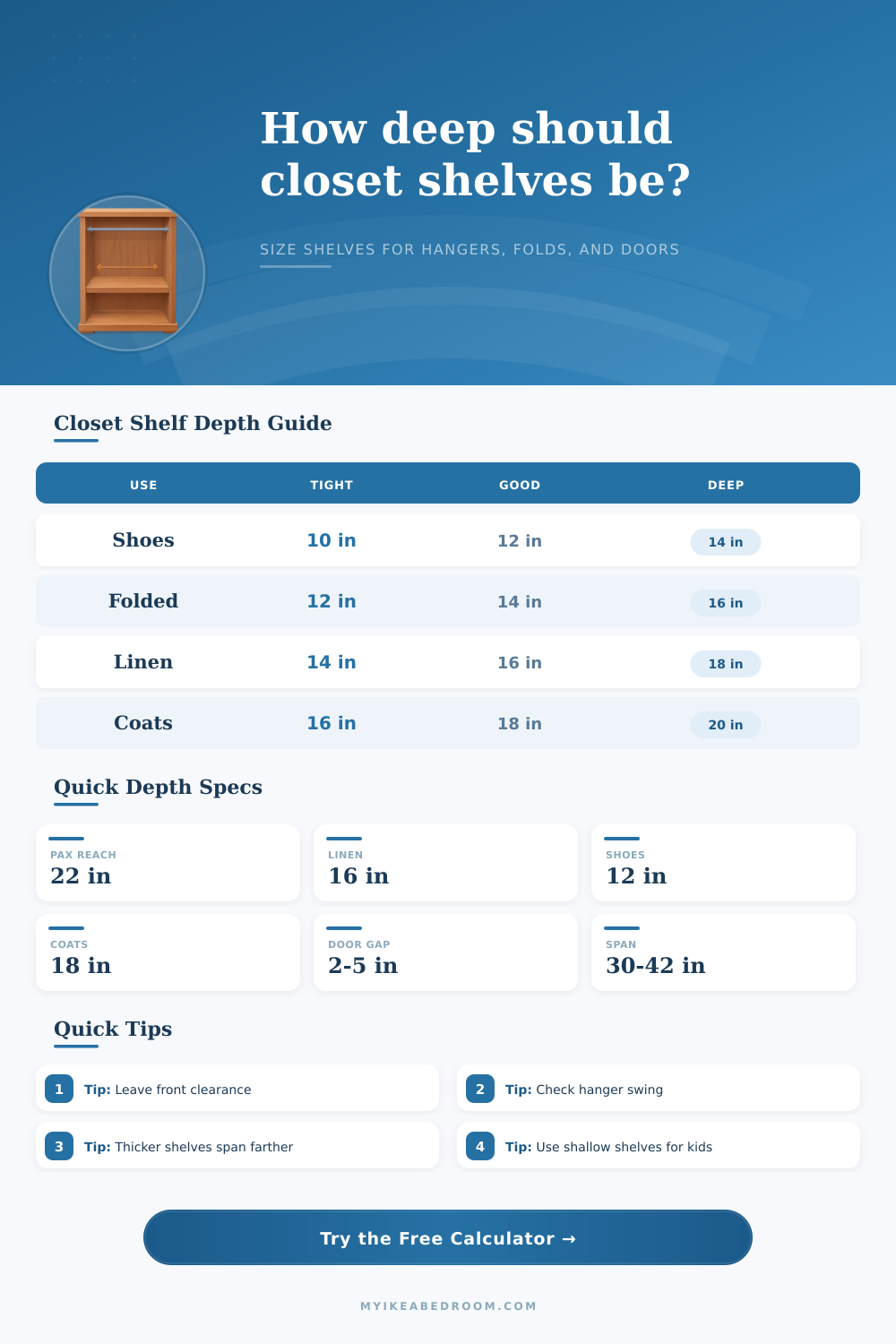
| Item type | Typical depth | Best use | Watch point |
|---|---|---|---|
| Shoe shelf | 10 to 14 in | Flat shoes, kids shoes, angled rows | Deep shelves hide back pairs |
| Folded clothes | 12 to 16 in | Sweaters, denim, bins | Leave finger space at front |
| Linen stacks | 14 to 18 in | Towels, sheets, bedding sets | Stacks slump when too deep |
| Hangers | 16 to 18 in | Shirts, dresses, mixed wardrobe | Check rail offset and door loss |
| Coats | 18 to 20 in | Bulky outerwear | Needs extra swing clearance |
| Deep storage | 18 to 24 in | Luggage, seasonal bins | Use only where reach is easy |
| Door type | Front reserve | Depth effect | Best shelf habit |
|---|---|---|---|
| Open front | 0.5 in | Almost full closet depth | Use reach comfort as the limit |
| Sliding | 2 in | Small track and finger allowance | Avoid bins proud of the shelf |
| Bypass | 3 in | More overlap and access loss | Keep daily items near the open side |
| Bifold | 4 in | Door panels need folding space | Keep shelves shallow near hinges |
| Hinged swing | 5 in | Largest practical front reserve | Check knobs, trim, and baskets |
| 1.5 in | Low door conflict | Still leave hand clearance |
| Shelf thickness | Light load span | Mixed load span | Heavy load span |
|---|---|---|---|
| 0.5 in | 24 in | 22 in | 18 in |
| 0.625 in | 28 in | 25 in | 21 in |
| 0.75 in | 34 in | 30 in | 25 in |
| 1 in | 42 in | 37 in | 31 in |
| 1.25 in | 48 in | 42 in | 35 in |
| Closet scenario | Inside depth | Starting shelf | Main clearance check |
|---|---|---|---|
| PAX reach-in wardrobe | 23 in | 18 to 22 in | Sliding door reserve |
| Linen closet | 20 in | 15 to 17 in | Folded stack depth |
| Kids closet | 18 in | 11 to 13 in | Short reach and safety |
| Pantry closet | 24 in | 14 to 18 in | Back row visibility |
| Coat closet | 28 in | 18 to 20 in | Hanger swing clearance |
| Shoe shelf | 14 in | 10 to 12 in | Toe overhang and access |
⑥ Practical depth tips
Front clearance: A shelf that uses every inch of closet depth can still fail if baskets, hangers, or door panels scrape the front plane.
Support spacing: Treat heavy folded stacks, pantry goods, and deep bins as shorter-span shelves, especially with thin particleboard.
Closets are built by instinct more than geometry. You spot an unused nook in the wall and figure it’s the same as everyone else: a closet should be 24 inches deep. So you hangs shelves from front to back. Looks great; until you attempt to grab a shoe box or the third item from the left, which requires dislodging everything in between.
This isn’t about the furnitures; this is about the math of capacity versus reachability. If the shelf is too deep, you hide stuff at the back and suddenly your tidy clothes have became an archaeological dig site: what’s up front counts and what’s not is irrelevant. If the shelf is too shallow, you’ve wasted prime real estate on the floor and need additional shelving. You want it, but you can’t afford it.
How to Measure and Build Better Shelves
Understanding What You’re Measuring Is The Trick Here By “shelf depth” I mean the actual amount of board projecting into the room. This is different than the raw measurement from the wall to the front trim. However, you can use that measurement if you prefer. Once you understand what’s going on, the rest is simple math.
Plug your constraints into the calculator above, and let it crunch the numbers for you. You don’t have to guess at how far your hanging hardware will extend, or how much swing room you’ll need to accommodate your closet door. Most home-owners neglect to realize that their shelves aren’t floating alone in space. They take up some of the same area as physical bulk of hangers full of clothes, sliding tracks, and swinging doors.
For example, if you have bifold doors, you need to leave enough room for them to fold back; otherwise they’ll crush the front edge of your shelves. That reservation cuts into your usable space by a few inches (or more). If you try ignoring this fact, you’ll end up drawing shelves that might look great on paper… but when the door tries to shut, it won’t fit.
Turns out there’s a surprisingly large element of material choice when it comes to real-world attainability: A thin particle board shelf may appear sufficient to hang a pile of sweaters from, but when suspended over any considerable distance, it’ll sag and bend in dramatic ways. Solid wood or thicker plywood lets you space out supports further and thus keep the visual lines clean, but still provides the necessary structural strength. The tool accounts for this by changing its span of support to match the thickness.
This ensures the recommended depth is not just easy to see, but also something that can realistically be built without too much extra hardware. Remember, you want shelves that are structurally sound, yet still able to maintain their form over time. A drooping shelf create a mental block. We don’t put things back onto a surface that appears to be giving way, which defeats the whole point of organization in the first place.
The same applies to depth; both your construction choices and item types determine this. Folded T’s and shoes don’t require an 18 inch depth. Their best configuration is shallower with everything in easy viewing distance. On the other hand, bulkier items like winter coats and coats requires more depth to keep them hung up without creasing and slipping off the hanger.
The depth reference table gives you a fast guide on what depth goes with what kind of storage and you’ll see how certain items is better suited for a deep shelf (you have to dig for them) vs. Shallow shelves cause items to fall right off. A basic design principle, matching the shape of the shelf to the item being stored makes a huge difference between having a closet function as a system versus a storage unit.
The rail offset (the distance from the back wall to the center of your hanging rod) is another subtle trade-off. Mounting it too far forward will take away your shoulder room when you’re hanging things. Mounting it too far back wastes depth that you might otherwise use for shelving. To balance all this, the calculator takes into account both the folded stack dimensions AND the clearance needed for hangers’ swings. That way there’s no overlap between zones.
This type of planning keeps you from making one of the most common mistakes people make with this stuff. Instead of installing the rod first and then trying to work the shelves around it, you avoid leaving awkward gaps and useless pockets of space.
In the end, however, a good-looking closet honors both the stuff inside it and the person who has to deal with it. It takes into consideration the shape of the human body, such as where you place your hands when opening a drawer or door. What will you touch? How do you reach into it? Because you’re creating an interface (between you and your possessions), you’re also creating some storage.
When you get the depth correct, you know exactly what’s at your fingertips, rather than having to make multiple treks to the far side of the closet. It transforms that shadowy space from a deep cavern into a chosen collection, where nothing is ever out of reach (and consequently hidden away in darkness). And that simplicity is so very worth those few additional minutes spent calculating before you swing a hammer.