Clock Hanging Height Calculator
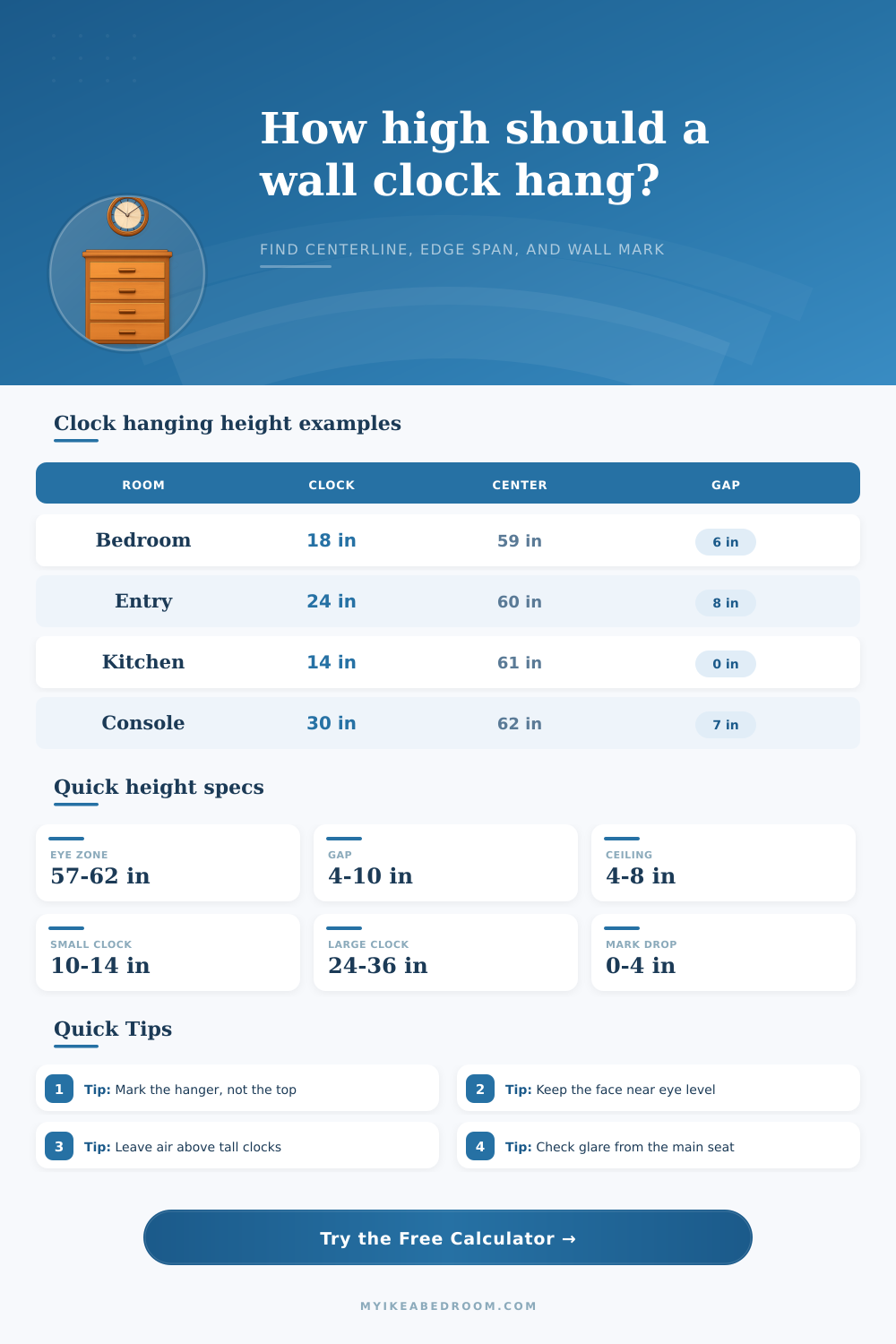
Set a wall clock from the actual hanger mark, not guesswork: enter clock size, room use, furniture height, eye level, viewing distance, ceiling clearance, and hardware drop.
Pick a real room situation, then adjust the clock diameter, furniture top, clearance, ceiling, and viewing distance.
| Clock diameter | Typical centerline | Best viewing distance | Use case |
|---|---|---|---|
| 10 to 14 in | 59 to 62 in | 3 to 6 ft | Desk, bedside, small kitchen, compact nook |
| 15 to 20 in | 58 to 61 in | 5 to 10 ft | Bedroom dresser, dining wall, hallway, office |
| 21 to 30 in | 59 to 63 in | 8 to 14 ft | Entry console, sofa wall, sideboard, open wall |
| 31 to 40 in | 61 to 66 in | 12 to 20 ft | Tall feature wall, large room, high ceiling area |
| Furniture below | Usual top height | Suggested clock gap | Why it matters |
|---|---|---|---|
| Nightstand | 24 to 30 in | 8 to 14 in | Keeps bedding, lamps, and alarm controls visually separate. |
| Dresser or chest | 32 to 42 in | 4 to 8 in | Lets the clock relate to the furniture without crowding it. |
| Console or sideboard | 30 to 36 in | 6 to 10 in | Gives entry decor and table lamps breathing room. |
| Sofa back | 30 to 38 in | 8 to 14 in | Prevents the clock from feeling attached to the seating line. |
| Desk or worktop | 28 to 31 in | 10 to 16 in | Keeps the clock visible over monitors and task lighting. |
| Hardware style | Common drop from top | Wall mark formula | Check before drilling |
|---|---|---|---|
| Sawtooth hanger | 0.5 to 1.5 in | Top edge minus drop | Find the exact tooth that will sit on the nail. |
| Keyhole slot | 1 to 3 in | Top edge minus slot center | Measure to the locked part of the slot, not the entry hole. |
| Picture wire | 2 to 5 in | Top edge minus pulled wire peak | Pull the wire tight as it will hang on the wall. |
| Fixed bracket or rail | 0 to 2 in | Top edge minus bracket line | Mark the bracket contact line, then level it. |
| Preset scenario | Clock size | Likely centerline | Typical note |
|---|---|---|---|
| Bedroom dresser | 18 in | 58 to 60 in | Center near shared standing eye level. |
| Entry console | 24 to 30 in | 60 to 63 in | Protect the console gap before centering. |
| Kitchen wall | 12 to 18 in | 60 to 62 in | Favor visibility from the table or prep route. |
| Child room | 10 to 14 in | 52 to 56 in | Lower the center for a child reader. |
| Feature wall | 30 to 40 in | 62 to 66 in | Confirm ceiling air before raising it. |
Best for: bedrooms, halls, kitchens, and offices.
Keeps the clock readable for daily glances without making the wall feel top-heavy.
Best for: dressers, consoles, sideboards, desks, and sofas.
Starts with furniture clearance, then raises the center only as much as needed.
Best for: kitchens, living rooms, and open-plan views.
Checks face size against viewing distance so decorative clocks still work as clocks.
Best for: large clocks, high ceilings, and open blank walls.
Allows a higher centerline while preserving ceiling margin and lower edge comfort.
Mark the hardware point. After you like the centerline, measure from the clock top down to the exact hanging point. That is the wall mark, not the visible top edge.
Test glare and distance. Tape a paper circle at the calculated span, then check it from the bed, chair, desk, or doorway before making the final hole.
Hanging a clock at the correct height require consideration of a variety of factors regarding the room in which the clock will be placed. By considering each of these factor, you can ensure that the clock face will be easy to read. Factors such as the height of the ceiling will affects where the clock is hung within the room.
For instance, if the ceiling within the room is only eight feet in height, there is a limited amount of spaces above the clock face that may be hung in the room. Conversely, in rooms with ten-foot ceilings or higher, clock have more space above them. The clock calculator will help protect a minimum top margin for the clock face so that it is not hung so high within the room that the room appear unbalanced.
How to Hang a Wall Clock at the Right Height
Additionally, the tool will ensure that the clock face have enough space in relation to the ceiling in the room to avoid crowding the corner of the space. The hardware that you will use to hang the clock will affect the place of the nail or screw within the wall. For example, sawtooth hangers is placed near the top of the clock face, but picture wires may allow for the clock to drop several inch from the top of the clock face when its hung.
The calculator will subtract this drop from the height of the top of the clock face so that the measurement is transferred to the wall to the point where the nail or screw will make contact with the clock face. This prevents the individual from having to continually drill into the wall until the clock is hung at the correct height. One of the primary function of a clock is for it to be readable.
Factors that affect readability include the size of the clock face and the distance between the individual that is viewing the clock and the clock face. Clocks with very small numerals may be dificult for an individual to read when they are standing a considerable distance from the clock. Small clocks may also appear to function only as décor within the room.
Therefore, the tool will compare the diameter of the clock face to the viewing distance in the room to ensure that the ratio between these two factors is low enough to allow for readability. After the individual recieve the measurements from the clock calculator, they should of perform a test to ensure that the clock will be correctly placed within the room. One test is to tape a piece of paper in the shape of a circle to the wall at the calculated height for the clock to determine how it will look when hung in the room.
Additionally, the individual should walk through the room to ensure that furniture does not block the clock face. If it is blocked, the clock may need to be lowered by an inch or two. However, the clock calculator will provide the individual with a solid starting point for the placement of the clock.