Clay Quantity for Pot Calculator
Estimate how much clay to prepare for thrown or hand-built pots using cylinder or frustum wall volume, base thickness, clay density, shrinkage, trimming waste, and pound or kilogram conversions.
📌Pottery presets
⚙Pot shape, clay body, and firing inputs
Enter finished target dimensions. The calculator expands them for shrinkage, then estimates wet clay from wall volume plus base volume before adding throwing and trimming waste.
Clay quantity estimate
Geometry and clay mass breakdown
⚖Clay density reference
📋Reference tables
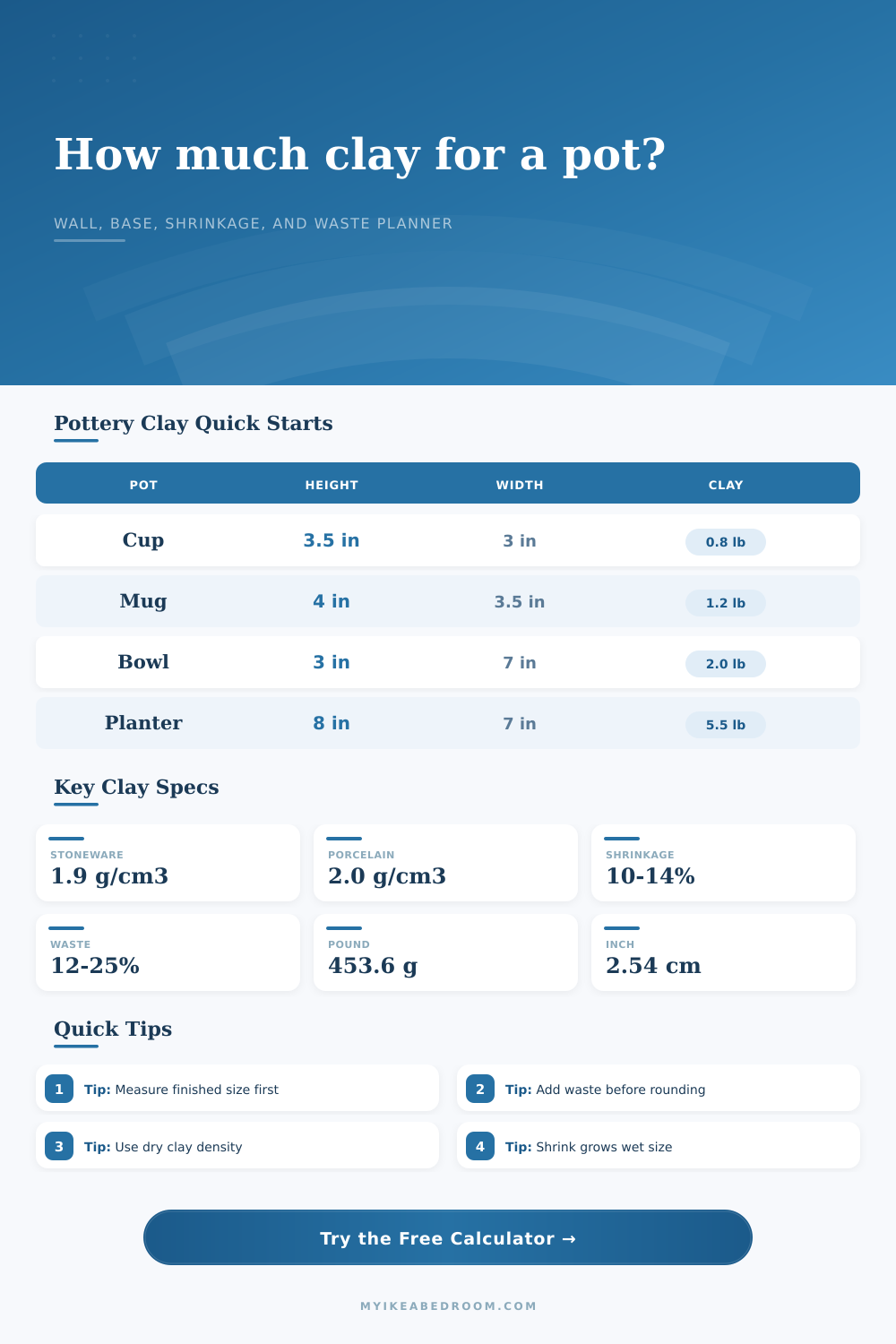
| Pot type | Typical finished size | Common geometry | Planning clay range |
|---|---|---|---|
| Espresso cup | 3 in high x 2.5 in rim | Cylinder | 0.5 to 0.9 lb / 0.2 to 0.4 kg |
| Handled mug | 4 in high x 3.5 in rim | Cylinder | 1.0 to 1.6 lb / 0.45 to 0.7 kg |
| Tumbler | 5.5 in high x 3.25 in rim | Cylinder | 1.2 to 2.0 lb / 0.55 to 0.9 kg |
| Cereal bowl | 3 in high x 7 in rim | Frustum | 1.5 to 2.5 lb / 0.7 to 1.1 kg |
| Serving bowl | 4 in high x 10 in rim | Frustum | 3.0 to 5.5 lb / 1.4 to 2.5 kg |
| Planter pot | 8 in high x 7 in rim | Frustum | 4.5 to 7.5 lb / 2.0 to 3.4 kg |
| Clay body | Planning density | 1 cubic inch weighs | Useful note |
|---|---|---|---|
| Stoneware | 1.90 g/cm3 | 31.1 g / 0.069 lb | Balanced default for wheel-thrown pots. |
| Porcelain | 2.00 g/cm3 | 32.8 g / 0.072 lb | Dense body; expect careful trimming. |
| Earthenware | 1.85 g/cm3 | 30.3 g / 0.067 lb | Good low-fire planning value. |
| Terracotta | 1.80 g/cm3 | 29.5 g / 0.065 lb | Slightly lighter red body estimate. |
| Grogged clay | 1.95 g/cm3 | 32.0 g / 0.070 lb | Useful for larger or thicker pots. |
| Paperclay | 1.55 g/cm3 | 25.4 g / 0.056 lb | Lower mass due to fiber content. |
| Formula step | Calculator method | Conversion | Why it matters |
|---|---|---|---|
| Shrinkage expansion | Wet size = finished size / (1 - shrinkage) | 12% shrink means 1.136x | Targets fired dimensions from wet throwing size. |
| Frustum volume | Volume = h x pi / 12 x (D1^2 + D1D2 + D2^2) | Diameters in inches | Models tapered bowls, vases, and planters. |
| Wall volume | Outer frustum minus inner frustum | Subtract 2 x wall from diameters | Estimates the clay in pot walls only. |
| Base volume | Bottom disk area x base thickness | pi x radius^2 x thickness | Adds the thicker foot and bottom clay. |
| Weight | Volume x density x 16.387 | 453.592 g per lb | Converts volume into pounds and kilograms. |
| Waste setting | Typical use | Per 1 lb base clay | When to increase |
|---|---|---|---|
| 8% | Slab or coil repeat forms | 1.08 lb prepared | Use only with very low trimming loss. |
| 12% | Experienced throwing | 1.12 lb prepared | Good for cylinders and simple cups. |
| 18% | General studio default | 1.18 lb prepared | Balanced for throwing plus trimming. |
| 25% | Bowls, planters, attachments | 1.25 lb prepared | Use for wide rims, handles, or thick feet. |
| 35% | Large or uncertain forms | 1.35 lb prepared | Helpful while testing a new clay body. |
💡Clay quantity tips
Sometimes you’re making a piece and suddenly realize you’ve run out of clay. Perhaps it’s a large bowl and you guessed wrong about how much material you’d need to throw on the wheel. Maybe everything is just right; its the perfectly shaped pot…but then…no more clay. How frustrating!
This can happen if you had not calculated your base volume and wall volume before starting. The math problem are solved by you entering your desired dimensions into the calculator above. You won’t have to guess anymore. It saves you from relying on vague intuition.
How to Use the Clay Calculator
The key to remember here: the finished pot will not be the same size as the wet clay. Why? Well, clay shrinks when dried and then again when fired. Generaly speaking, most stoneware shrink by about twelve percent. For example, if you wish to create a four inch tall mug, you need to throw a slightly bigger pot (in the wet state). The calculator adjust the desired dimensions accordingly, taking into account the shrinkage factor you input. This part is very important, throwing to final fired size means your pot will be undersize.
Remember, you’re going backwards. You start from the end result and work back to find out how much mass you should of begin with.
Another source of error involve the thickness of the walls. For instance, two cups with the same size rim will hold different amounts of tea depending on their thickness: a thicker walled planter would hold more then a thin walled one. You can define the required thickness of both the base and walls for your form. Why do this? The base generally must be heavier than the walls to keep its shape and hold up under weight of whatever is inside. The calculation subtracts the amount of material used in the wall from the amount in the base to provide a better approximation. It also consider whether the form itself has a tapered or straight cylindrical shape.
Secondly, plan for waste. Throwing is not a no loss effort. You have to trim off the foot. Pull out lumps. Make inevitible mistakes. A field exists in the calculator for trimming and throwing waste. Adding 15-20% is a safe bet for most studio work. This accounts for the clay that ends up on the wheel head or floor. If you’re making multiple copy of the same pot then the percentage is even more important. The last thing you want is to be left short on clay because you figured out just the right amount but didn’t leave yourself room for error.
How much it weighs depends on the clay body. Because some clays are denser, you need more of them by weight to fill the same volume. For example, earthenware is less dense than porcelain. Look at the chart on the page for various clays and their comparison (grams/cubic cm). So if you use a clay with a high amount of grog compared to one that is dense porcelain, say, you’ll change the weight estimate. Volume doesn’t change but the weight does. When you put in the right type of clay, the volume calculation will turn into a weight you can measure on your scale.
And it saves you money and reduces your stress. It saves you from wasting all that extra clay when you dry it out but then don’t use it. And it helps with your studio time planning. Do you know you’ll need three pounds of clay for a set of mugs? Wedge up and prep that much in advance. Spend less time thinking about how much clay you have, and more time making.
The calculator is a planning tool. It allows you to start throwing confidently, knowing you have what you need and won’t be second guessing yourself. That’s worth a couple of seconds entering your numbers into the calculator.