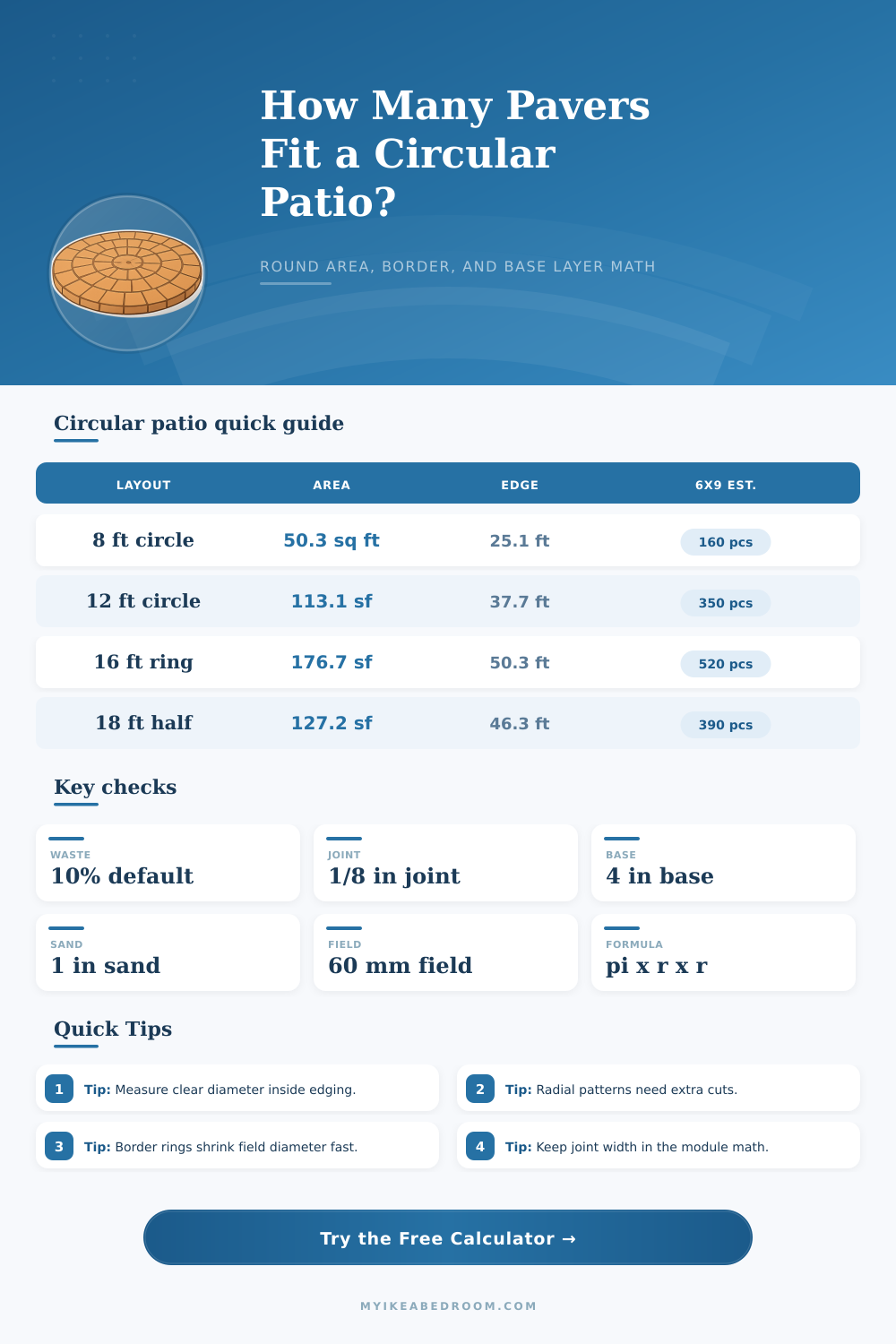
Round patio geometry and paver takeoff
Circular Patio Paver Calculator
Estimate paver counts for solid circles, rings, half circles, and quarter-circle patios with real module sizes, border-course math, bedding sand, edge length, and base aggregate in one layout.
Start with a real round patio scenario, then tune the layout style, paver module, joint width, border courses, opening, and base layers for your exact circle.
| Layout mode | Area formula | Edge formula | Best use |
|---|---|---|---|
| Solid circle | pi x r x r | pi x D | Bistro pads and dining circles |
| Ring patio | pi x (R2 - r2) | pi x D + pi x d | Fire pits, fountains, tubs |
| Half circle | 0.5 x pi x r x r | (pi x D / 2) + D | Wall-adjacent patios |
| Quarter circle | 0.25 x pi x r x r | (pi x D / 4) + D | Corners and entry nooks |
| Paver | Actual face | 60 mm note | Border width |
|---|---|---|---|
| 4 x 8 Holland | 3.94 x 7.87 in | Classic pedestrian field | 4.07 in with 1/8 joint |
| 6 x 6 square | 5.9 x 5.9 in | Easy arc fitting for small patios | 6.03 in with 1/8 joint |
| 6 x 9 rectangle | 5.9 x 8.86 in | Balanced cut rate on circles | 6.03 in with 1/8 joint |
| 12 x 12 slab | 11.81 x 11.81 in | Better on large diameters | 11.94 in with 1/8 joint |
| Layer depth | Sq ft per cu yd | Sq m per cu m | Typical use |
|---|---|---|---|
| 1 in bedding | 324 sq ft | 9.84 sq m | Screeded bedding sand |
| 4 in base | 81 sq ft | 2.46 sq m | Pedestrian patio minimum |
| 6 in base | 54 sq ft | 1.64 sq m | Heavy clay or freeze areas |
| 8 in base | 40.5 sq ft | 1.23 sq m | Larger circles and soft soils |
| Outside diameter | Net area | Outer edge | 6 x 9 est. |
|---|---|---|---|
| 8 ft | 50.27 sq ft | 25.13 ft | 131 pieces |
| 10 ft | 78.54 sq ft | 31.42 ft | 205 pieces |
| 12 ft | 113.10 sq ft | 37.70 ft | 295 pieces |
| 16 ft | 201.06 sq ft | 50.27 ft | 524 pieces |
Building a circular patio requires the use of mathmatical calculations to determine the amount of paving materials that is necessary for the project. A circular patio is generally more difficult to construct than a rectangular patio. While a rectangular patio is made up of straight lines, a circular patio is made up of a curved line, which impacts the way in which the pavers is laid.
You must calculate the area of the circle in order to determine the size of the circular patio; the multiplication of pi and the radius of the circle multiplied by itself determines the area of a circle. The perimeter of the patio can be calculated by doubling the radius of the circle and multiplying it by pi. In addition to calculating the area of the circle, you must also account for the dimension of the pavers.
How to Figure Out Materials for a Round Patio
Pavers is generally rectangular in shape, and each paver has joints between each of the pavers. The width of these joints must be accounted for when calculating the total number of pavers that are needed to complete the patio. For example, if the paver is 6 inches by 9 inches in size, and the joint between the pavers is 1/8 inch in width, then the paver and joint will cover a certain amount of square footage.
The number of pavers that will cover the area of the circular patio can be determined by calculating the area of every paver and dividing the area of the patio by that number. In addition to the area that is to be covered by the patio, there are additional factor to consider in the building of the circular patio. One of the main factors to consider is waste.
For instance, if you are to cut pavers to fit the curve of the circular patio, waste will be created from those cuts. Radial patterns of pavers will create more waste than other patterns of pavers. For instance, radial patterns will require many angled cuts to the pavers to fit those circular patios, which will create waste in the amount of approximately ten percents.
Alternately, patterns like running bond will create less waste in the patio of pavers, which may be less than three percent in amount. Finally, patterns like herringbone are created to ensure the stability of the patio, but will also create waste when cut to those curves, as well. For instance, herringbone patterns will create waste in the amount of eight percent of the total number of pavers requiring for the patio.
Each of these percentages of waste should of be added to the total number of pavers required to ensure that there is an ample amount of pavers for the installation of the patio. Another consideration for the patio is the border that will surround the patio. These borders will help to keep the patio from shifting.
A border can be built with a single course of pavers, but another option for borders is to use multiple ring of pavers as the border for the patio. In this case, the placement of these border pavers will reduce the diameter of the circular patio in size. The size of the circular patio that is constructed within the borders should be measured, as the diameter will be smaller than that of the total diameter of the circular patio.
Materials like clay bricks or Holland stones are often used to form borders for patios of this type, since the bricks are able to hug the curves of the patio. Another consideration in the building of a patio is the base layer. Crushed stone must be used for the base layers of the patio for stability.
For most patios, a four inch layer of crushed stone will be compacted into the ground. If the soil is soft or if the area experiences freezing temperatures, however, then a six inch or eight inch base of crushed stone will be required. In addition to crushed stone, a layer of sand will also be placed into the site of the patio.
One inch of sand is typically all that will be required for this sand layer for screeding the pavers into the site. Each of these layers of crushed stone and sand will be measured in volume in cubic yard in order to order the crushed stone and sand pallets that will be delivered to the site of construction of the circular patio. Additionally, there are different paving patterns for the patio that will impact the calculations of the amount of paving material that is required.
For instance, a running bond is a paving pattern that hides imperfection easily. A radial pattern will create a more specific look for the circular patio. However, the radial pattern will require additional cuts to the paving stones, and therefore will create additional waste for the patio.
The total amount of paving material for a patio using radial patterns will increase by fifteen percent or more. Finally, an ashlar pattern uses different sizes of rectangular tile or slabs. The ashlar paving pattern could potentially reduce waste, though this is only true for very large patios with a diameter of fourteen feet or more.
In addition to the factors discussed above, it is also important to consider the drainage of the circular patio. Permeable setups for the patio will allow water to pass through the base of the patio instead of collecting on the surface of the patio. Finally, another factor to consider is the weight of the different materials for the patio.
For instance, the pallets of paving material are very heavy, and they will have to be staged appropriately to avoid any damage to the area in which the patio will be constructed. Thus, with consideration of each of these different factors, it is possible to successfully construct the circular patio.