Christmas Tree Ornament Quantity Calculator
Estimate ornament count from tree height, tree diameter, fullness, ornament size, coverage style, garland length, large ornament share, visible sides, and cluster spacing.
Pick a realistic starting tree, then adjust the inputs for your actual room placement and ornament mix.
Glass
Best for: sparkle, heirlooms, adult-height branches.
Count note: use fewer very reflective pieces near lights.
Shatterproof
Best for: kids tree, pets, low branches, busy rooms.
Count note: safe filler for dense lower coverage.
Wood or paper
Best for: Scandi, natural, lightweight branch tips.
Count note: reads softer, so spacing can be tighter.
Fabric or felt
Best for: nursery, tabletop, handmade family trees.
Count note: low shine benefits from color grouping.
Metal
Best for: slim silhouettes and modern accent sets.
Count note: hang inward if pieces are heavy.
Ceramic
Best for: keepsake pieces on strong interior branches.
Count note: treat as large-share visual accents.
Acrylic
Best for: clear, icy, or colorful light-catching sets.
Count note: mix with matte pieces for depth.
Natural picks
Best for: pinecones, berry stems, floral clusters.
Count note: count them like garland coverage.
| Tree setup | Typical diameter | Visible sides | Balanced ornament range |
|---|---|---|---|
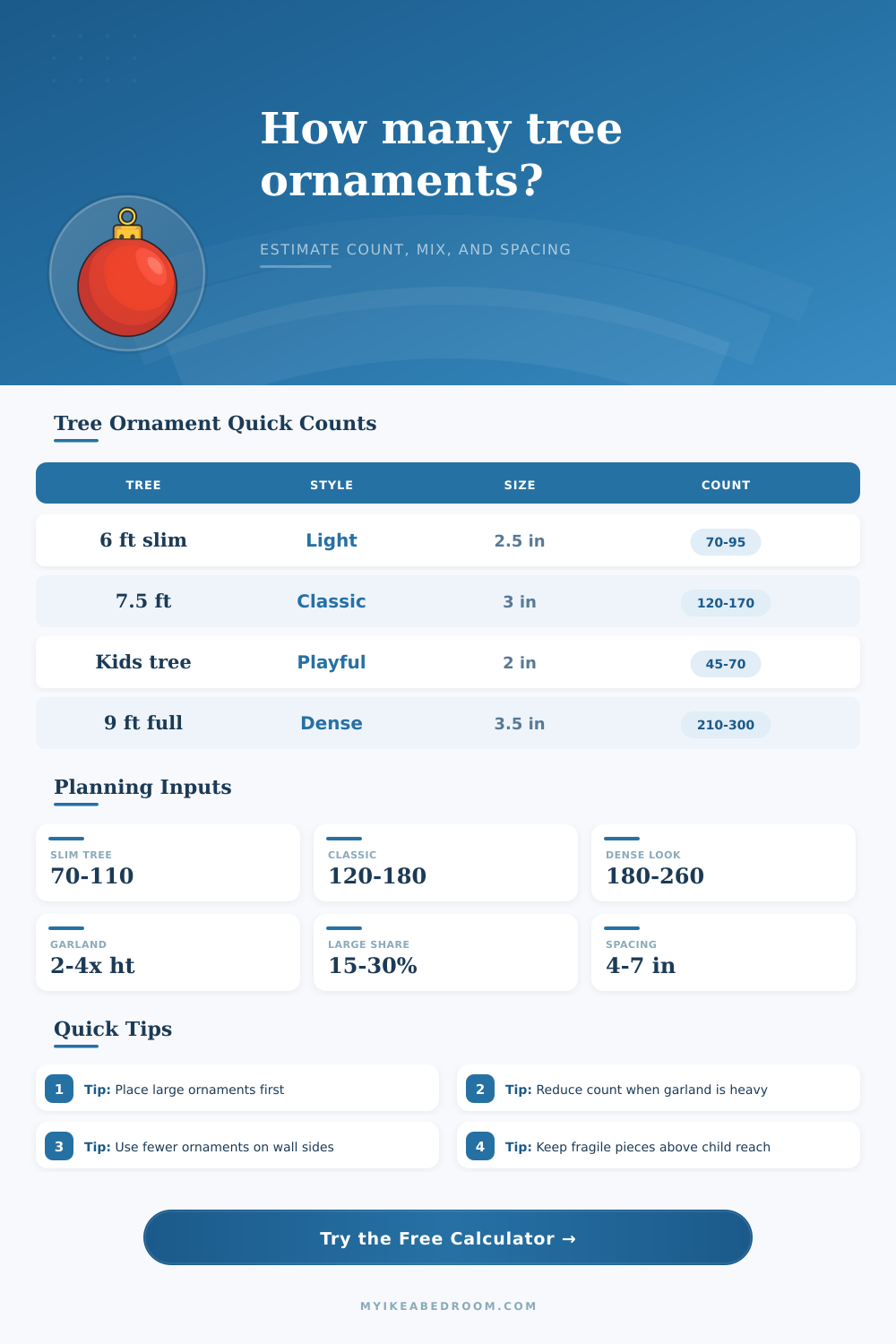
| 4 ft tabletop tree | 18 to 28 in | 3 to 4 sides | 35 to 65 mini ornaments |
| 6 ft slim tree | 30 to 40 in | 2 to 4 sides | 70 to 120 mixed ornaments |
| 7.5 ft classic tree | 48 to 58 in | 3 to 4 sides | 120 to 180 mixed ornaments |
| 9 ft full tree | 60 to 72 in | 3 to 4 sides | 210 to 320 mixed ornaments |
| Coverage style | Look | Density multiplier | Best use |
|---|---|---|---|
| Minimal airy | Branch detail remains visible | 0.36 | Natural, Scandi, sparse trees |
| Light family | Open but clearly decorated | 0.46 | Kids trees, heirloom-only sets |
| Balanced classic | Filled without crowding | 0.55 | Most living room trees |
| Full decorated | Layered ornaments and accents | 0.68 | Photo-ready family trees |
| Dense showroom | Very little open branch space | 0.82 | Large full trees and displays |
| Ornament size | Common role | Suggested spacing | Count behavior |
|---|---|---|---|
| 1 to 1.5 in | Mini filler | 2 to 3 in | High piece count, good for tabletop trees |
| 2 to 2.5 in | Small family ornament | 3 to 5 in | Works well on 4 to 6 ft trees |
| 3 to 3.5 in | Standard ball | 4 to 7 in | Balanced count for 6 to 9 ft trees |
| 4 to 5 in | Large statement piece | 7 to 10 in | Lower count, stronger visual rhythm |
| Planning factor | Low | Balanced | High |
|---|---|---|---|
| Garland length | 1 to 2x tree height | 2.5 to 4x tree height | 4.5x or more tree height |
| Ornament reduction | 2% to 6% | 7% to 14% | 15% to 22% |
| Large ornament share | 8% to 15% | 16% to 28% | 29% to 40% |
| Visible side factor | Front only: 42% | Corner: 58% | All sides: 100% |
Build depth first: hang large ornaments slightly inward, then use small ornaments near branch tips so the tree looks full without forcing every visible gap to hold a bauble.
Adjust for placement: a wall-side tree can use fewer ornaments on the back, but keep a handful of small filler pieces near side edges so the front view does not look flat.
When is it that you get the panic? It is November. You’ve purchased the tree; it’s looking great in the living room. And then you unpack the ornament box: ah, too many little glass ball; no, not enough big statement pieces.
The outcome? Typically an extreme of two options. On the one hand, there are ornaments that look lost on a tree whose branches is barely covered. Or on the other, it’s a Christmas cracker that’s been stuffed so full it can’t breathe.
How to Decorate Your Christmas Tree Perfectly
The trick to achieving the balance is not simply flinging stuff around the branches. It has to do with seeing what meets the eye (visible surface area) and how our eyes judges depth. And if you’re counting ornaments to try to decorate, you are doing it wrong; most people do. Instead, they should of thinking about spacing and coverage.
Plug your tree’s fullness, diameter, and height into the calculator (above), and it does the math for you. No more guesswork: Do I need a hundred ornaments on my six-foot slim tree? Or do you only need forty? Consider the fact that it’s not just a cylindrical shape, but a tapered one (a crucial difference). A denser tree reveal more branch area, so it requires more ornaments to achieve the same visual effect than a looser one. Without accounting for fullness, your pile of decorations will overwhelm a natural pine with gaps between the branches. It might also make a thin artificial tree look bare.
It’s not just quantity but also the combination of different sizes that help make it look more pro. About twenty to thirty percent of all of your ornaments should be big statement pieces. The remaining two-thirds or so can be small filler ornaments. Think of them as anchor points; think of the way a big ball draw your eye into the center of the tree and gives a sense of depth. Even if you’re standing several feet away, the tree seem substantial.
Then there are the little guys who fill the empty spaces around the big ones and reflect light different than do their large spherical counterparts. A single-size tree doesn’t read well. It resembles a grid instead of an organic arrangement of holiday goodies. That’s what many decorators fail to consider when buying sets of same-sized ball.
How many decorations? How you place them makes an enormous difference here. If you have a tree in the middle of the room, it’s going to take cover from every angle. Therefore your number of ornaments has to match the number of views (four, in this case). But if you have a tree pushed up against a wall, or in the corner, then you’re just concerned with looking good from one direction or another. Because, let’s face it, who is going to notice what’s on the back branches? With these placements, you can really cut down on your number.
Not that you shouldn’t pay any attention to the back at all, but there’s no point wasting time trying to find a home for a precious family heirloom on the part nobody sees. Reserve the precious stuff for the side- and front-facing branches, which are the ones that people’s eyes naturaly go toward.
This also affects your ornament budget: Ribbon and garland is unexpected players. Wide velvet ribbon or thick white beaded garland takes up space. Think of it this way: that garland breaks up the green and adds visual texture to the tree. This means you don’t necessarily need as many ornaments to make the tree look full. Every 20 feet of garland you add can cut down your number of ornaments needed by almost 15 percent. It is basically free coverage. Don’t go crazy buying little fillers if you’re planning on draping. The ribbon will do the trick for you.
The type of ornament also affects where you place it on the tree. Glass is heavy. Shatterproof plastic is best for low branches, especially when pets or kids are running through the space. Wood and paper ornaments is lighter and will fit well in sparser, more natural trees. These ornaments show off the shape of the tree instead of hiding it behind decorations. Even equal-sized ornaments made from different materials has varying visual weights.
The bottom line: Decorating is as much about balance and rhythm as it is about exact math. Begin around the trunk with your biggest elements, moving out toward the branches in scale from there. Don’t pack things in too tightly; allow space for your lights to penetrate the needles. Too sparse? The tree will appear empty. Too full? The tree will be dark and cluttered.
What you’re aiming for is something that feels intentional but not manicured. Something that feels like you could walk into that space and hang up your coat for hours, enveloped by light and warmth. That’s what a well-spaced-out tree does for you. It transforms an otherwise random array of elements into a connected holiday scene… Festive and grounded all at once.