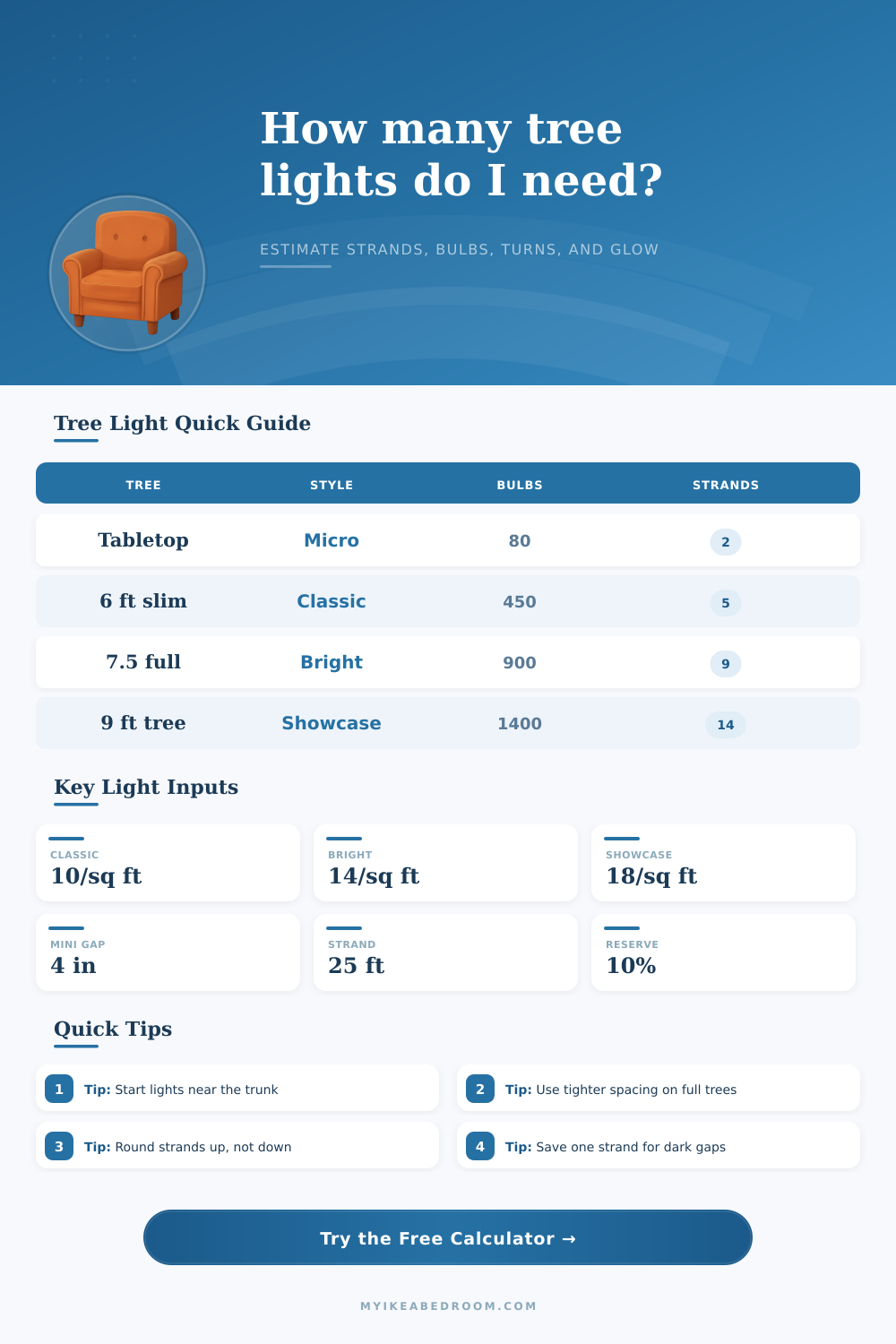
Christmas Tree Light Quantity Calculator
Estimate Christmas tree light strands, bulb count, spiral path length, vertical turns, trunk wrap length, bulb spacing, and brightness density from the real tree height, width, wrap style, strand length, and units.
Choose a common tree setup, then adjust the shape, strand specs, wrap style, and brightness target to match your actual lights.
| Density | Starting target | Visual result | Good for | Calculator behavior |
|---|---|---|---|---|
| Subtle | 7 bulbs per sq ft | Soft glow with more greenery showing | Tabletop, pencil, and minimalist trees | Wider vertical spacing and lower bulb target. |
| Classic | 10 bulbs per sq ft | Balanced sparkle without heavy layering | Most 6 ft to 7.5 ft indoor trees | Moderate spiral spacing and practical strand count. |
| Bright | 14 bulbs per sq ft | Fuller glow across branch tips | Full trees, windows, and mixed ornaments | Shorter vertical spacing and more bulbs per surface area. |
| Showcase | 18 bulbs per sq ft | Layered display with fewer dark pockets | Large trees and feature displays | Raises target length and flags high brightness. |
| Maximal | 22 bulbs per sq ft | Dense glow for ornament-heavy trees | Deep branch wrapping and collector trees | Uses the tightest default spacing and largest reserve need. |
| Tree setup | Typical width | Classic bulb range | Bright bulb range | Planning note |
|---|---|---|---|---|
| Tabletop tree, 2 to 3 ft | 1 to 2 ft | 60 to 150 bulbs | 120 to 250 bulbs | Micro lights often look smoother than large mini bulbs. |
| 6 ft slim tree | 2.5 to 3.5 ft | 350 to 550 bulbs | 500 to 750 bulbs | Front or corner placement can reduce the needed wrap length. |
| 7.5 ft full tree | 4.5 to 5.5 ft | 700 to 950 bulbs | 950 to 1300 bulbs | Branch-depth wrapping usually needs a reserve strand. |
| 9 ft tree | 5 to 6.5 ft | 1000 to 1500 bulbs | 1400 to 2100 bulbs | Check circuit limits and split strands into easy zones. |
| 10 ft plus foyer tree | 6 ft plus | 1500 bulbs plus | 2200 bulbs plus | Work in lower, middle, and top sections for even density. |
| Strand type | Bulb spacing | Lit length | Approx bulbs per strand | Best use |
|---|---|---|---|---|
| Micro or fairy lights | 2 to 3 in | 16 to 33 ft | 80 to 200 bulbs | Tabletop trees, branch-depth wrapping, and delicate trees. |
| Mini LED string | 3 to 4 in | 20 to 35 ft | 70 to 150 bulbs | Most indoor trees with classic or bright density. |
| Wide-spaced mini string | 5 to 6 in | 25 to 50 ft | 50 to 100 bulbs | Loose spiral wraps and outdoor porch trees. |
| Globe or faceted bulbs | 6 to 8 in | 20 to 35 ft | 30 to 70 bulbs | Accent glow where each bulb is meant to be visible. |
| Wrap style | Surface coverage | Path multiplier | Turn behavior | Use when |
|---|---|---|---|---|
| Classic full spiral | 100% | 1.00 x | Even helical passes around the tree | You want predictable all-around light coverage. |
| Loose spiral | 88% | 0.86 x | Fewer vertical turns with more space between wraps | The tree is open, sparse, or already pre-lit. |
| Tight spiral | 108% | 1.16 x | More passes and closer spacing | Full trees need brighter depth from outside branches. |
| Vertical cascade | 90% | 0.92 x | Runs go down and back up instead of a pure spiral | You prefer easy removal and visible vertical lines. |
| Branch-depth wrap | 118% | 1.36 x | Extra length goes into inner branches | You want glow from the trunk outward. |
| Front-facing tree | 58% | 0.64 x | Partial spiral across the visible face | A wall, corner, or window hides the back. |
Mini LED
Best all-around pick. Low heat, many bulb counts, and close spacing options.
Good for classic, bright, and tight spiral wraps.
Micro LED
Dense sparkle. Small wire disappears into branch tips and tabletop trees.
Use shorter bulb spacing when the tree is slim or delicate.
Incandescent Mini
Warm traditional glow. Bulbs look soft, but heat and load matter.
Check strand ratings before combining many strings.
Globe Lights
Decorative points. Larger bulbs read as ornaments, not hidden sparkle.
Use lower bulb density and wider vertical spacing.
Work in zones. Divide tall trees into bottom, middle, and top sections so strand joins land near the trunk instead of on visible branch tips.
Check brightness after one pass. If the first spiral looks patchy, tighten the vertical spacing before adding ornaments, ribbon, or picks.
Decorating your Christmas tree doesn’t need to be a guessing game. You don’t want to buy too many lights (and end up with a tangle), or too few (and have some really dark spots). It all boils down to estimating how much light you’ll actualy get.
You have to translate two-dimensional numbers into three-dimensional coverage, which is something most of us guess at based off the height of our trees. It is chaotic, or just plain dim. Thankfully, the calculator figures out surface area of a cone for you. This means you don’t has to imagine what it will look like once wrapped before you head to store.
How to Choose the Right Amount of Lights
The first variable people gets wrong is width of tree. The height label makes us think only about height. It makes us forget that light requirement grows with the branch spread. (A fuller tree like a Douglas Fir will require far more bulbs to cover its surface area then a slender one of equal height.) Enter widest point of your branches into tool to tell it how much space you want to cover. This is more important than the height. If you don’t account for width, then when you hang your strands they’ll just stop partway up bottom branches (since you under-estimated circumference).
How many? Your choice depends on personal preference versus practical reality. For a classic wrap, think roughly ten bulbs per square foot of visible tree surface. Enough sparkle but not overpowering the ornaments. To create a look with each tip of each branch shining through, you could push it up to maybe fourteen or even eighteen bulb per square foot. If you choose showcase density on the calculator, that’s what math will adjust to.
And no, this isn’t just about throwing more strings in there willy-nilly. It’s about how far apart they’re spaced on those strands too. Tighter bulb spacing mean you need fewer feet of wire to get same brightness. This makes installation quicker and means you won’t have to hunt for outlets as often.
You can also plan realisticly by using tool’s option to wrap the lights around tree instead of spiraling them up from bottom. While most of the tutorials features a neat spiral end-to-end, nobody installs their Christmas tree like that. You don’t have to light the back side if your tree is near a wall/corner/etc. Going with the wrap style cuts estimated strand count down a huge amount since it’s ignoring all of hidden surface area.
Also, if your tree has really deep inner branches that catch your eye, a normal exterior spiral isn’t going to light anything but outside. A trunk-wrap or even a branch-depth option give you more length. This allows you to tuck a few strands inside instead of just hanging them on the very tips and draping them outward over rest of tree.
One common mistake is using too short a strand. When purchasing string, many do it by total string length including plug leads, but you only get coverage from the lit part. If you have a long extension cord, then a twenty five foot strand may really be just twenty feet of bulb. The tool requests that you enter the length of usable strand so that bulb count is correct. With wider spaced globe lights, you can span further with the same number of strands than with dense spaced micro lights. That’s a tradeoff between convenience and density.
One caveat: Always estimate high. The calculator includes a reserve factor for tangle-prone areas like plug leads and dark spots, and for the occasional five feet of wire you’ll find yourself needing but didn’t accounted for. That extra 10% will be what turns a ‘hmmm’ tree into a ‘done’ tree, and it’s the reason nobody would of want to drive to store at midnight.
Lighting a tree is as much about geometry as it is about decoration. Do the math correctly and the rest comes naturaly, with no stress caused by last-minute shopping runs or tripping over surplus cord.