China Cabinet Capacity Calculator
Estimate how many place settings, plates, bowls, mugs, glasses, and serving pieces fit in a china cabinet while checking usable shelf area, door clearance, display fullness, and shelf load.
Choose a common dining room, apartment, hutch, or display cabinet setup, then fine tune the dimensions and dinnerware mix.
How this calculator estimates capacity
Usable shelf area subtracts side, door, and back clearance, then multiplies by the number of storage levels. Practical capacity applies display fill and reserve space before comparing the target dinnerware footprint.
Place settings are estimated from plates, bowls, cups, glasses, and serving pieces. Plate stacks use your maximum stack size, while tall glass fit is checked against the average clear height per level.
Run the calculator to see whether your cabinet is open, balanced, dense, or overloaded.
| Piece type | Planning footprint | Typical height | Capacity note |
|---|---|---|---|
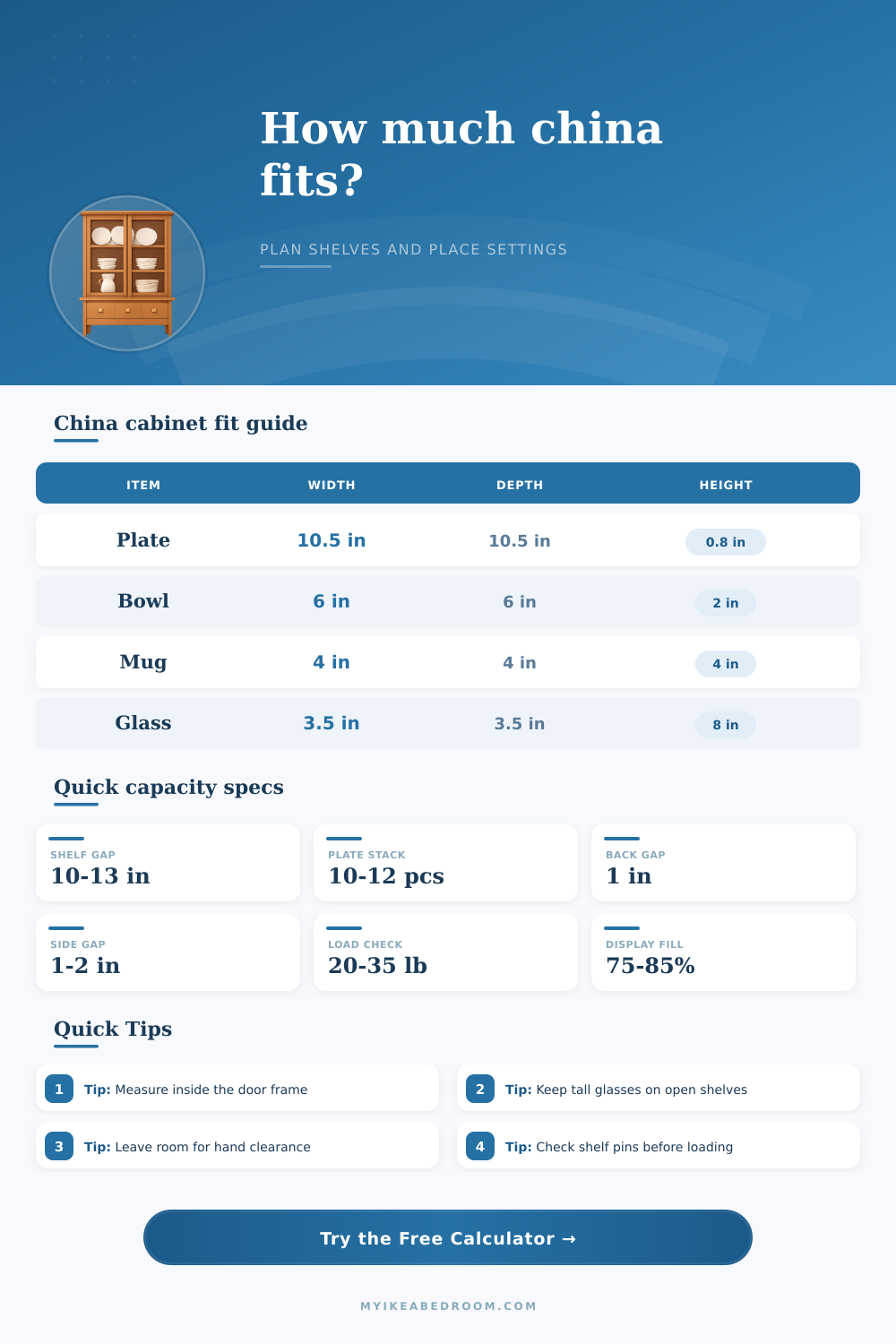
| Dinner plate stack | 10.5 x 10.5 in | 0.55 to 0.85 in each | Keep stacks at 8 to 12 plates for easier lifting. |
| Salad or dessert plate | 8.5 x 8.5 in | 0.45 to 0.70 in each | Can often share a shelf with cups or saucers. |
| Soup or cereal bowl | 6 x 6 in | 2 to 3 in each | Nested bowls save area but still consume vertical clearance. |
| Tea cup or mug | 4 x 4.5 in | 3.5 to 4.5 in | Handles create dead space if cups are lined in rows. |
| Wine glass or flute | 3.5 x 3.5 in | 7 to 10 in | Needs a level with enough clear height and stable shelf depth. |
| Serving platter | 14 x 10 in | 1.5 to 3 in | Large pieces usually count as two to four normal pieces. |
| Usable depth | Best for | Watch for | Planning guidance |
|---|---|---|---|
| 8 to 10 in | Cups, saucers, small plates | Dinner plates may not sit flat | Use upright plate stands or smaller stacks. |
| 11 to 13 in | Dinner plates and bowls | Door frame can steal front clearance | Leave at least 1 inch at the front. |
| 14 to 16 in | Full place settings | Deep rows hide rear items | Keep everyday pieces in the front row. |
| 17 to 20 in | Large platters and dense storage | Heavy load near the front edge | Use stronger shelves or distribute weight. |
| Cabinet type | Interior size | Comfortable capacity | Notes |
|---|---|---|---|
| Narrow display tower | 24 x 48 x 12 in | 4 to 6 settings | Best with limited serving pieces. |
| Standard china hutch | 42 x 54 x 14 in | 8 to 10 settings | Balanced storage and display spacing. |
| Wide dining cabinet | 60 x 58 x 15 in | 12 to 16 settings | Good for stemware plus platters. |
| Sideboard upper cabinet | 48 x 28 x 13 in | 6 to 8 settings | Lower height limits stemware shelves. |
| Corner cabinet | 30 x 60 x 10 in usable | 4 to 8 settings | Triangular shelves reduce usable area. |
| Shelf material | Typical concern | Safer loading pattern | Calculator input tip |
|---|---|---|---|
| Glass shelf | Point loads and edge chips | Spread stacks evenly across supports | Use a lower shelf load rating. |
| Wood shelf | Sag over long spans | Put plates near sides or center support | Use maker rating when available. |
| Adjustable pins | Loose holes or worn pegs | Confirm all pins seat fully | Reduce target fill for older cabinets. |
| Face-frame cabinet | Door opening narrower than interior | Measure the actual retrieval path | Add side hand gap and door depth loss. |
Measure the opening, not just the inside box. A face frame, glass door rail, knob, plate groove, or magnetic catch can make a cabinet feel smaller than its interior dimensions suggest.
Separate display capacity from storage capacity. A cabinet can physically hold more pieces than it can show gracefully; reserve space keeps fragile items visible and reachable.
Width is typicaly how most folks think of china cabinets. It’s the long row of plates on the shelf. That is typically wrong. The actual limits will likely be height and depth.
When you think about it, those measurements feels abstract. How do you get this plate passed the door knob? How am I going to lift all this heavy porcelain without it toppling over? You’ve seen those cabinets from the outside that look big. The inside space is another matter.
How to Measure Your China Cabinet
First, always measure what your cabinet has room for, the interior of the box. The outside measurements of the cabinet aren’t all that matter. You’ll want to deduct thickness of glass door and face frame. Rails inside will eat up some of the depth as well. An inch here or there can make a difference. It’s the difference between your plates being able to sit level on the shelf or having to sit tilted toward the end.
With the cabinet calculator, it do the math for you and allows you to deduct amount that will be taken away by those obstructions before calculating capacity. That’s an important part because sometimes a fourteen-inch-deep cabinet might only hold twelve inches deep. Remember to account for handle and door swing clearance.
And then what happens when the dishes go in? How do they behave? Do your plates stacks? How many can you stack before it’s unsafe? There’s only so far that dinnerware will go. At some point, weight becomes unmanageable or the bottom plate cracks. At some point, all those plates will weigh down the bottom dish and cause it to crack.
Some folks tend to stuff as much in here as humanly possible, which leads to frustration later on. It’s difficult to grab a single salad plate for, say, a casual dinner. Instead, it looks better when things is more balanced. Leave some empty space so everything shows up.
Here’s a good way to guide yourself: use a practical fill target. Sixty-eight percent of capacity feels open. Ninety-two percent feels like you’re storing a lot. Neither is right or wrong. It just serves a different purpose.
Glasses complicate matters because they require height (not width). Even if your shelves has decent square footage, it doesn’t mean they’re usable for wine bottles. It could be that the vertical space between shelves are too narrow. On every level, make sure there’s enough room for tall things. Consider the thickness of the shelf itself. Wooden shelves can be very thick and gobble up precious vertical inches. This means fewer useful levels.
Consider how much you use an item when storing it. Make what you reach for most grabbable. Stash the special stuff way in back or high overhead. For example, everyday china stored deep within a cabinet could mean thinking about volume vs. Display.
How much does it weigh? Don’t wait till a shelf collapses. Porcelain is heavier then it looks. A fully laden cabinet will pack on pounds fast. Add serving platters & that’s even more lbs! Look at weight limits per shelf. Then don’t go over capacity. Be careful if you have glass shelves. Even a safe total weight could of be exceeded by a point load. Spread your stack around to minimize this risk.
If you’re unsure, use tables which lists typical footprints for most stuff. Use those as a starting point then compare your own mixed bags of everyday dishes and your special heirlooms.
There’s a lot more to organizing a china cabinet than just the amount of dishes you have. There’s also the friction involved. What do you use most often? How easy should it be to reach? And how tightly should things be packed so they’re not hard to get out? Plan for height, width, depth and how many stacks can fits in there. That will shift the process from guesswork to planning. From clutter to order.
You don’t want to force every single item into the space. You want a system that allows for items to be pulled out easily. That balance turns the piece of furnitures into something that becomes a practical part of your dining routine.