Chandelier Height Over Table Calculator
Calculate tabletop clearance, fixture bottom height, ceiling drop, chain or rod length, sightline fit, and table scale for chandeliers centered over dining, breakfast, game, or homework tables.
Choose a real table setup, then adjust the ceiling, table, fixture, and sightline details.
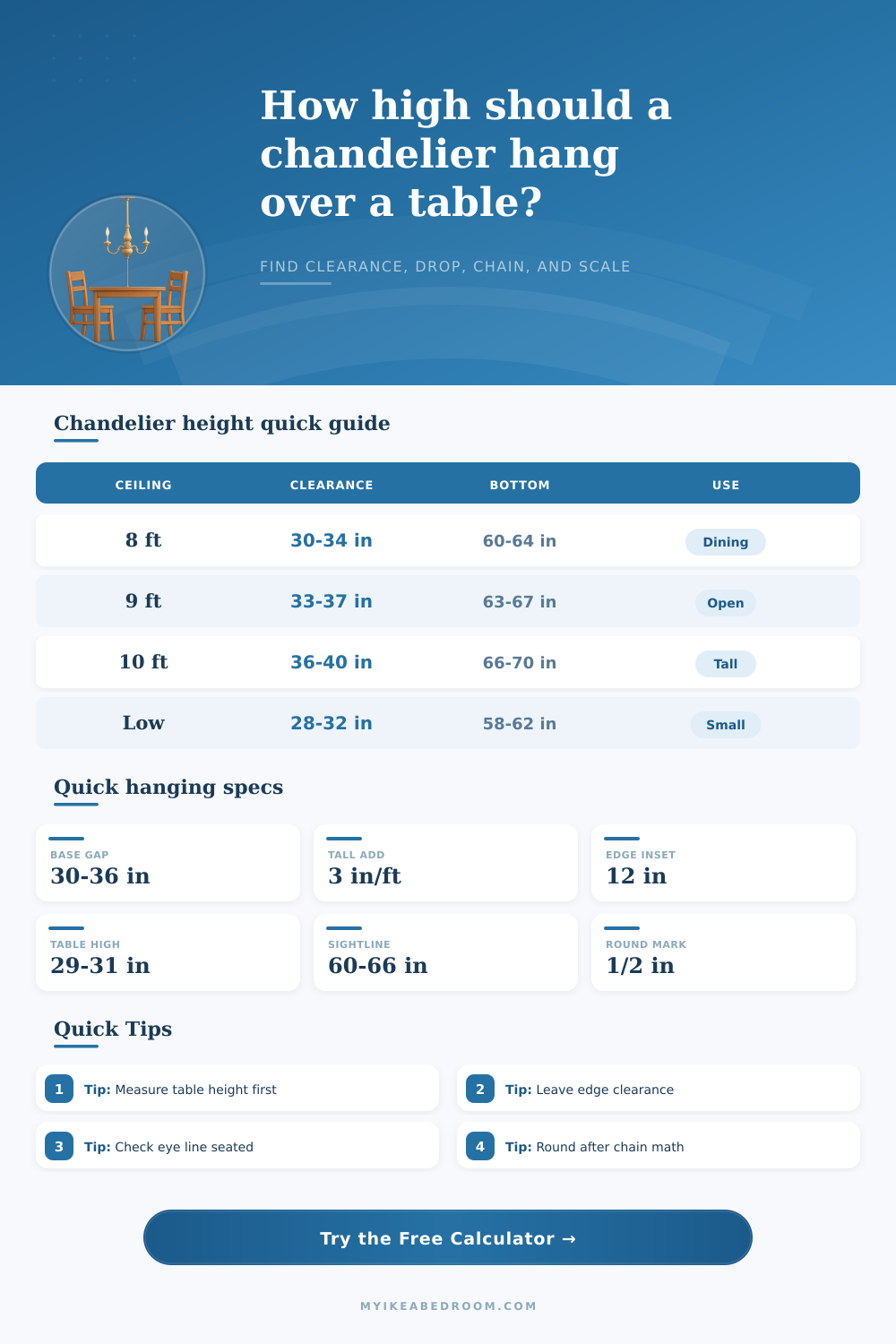
| Ceiling height | Typical clearance | Fixture bottom from floor | Best adjustment |
|---|---|---|---|
| 84 in or lower | 28 to 32 in above tabletop | 58 to 62 in with a 30 in table | Use a shallow fixture and protect sightlines. |
| 96 in | 30 to 36 in above tabletop | 60 to 66 in with a 30 in table | Classic dining room starting range. |
| 108 in | 33 to 39 in above tabletop | 63 to 69 in with a 30 in table | Add about 3 inches for the extra ceiling foot. |
| 120 in | 36 to 42 in above tabletop | 66 to 72 in with a 30 in table | Use body height and chain length to keep presence. |
| 132 in or taller | 39 to 45 in above tabletop | 69 to 75 in with a 30 in table | Large fixtures can hang lower if sightlines stay open. |
| Table width or diameter | Good fixture width | Minimum edge inset | Scale note |
|---|---|---|---|
| 36 in | 18 to 24 in | 6 to 9 in each side | Small round and apartment tables need compact bodies. |
| 42 in | 21 to 28 in | 7 to 10 in each side | Breakfast nooks work well with drum or globe shapes. |
| 48 in | 24 to 32 in | 8 to 12 in each side | Common square or round dining table proportion. |
| 60 in | 30 to 40 in | 10 to 15 in each side | Larger round tables can support a wider chandelier. |
| 72 in or wider | 36 to 48 in | 12 in or more each side | Linear chandeliers may use length plus width checks. |
| Fixture body height | Ceiling drop needed | Chain or rod estimate | Watch for |
|---|---|---|---|
| 8 to 12 in body | 33 to 38 in | 19 to 28 in after canopy | Best for low ceilings or small tables. |
| 13 to 18 in body | 34 to 42 in | 14 to 27 in after canopy | Works in most 8 to 9 foot dining rooms. |
| 19 to 26 in body | 38 to 48 in | 10 to 27 in after canopy | Check seated sightlines before lowering. |
| 27 to 36 in body | 44 to 58 in | 6 to 29 in after canopy | Needs ceiling height or a shorter clearance target. |
| Table setup | Clearance target | Fixture width | Priority |
|---|---|---|---|
| Round breakfast table | 30 to 33 in | 50 to 65 percent of diameter | Cozy light without blocking conversation. |
| Formal dining table | 34 to 38 in | 55 to 70 percent of width | Open sightlines and balanced room presence. |
| Long rectangular table | 32 to 38 in | Keep 12 in inside long edges | Use linear width and centerline alignment. |
| Game or homework table | 36 to 42 in | Compact or shallow body | Faces, screens, boards, and papers stay visible. |
Best for: everyday dining.
Starts with tabletop clearance, then checks chain length, fixture body height, and table edge inset.
Best for: game, homework, and view tables.
Raises the bottom edge above seated eye line before checking the classic dining range.
Best for: tall rooms.
Uses the visible drop from ceiling to fixture bottom so the chandelier does not float too high.
Best for: fixture shopping checks.
Compares chandelier width with table width and confirms the fixture stays inside table edges.
Measure from the actual tabletop, not the floor alone. A table that is 31 inches high makes the same fixture bottom sit 1 inch closer to the table than a 30 inch table.
Separate fixture body height from chain or rod length. The calculator subtracts body height and canopy allowance from the ceiling-to-bottom drop so the cut length is not guessed.
To determine the height of the chandelier that you would like to place over your dining table, there are several specific measurement that must be made. These measurements include the height of the dining table, the height of the ceiling in the room, and the height of the chandelier fixture itself. If the chandelier is hung too low, a diner may bump into the chandelier.
If the chandelier is hung too high, the chandelier will not provide sufficient light to the dining table for those who are at the table. Therefore, calculating the height of the chandelier is important to ensure that the chandelier does not obstruct the view of those who are at the table, but provides enough light to the area for those individuals to see there meals. The height of the dining table is the first measurement that must be made to calculate the desired height of the chandelier.
Finding the Right Chandelier Height for Your Dining Table
The height of most dining table is 30 inches, but you must measure the height of the specific dining table in your kitchen or dining area. If the height of the table is slightly different than 30 inches, that alteration in height will affect the height of the chandelier. The height of the ceiling in the room is another measurement that must be made in the determination of the height of the chandelier.
For instance, a ceiling height of 8 feet is lower than a ceiling height of 10 feet, so the chandelier can be larger for the 10 foot ceiling than it can be for the ceiling of 8 feet. The height of the body of the chandelier must also be measured. The height of the chandelier body will take up some of the available vertical space between the ceiling and the dining table.
Therefore, if the chandelier has a very tall body, there will need to be less length for the chain of the chandelier such that it does not hang too low from the ceiling. Furthermore, if the bottom of the chandelier hangs below the eye level of the individuals who are at the dining table, then the chandelier will obstruct the view of other individuals who are at the same table. The width of the chandelier should also be taken into consideration.
The width of the chandelier should be proportional to the width of the dining table. If the chandelier is too narrow for the width of the table, it will appear out of scale with the table itself. If the chandelier is too wide for the dining table, it will come too close to the edge of the table.
It is important to ensure that there is sufficient space between the chandelier and the edge of the table for the diner to reach for their plates without bumping into the chandelier. The type of room that you have will have different considerations for the height of the chandelier that should be placed in that area. For example, a breakfast nook area may require a chandelier that hangs lower than those that is used in other areas of the house.
Additionally, if the table is to be used as a game table or a homework table, you should hang the chandelier higher to ensure that it does not obstruct the view of the tasks that are to be performed at the table. In formal dining rooms, though, it is best to find a middle ground. The chandelier should be impressive in its design and light output, but should not obstruct the view of others who may be seated at the table.
A profile selector can be used to adjust the chandelier to account for these different considerations. There are some mistakes that may be made in determining the height of the chandelier. For instance, some individuals may make a measurement of the distance from the floor to the ceiling.
However, it is important to take into consideration the height of the dining table (30 inches) in this calculation. Additionally, it is possible that individuals will not account for the height of the chandelier body, but only the length of the chandelier’s chain. In creating a calculator that estimates the height of the chandelier, it is critical to provide a breakdown of each of these calculations to allow individuals to understand how to determine the height of the chandelier.
In addition to the calculations, there are some physical constraints on the chandelier that must also be taken into consideration. For instance, there may be beams in the ceiling that prevent the chandelier from being hung in the center of the dining table. Additionally, there may be air conditioning unit or fans that must be avoided in hanging the chandelier.
Despite the fact that there are these physical constraints on the placement of the chandelier, it is still important to use the calculator to determine the target height of the chandelier. The chandelier can then be adjusted to account for these physical constraints. In addition to the calculations and constraints on the placement of the chandelier, there are also reference tables for chandeliers that can provide additional information to the individual who is calculating the height of the chandelier that will be placed in the dining area.
These tables can provide examples of the clearances that can be provided to the dining area based off the height of the ceiling in the room and the width of the dining table. These reference tables can help to ensure that the calculations that are performed are accurate. Finally, once you determine the height of the chandelier, there are some additional steps that can be taken to ensure that the height of the chandelier will be appropriate once it is installed in the dining area.
For instance, the chandelier can be temporarily hung from the ceiling. While dining at the table, the individual can review the chandelier to determine if the light levels are appropriate for the table’s area, as well as whether or not the chandelier obstructs the view of others who are at the table. Making adjustments to the height of the chandelier prior to permanently installing it in the dining area will prevent the need to make such adjustments after the chandelier is permanently installed.