Chair Sash Length Calculator
Calculate cut length for chair sashes, bows, knots, tails, flat bands, total yardage, and roll count from real chair back measurements and event quantity.
Choose a common event chair and tie style, then adjust the dimensions to match your actual chair back and desired bow shape.
| Chair type | Back width | Back depth | Common sash use |
|---|---|---|---|
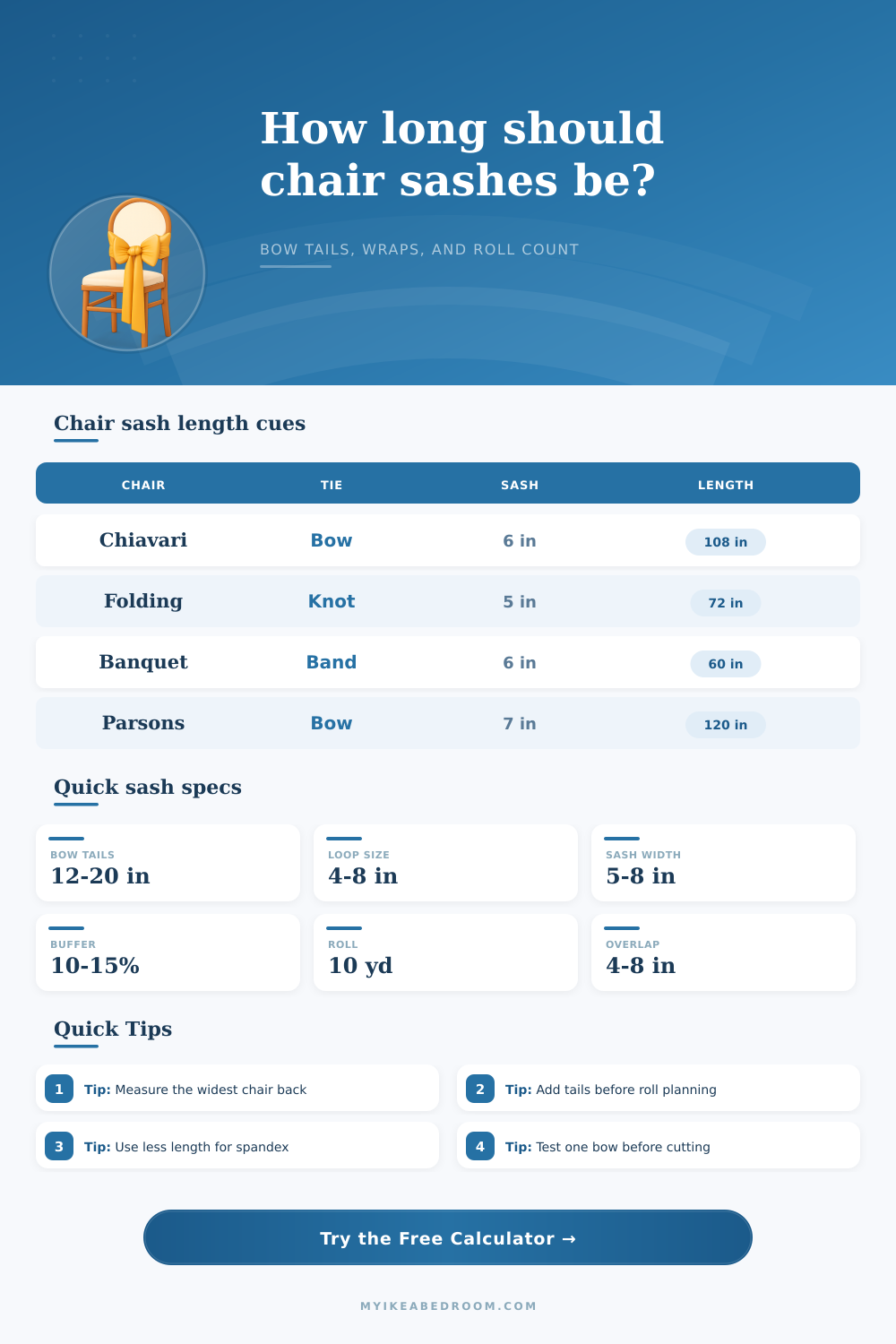
| Chiavari or ballroom chair | 13-15 in / 33-38 cm | 1-2 in / 2.5-5 cm | Organza or satin bow at center back |
| Folding event chair | 15-17 in / 38-43 cm | 1-2 in / 2.5-5 cm | Short knot, band, or small bow |
| Banquet chair with padded back | 17-19 in / 43-48 cm | 2-4 in / 5-10 cm | Spandex band or wider sash wrap |
| Parsons dining chair | 18-21 in / 46-53 cm | 3-5 in / 8-13 cm | Long bow tails or wide decorative band |
| Cross-back or garden chair | 15-18 in / 38-46 cm | 1-3 in / 2.5-8 cm | Loose bow tied around rails |
| Tie style | Loop allowance | Tail allowance | Best for |
|---|---|---|---|
| Flat band | 0 in / 0 cm | 0 in / 0 cm | Spandex bands, chair labels, simple wraps |
| Simple knot | 0 in / 0 cm | 16-28 in / 41-71 cm total | Modern chair backs and narrow ribbon |
| Classic bow | 30-45 in / 76-114 cm | 24-40 in / 61-102 cm total | Weddings, banquets, and dinner seating |
| Double-loop bow | 55-80 in / 140-203 cm | 28-44 in / 71-112 cm total | Full tulle or organza statement bows |
| Rosette | 18-35 in / 46-89 cm | 8-24 in / 20-61 cm total | Gathered side detail or floral twist |
| Cut length | Per 10 yd roll | Per 25 yd roll | Metric cut cue |
|---|---|---|---|
| 60 in | 6 sashes | 15 sashes | 152 cm each |
| 72 in | 5 sashes | 12 sashes | 183 cm each |
| 96 in | 3 sashes | 9 sashes | 244 cm each |
| 108 in | 3 sashes | 8 sashes | 274 cm each |
| 120 in | 3 sashes | 7 sashes | 305 cm each |
| Sash width | Visual effect | Works well with | Length note |
|---|---|---|---|
| 3-4 in / 8-10 cm | Narrow ribbon look | Cafe, school, and small folding chairs | Needs careful tails to avoid looking short |
| 5-6 in / 13-15 cm | Standard event sash | Chiavari, banquet, garden, and dining chairs | Most bow length charts assume this width |
| 7-8 in / 18-20 cm | Full formal sash | Parsons and padded chair backs | Add knot length for bulk and clean tails |
| 9-10 in / 23-25 cm | Dramatic fabric panel | Velvet, burlap, and statement head chairs | Use extra buffer because folds consume length |
Classic Bow
Balanced two-loop bow with two tails; usually the safest choice for wedding chairs.
Simple Knot
Shorter, cleaner, and faster to tie when the sash is used more like a ribbon accent.
Flat Band
Lowest fabric use; good for stretch bands, clipped chair wraps, or simple color coding.
Double Bow
Fuller look with extra loops; best for tulle, organza, or special head-table chairs.
Tie one real sample before cutting the stack. Chair backs vary more than they look, and bow fullness changes by fabric. Measure the finished sample from end to end, then use that length as your final cut standard.
Separate guest chairs from feature chairs. Head-table, aisle, or sweetheart chairs often use longer tails or fuller bows. Plan those as a second preset so the bulk chair count stays efficient.
Spent your afternoons arranging flowers, only to realize that sashes on your chairs look like they were cut by someone in a hurry? They don’t lay flat; the bow is crooked; the tail hangs off unevenly. Why? Because we tend to think about sash lengths as a number instead of a set of unique components.
If you understand these inputs, the calculator above will do the math for you. Not sure what to plug into the calculator? That’s the difference between looking pretty or looking sloppy.
How to Choose the Right Sash Length
First: The chair. What’s the size of the back? Measure the width first, then take into account how thick the back is (i.e., how many inches from front to back). This is always the forgotten part. A thin wooden slat needs almost no extra fabric to wrap around it; on the other hand, a fat cushioned banquet chair will gobble up 3-4 inches just at circumference. Underestimating that dimension mean your sash won’t make it across to meet itself for tying. It’s like taking measurements for the ribbon’s journey without considering the bow itself yet.
Finally there’s fabric selection: the more your knot consumes as part of that length, the longer your final result needs to be. If you choose a fabric like organza that doesn’t compress very well. Meaning it won’t pull the loops into an easy round shape, you need more fabric to make that happen. On the flip side, something like velvet traps excess bulk within the center of the bow, doing just the opposite. With built-in multipliers for these kinds of variations, the tool factors all this stuff in; so a six-inch loop made from satin, while appearing visually identical to one in velvet, will require fewer yards of the former than the latter. It is a small detail, but it is important when you’re cutting out hundreds of chair covers and want them consistent throughout each row.
Style wars against function when it comes to tail length. On paper, long tails are dramatic. In real life they get caught in people’s legs while serving dinner. Short ones make you feel like you’re liviv in the now. But sometimes they just kind of vanish visually (unless the sash color is very different from the chair). With the calculator, you can specify how much of a drop and that really helps you visualize what the final silhouette will be before you place an order.
You’ll want to pad it by some amount for cutting mishaps. No matter how experienced we are as a decorator, we’ve all made cutting mistakes at some point or another while working late into the night at a big event. Ten percent padding is standard, so you have something extra for those inevitable misalignments, but not enough to go way over-budget. The tool then turns this per-chair cut length into the number of rolls you need and the overall yardage needed. Because who wants to panic about being short of fabric halfway through set up?
It will tell you exactly how many 10-yard rolls to purchase depending on what waste factor you choose and your exact number of chairs. You won’t buy too much and have it sit in storage forever, or cut corners so badly that you has to run back to the store as people arrive at your house.
For example, the reference table on the page breaks down the use of materials. It shows that different types of ties uses different amounts of material. A basic tie is quick and easy, perfect for a casual occasion or if you’re operating on a shoestring. A double loop bow looks much dressier. It fills out your look more fully, but it requires a lot more material. So knowing the feel of an event will help determine if you want to be economical or elegant with your choice.
You must test-cut a sash first, then cut the rest. Even though chair backs are all in the same batch from the rental place, they’re not exactly alike; fabric stretches and drapes differently when it’s tensioned. Tie a sample and see if you prefer more or less tightness/drapery, and adjust calculations accordingly. Five minutes should of saved hours unravelling later. Until you realize something isn’t quite right about how it looks.
When it comes to detail, getting the sashes in the correct length does make a difference. It supports the space instead of taking away from it. The attention to detail makes every chair look like it belongs. You get that clean, professional finish not by guesswork, but because you prepared, accounted for the variables that always arise, and measured carefully. Prep equals the effort; the result is that it just works.