Chair Cover Size Calculator
Estimate fitted chair cover dimensions, fabric yardage, skirt drop, elastic length, tie length, and cut panels from your chair's seat, back, height, fabric width, stretch, and seam choices.
Pick a common chair style, then adjust the real measurements from your chair. Presets use practical dimensions for slipcovers, dining covers, stretch covers, and loose dust covers.
How the calculator sizes a chair cover
Seat panel: seat width and depth are expanded by cushion thickness, ease, seam allowance, hem, and any skirt drop that wraps below the seat.
Back panel: back width and height are expanded for side seams, hem allowance, back thickness allowance, and cover style. Stretch fabric reduces the final relaxed cut size.
Fabric yardage: the calculator estimates total cut area, compares it with your fabric bolt width, then adds your cutting buffer for repeat matching and small errors.
Elastic or ties: stretch and fitted covers use the seat perimeter; loose and skirted covers show tie length instead.
| Chair type | Typical seat width | Typical seat depth | Typical back cover height |
|---|---|---|---|
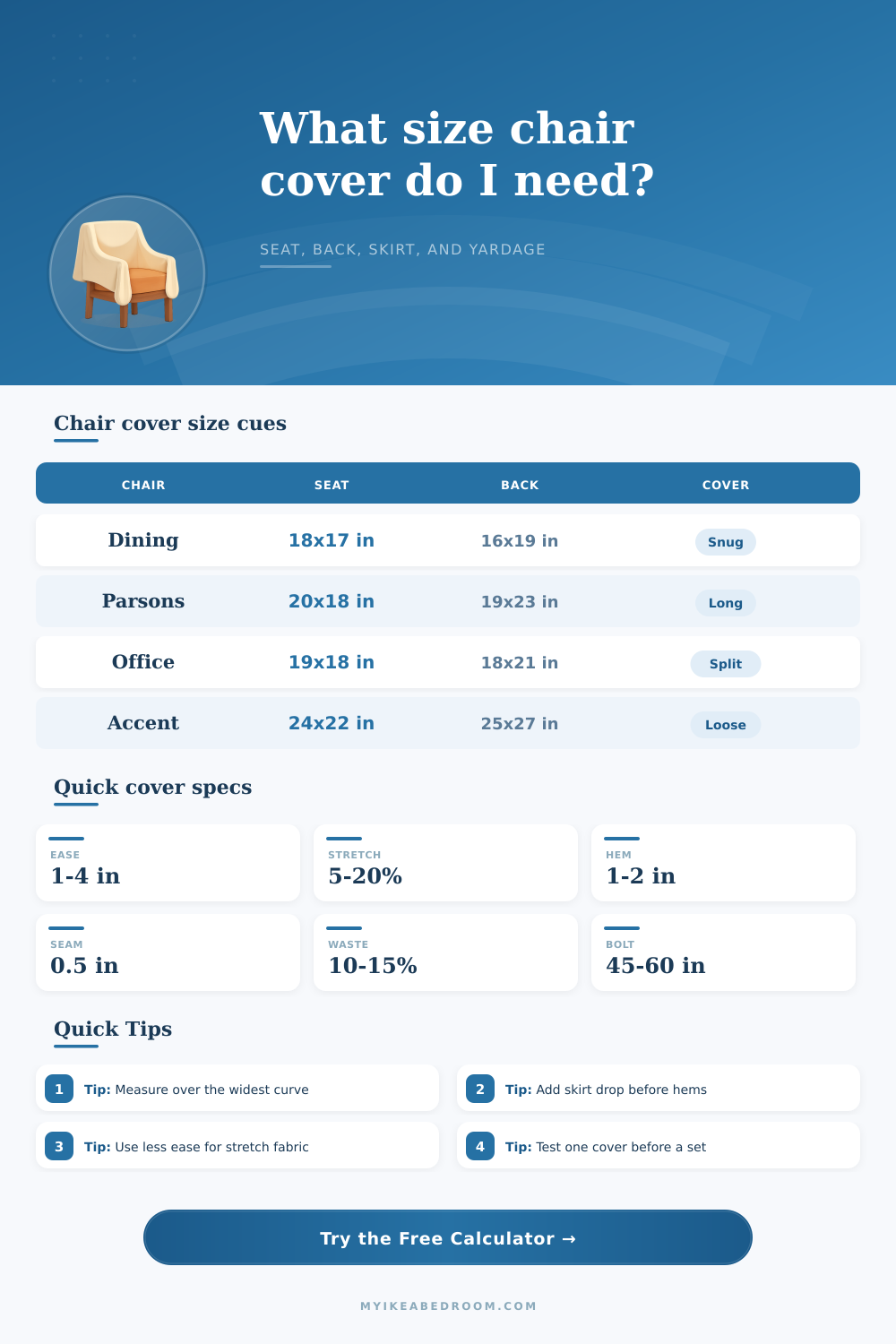
| Dining chair | 17-19 in / 43-48 cm | 16-18 in / 41-46 cm | 18-22 in / 46-56 cm |
| Parsons chair | 19-21 in / 48-53 cm | 17-20 in / 43-51 cm | 22-26 in / 56-66 cm |
| Folding chair | 15-17 in / 38-43 cm | 15-17 in / 38-43 cm | 14-18 in / 36-46 cm |
| Office task chair | 18-21 in / 46-53 cm | 17-20 in / 43-51 cm | 18-24 in / 46-61 cm |
| Accent chair | 22-28 in / 56-71 cm | 20-25 in / 51-64 cm | 24-32 in / 61-81 cm |
| Wingback chair | 24-30 in / 61-76 cm | 22-27 in / 56-69 cm | 30-38 in / 76-97 cm |
| Fit goal | Woven fabric ease | Stretch fabric reduction | Best use |
|---|---|---|---|
| Very snug event cover | 0.5-1 in | 10-20% | Spandex banquet or folding chair covers |
| Everyday fitted cover | 1-2 in | 5-10% | Dining, patio, and washable seat covers |
| Comfort slipcover | 2-3 in | 0-5% | Parsons and office chair covers |
| Loose dust cover | 3-4 in | 0% | Accent chair and short-term protection covers |
| Fabric width | Small dining cover | Parsons cover | Accent cover |
|---|---|---|---|
| 45 in / 114 cm | 1.4-1.8 yd each | 2.0-2.7 yd each | 4.0-5.5 yd each |
| 54 in / 137 cm | 1.2-1.6 yd each | 1.8-2.4 yd each | 3.6-5.0 yd each |
| 58 in / 147 cm | 1.1-1.5 yd each | 1.7-2.3 yd each | 3.4-4.8 yd each |
| 60 in / 152 cm | 1.1-1.5 yd each | 1.6-2.2 yd each | 3.3-4.6 yd each |
| Detail | Typical allowance | Metric cue | Calculator input |
|---|---|---|---|
| Basic seam allowance | 0.5 in | 1.3 cm | Seam allowance |
| Turned hem or casing | 1-2 in | 2.5-5 cm | Hem allowance |
| Under-seat tuck | 2-4 in | 5-10 cm | Skirt or drop |
| Full dining skirt | 14-18 in | 36-46 cm | Skirt or drop |
| Pattern matching buffer | 10-20% | 10-20% | Cutting buffer |
Stretch event cover
Lowest ease, smaller relaxed panels, most elastic demand, best for identical chairs and smooth temporary presentation.
Fitted slipcover
Balanced ease and seam allowance, good for dining sets, washable covers, and repeatable home chair sizing.
Skirted cover
Uses more fabric because the drop wraps below the seat; best when hiding chair legs or storage under seats.
Loose draped cover
Highest fabric allowance and simplest fit; useful for accent chairs with curves that are hard to pattern tightly.
Measure the chair, not the old cover. Old covers stretch, shrink, and distort at corners. Measure across the widest seat, tallest back, and thickest cushion so the calculated panels start from the real chair shape.
Cut one trial before a whole set. When covering six or eight chairs, test the first cover with inexpensive fabric or extra allowance, then reuse the adjusted measurements for the final batch.
The purchase of chair covers has never felt very exact to me…until I tried to sew one. It sounds like a good idea, and you have measured out the width of the seat. But then you realize you didn’t factor in the skirt drop so now the fabric runs out. Been there done that.
People don’t realize how much more fabric is actualy needed compared to what they expects for a chair. So when sewing, it help to have a way to visualize the cut ahead of time.
How to Measure Your Chair Correctly
In general, it’s about ease. When I say “ease,” I mean that excess amount of fabric you include in your pattern so that the cover doesn’t tear away from the chair when someone stand up or sits down. For example, if you cut a cover the exact same size as the chair, it’ll bind at the seams. Cotton duck and other woven fabrics (i.e., no stretch) require more physical ease in the pattern. With stretch knits, there’s no need; the material stretches itself.
The calculator above know that and automatically adjusts for it by increasing/decreasing panel sizes based on which option you chose (spandex blend or stable weave). No guessing required about how much to allow for movement.
The backrest also takes some self-control when measuring chair. I’ve seen most folks take out a tape measure, wrap it around where their back would be and say “that’s my back.” No! It isn’t! They are missing the arc of the chair. The chair has a real high spot in the back, and the cover need to hit there. Measuring straight up won’t give you this. You’ll end up with too short a cover at the top. That’s what messes up a good fit.
The tool asks for both width and height of the back. Why? Because those two measurements don’t necessarily correspond exactly. Sometimes a chair has a really wide bottom back but a narrow top. This affects how you cut or divide the fabric into panels.
The other difficult variable is the skirt. If you’re sewing a basic seat cover with just an inch or two needed for hem allowance, it might only require a small amount of fabric. On the other hand, if you’ve got your heart set on a full floor-length skirt and want a fancy-dinner kind of look, those inches starts to add up fast. Don’t forget to account for length the skirt will drop below the seat, the hem at the base, and the seam allowance where the skirt meets the seat. Skirts take up more vertical space than you’d think, which makes it easy to miscalculate.
The calculator takes these deductions into account to prevent you from winding up with a half-a$ cover that doesn’t reach all the way down the leg of the chair.
The other thing is the width of the fabric matter more then you might think. Upholstery fabric is available in standard widths of 45, 60 inches. And then when you account for hem allowance and seam allowances, your panel could be even wider. Let’s say your back panel is twenty-two inches across. That means you have one inch for both side seam allowances. That brings your overall cut width out past what can fit on a single narrow fold. This means you’ll either have to purchase additional length or piece the parts together and work within the limits of the bolt.
On the page, there is a reference chart which explains how the usual upholstered chairs typically falls into these standard widths. It will help you know ahead of time if you’re looking at an easy cut or not.
And the finished look matters too (always think about that at the outset). Slipcovers do require precise measuring and will reveal any slight flaws in your chairs (older dining sets tend to have a few lumps and bumps). If perfection isn’t possible, then a snug slipcover might not be for you. A looser draped cover, however, masks small differences; it doesn’t follow the contours of the chair’s padding or wood, so a bit of wonkiness is no big deal. I know it uses more fabric. But you would of had to wrestle with getting things just right.
Creating good chair covers comes down to understanding the geometry of what you’re covering. You can’t just measure a flat rectangle and expect it to wrap around a three-dimensional form. It won’t wrap around a three dimensional form without wrinkles or gaps, so you can’t simply take a measurement based off of a flat rectangle.
If we account for fabric behavior, hems, seams and ease beforehand, we transform the guessing game into a predictable method. Then when it comes time to make that initial pin at the first seam, the fabric will fall in place because the math makes sure of that.
That peace of mind is priceless. More valuable than all those additional yards of material.