Window insulation planner
Cellular Shade R-Value Calculator
Estimate combined window R-value, effective U-factor, heat flow, improvement percent, and coverage-adjusted insulation impact for cellular shades.
| Glass Type | Typical U-Factor | Approx R-Value | Calculator Use |
|---|---|---|---|
| Older single-pane clear glass | 0.95 to 1.10 | R-0.9 to R-1.1 | Use high U-factor baseline for drafty sash. |
| Basic double-pane window | 0.45 to 0.60 | R-1.7 to R-2.2 | Common bedroom and apartment estimate. |
| Low-e double-pane window | 0.28 to 0.38 | R-2.6 to R-3.6 | Use when glass already has low-e coating. |
| Efficient triple-pane window | 0.15 to 0.25 | R-4.0 to R-6.7 | Shade impact is smaller but still measurable. |
| Shade Cell Type | Added R Used | Best Gap Setting | Notes |
|---|---|---|---|
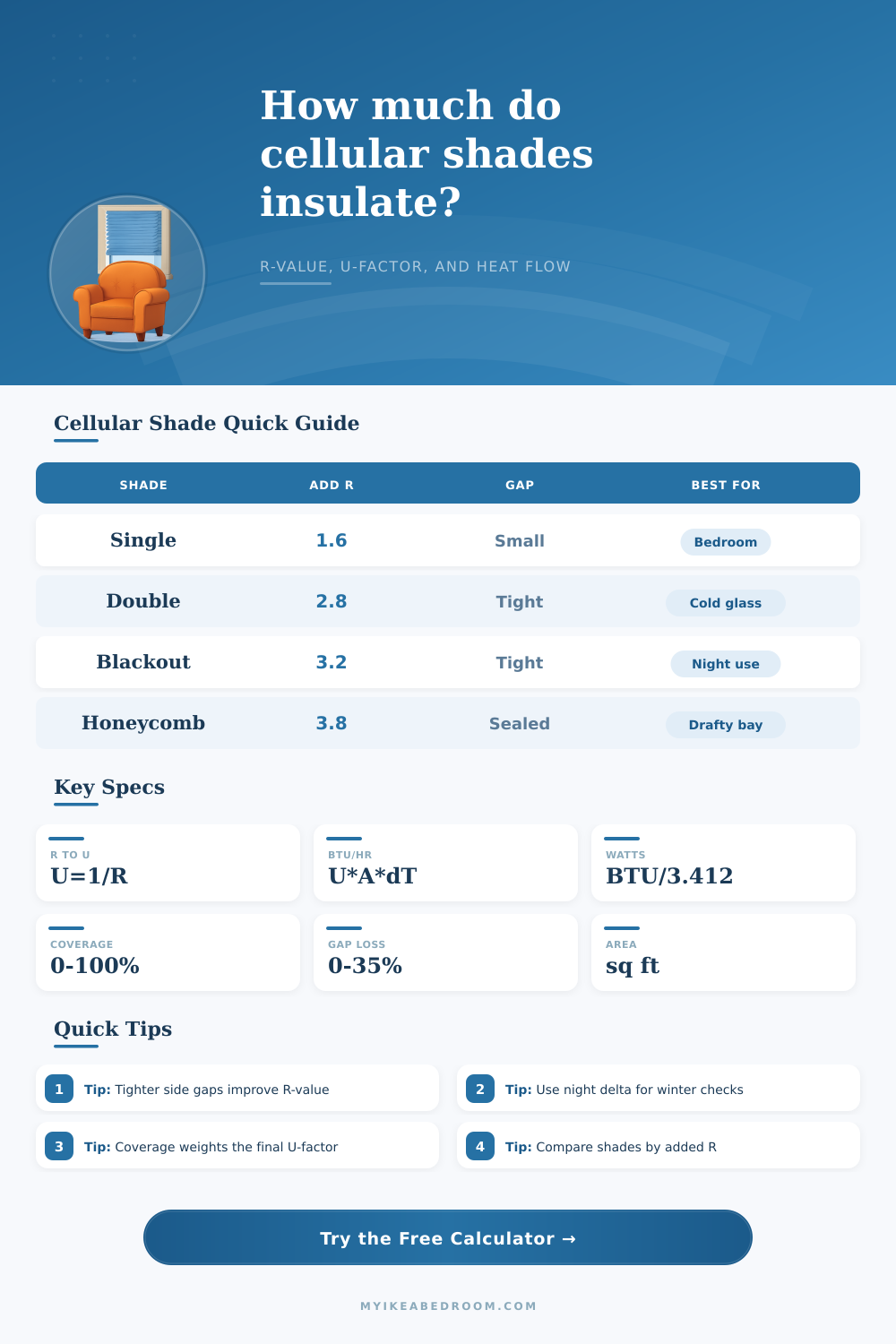
| Single-cell translucent | R-1.6 | Normal or tight | Simple still-air layer for modest improvement. |
| Single-cell room-darkening | R-2.0 | Tight inside mount | Denser fabric and lower air movement. |
| Double-cell light filtering | R-2.8 | Tight inside mount | Good balance for bedrooms and offices. |
| Blackout double-cell | R-3.2 | Tight or outside overlap | Often chosen for nighttime heat retention. |
| Deep honeycomb insulated | R-3.8 | Outside overlap | Higher cell depth improves air trapping. |
| Honeycomb with side tracks | R-4.6 | Tracked edge | Reduces side bypass and convection loops. |
| Mounting Gap | Shade R Multiplier | Bypass Effect | Use When |
|---|---|---|---|
| Tracked or sealed edge | 1.12x | Lowest bypass | Side channels or very tight edge control. |
| Tight inside mount | 1.00x | Low bypass | Shade edges sit close to the jamb. |
| Outside mount overlap | 0.92x | Moderate bypass | Shade overlaps trim but may project outward. |
| Normal inside mount | 0.86x | Moderate bypass | Typical bracket clearance around shade edges. |
| Loose side gaps | 0.68x | High bypass | Visible side gaps or uneven jambs. |
| Formula | Imperial Input | Metric Handling | Result Meaning |
|---|---|---|---|
| Glass R | R = 1 / U | Metric U converts to imperial U first | Baseline thermal resistance. |
| Covered R | Rglass + Rshade + Rfilm | Series resistance remains in imperial R | Insulated portion of window. |
| Effective U | Coverage weighted U | Converted back to W/sq m K display | Whole-window average after shade coverage. |
| Heat flow | U x area x delta F | Watts = BTU/hr / 3.412 | Conductive heat transfer estimate. |
The main reason to purchase window treatments is for privacy and light control. Is it insulation? That’s just some marketing hoo-hah, right? It is a slight exaggeration designed to upsell you, because it seem like overkill.
Turns out, cellular shades actualy can help retain heat, but under certain conditions. And those conditions has everything to do with how air flows around them. It’s not magic. It’s physics.
How Cellular Shades Save Energy
Still air between the window and outside world is a good insulator. Moving air isn’t. The math will work itself out by plugging in your own numbers to the calculator above. Plug in the temperature differential and your window size and let the calculator do the math for you. You do not need to convert units or guess what thermal coefficient mean.
This brings us to the biggest factor to consider: the mounting gap. Even the most expensive double-cell shade in the world won’t do its job well if it’s mounted loosely into window frame so that we can see huge gaps along the sides. Remember what I said about warm air rising and cold sinking? When your shade has open edges both at the top and the bottom, you create a convection loop: Warm room air escapes up the back of the shade and cold drafts slip down the front from the glass. That totally cancels out the R-value for which cells were engineered in the first place.
So, yes, that’s why it matters so much how tightly your shade fits. Either a tight inside mount or one with side tracks will seal off that air pocket and let insulation…well, actually do its thing.
Before we can talk about savings, let’s get to our baseline. Single-panes from the past are thermal black hole of windows. Their U-factor is like having the door wide open. Even a simple single-cell shade makes a huge difference on these windows since the relative improvement is so great. You’re going from essentially zero resistance (no window) to some resistance (window + shade).
On newer, low-e double and triple-pane windows, you’ve already got something pretty good for retaining heat inside. The extra benefit of adding a shade there is less, though still not zero, particulary when the difference between outdoor and indoor temperatures spikes during the coldest part of the night.
There are also variables, like the percentage of coverage, that people take lightly: I can’t say my shades is keeping this window insulated 24/7 if I leave them open all day so sunlight can filter in. This tool lets you assign what percent of time the actual shade was down. (meaning it is darker out).
So a blackout shade closed at night does better over the course of a winter season than one that’s translucent and left up most of the morning. Be truthful about your habits here. If you just close it when you’re sleeping, assign a percentage that reflects those eight or nine hour. It paints a much more realistic picture of the annual energy impact.
In brochures, people over-sell the difference between single- and double-cell construction, but in real life, it’s no small thing. A single cell traps one layer of air. A double cell traps two. Because there are now more layers of still air to penetrate, that cold radiating off the glass must travel farther before it enters your livig space. That makes a big difference if you live in an old apartment building whose walls is thin, or even if you’re in a drafty bay window. That second layer prevents the chill you experience while standing by a wall, although your thermostat read the room as “warm.”
People can become obsessed with the R-value as if it were a sure indicator of performance. In fact, window R-values is notoriously difficult to nail down. They vary by glazing type, frame material and installation quality. On our calculator, we make certain assumptions (which tend toward the standard) and give you an estimate. Use it to compare options, not to predict your electric bill to the penny. That’s why you use it to understand how much more heat each shade reduces in your particular setup.
In the end: Energy saving aside, the question of purchasing cellular shades is a matter of comfort. The math explains some of it. Standing next to the windows feeling warm instead of chilly explain the rest. Knowing something about the insulating properties of gaps in the air and coverage will allow you to know that hardware is doing its job.
You are really paying for a barrier between you and the chill outside, not just fabric. It is a barrier that should of been sealed.