💡 Ceiling focal-point planning
Ceiling Medallion Size Calculator
Balance room size, canopy diameter, fixture spread, ceiling height, and crown clearance so your medallion looks deliberate instead of undersized or crowded.
Preset rooms and fixtures
Each preset uses a real room-and-fixture scenario so you can jump straight to a practical medallion range.
Sizing inputs
Use the visible fixture width, and for a fan-light enter the motor housing or light kit spread, not the blade span.
Common medallion families
Reference tables
| Medallion | Canopy band | Fixture spread | Typical use |
|---|---|---|---|
| 10 in | 4-5 in | 12-18 in | Bath or hall flush mount |
| 12 in | 5-6 in | 16-22 in | Bedroom drum or compact semi-flush |
| 16 in | 5-6.5 in | 20-28 in | Breakfast nook pendant |
| 20 in | 5.5-7 in | 26-34 in | Dining pendant or fan-light housing |
| 24 in | 6-7.5 in | 30-40 in | Dining chandelier |
| 30 in | 6.5-8 in | 38-50 in | Foyer lantern or formal chandelier |
| 36 in | 7-9 in | 46-60 in | Tall foyer chandelier |
| 48 in | 8-10 in | 60-84 in | Great room or grand stair hall |
| Ceiling height | Adjustment | Visual read | Reason |
|---|---|---|---|
| 8 ft | -1 in | Tighter | Low ceilings need a crisper, less heavy ring. |
| 9 ft | 0 in | Neutral | This is the reference height for most stock medallion sizing. |
| 10 ft | +1.5 in | Airier | Extra wall height can carry a slightly larger ceiling feature. |
| 12 ft | +4.5 in | Formal | Taller rooms need more top-weight so the ceiling does not feel bare. |
| 14 ft+ | +7 in | Grand | Large ceiling fields can visually swallow small medallions. |
| Fixture type | Ratio | Use this spread | Read on ceiling |
|---|---|---|---|
| Flush mount | 0.90x | Trim or shade | Needs strong border because the fixture hugs the ceiling. |
| Semi-flush | 0.82x | Shade width | Balanced when the medallion is slightly smaller than the fixture face. |
| Pendant | 0.72x | Shade or bowl | Often reads best as a clean halo, not a full mirror of the shade. |
| Chandelier | 0.58x | Body width | Large chandelier arms already fill the field, so the medallion can step back. |
| Lantern | 0.66x | Lantern frame | Boxier fixtures need enough ring around the canopy to look anchored. |
| Fan-light | 1.25x | Motor or light kit | Ignore blades and size to the compact center mass instead. |
| Edge gap | Ceiling read | Good for | Note |
|---|---|---|---|
| 3 in | Tight | Small baths | Only use when the room is compact and the crown is light. |
| 4-6 in | Normal | Most rooms | This leaves a visible margin so the medallion still reads as a separate shape. |
| 8-10 in | Formal | Dining rooms | More field around the medallion helps larger rooms look calm and deliberate. |
| 12 in+ | Grand | Tall foyers | Large ceiling fields can keep generous negative space without looking empty. |
Comparison grid
Installation-minded tips
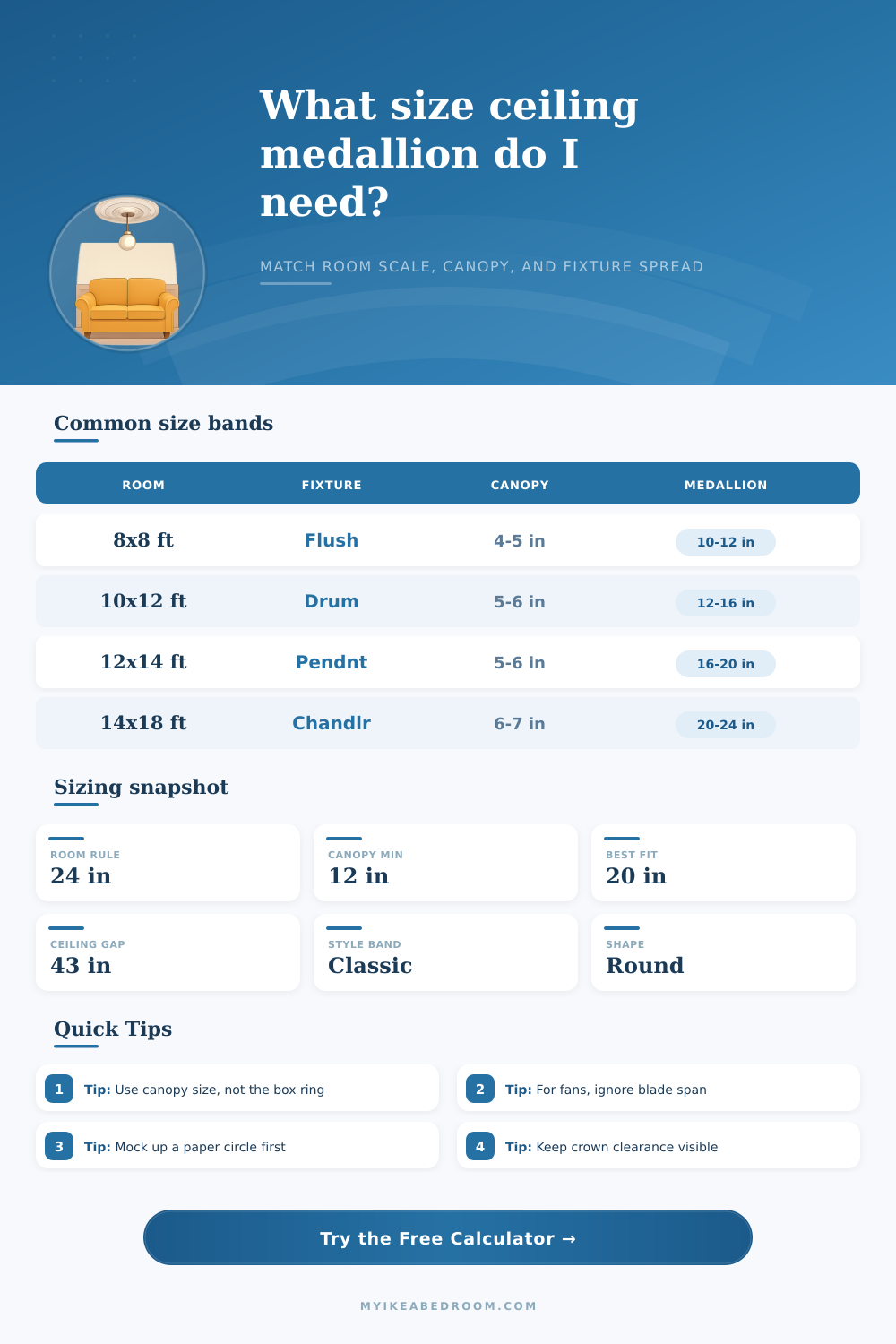
Paper mock-up first: Cut the recommended diameter from kraft paper and tape it up before painting. This catches oversizing fast, especially near deep crown or beams.
Measure the visible canopy: Use the diameter that stays exposed after trim rings and escutcheons are installed, not the ceiling box opening or mounting strap.
A ceiling medallion is a decorative element that is placed on a ceiling to frame a ceiling light fixture. When you purchase a ceiling medallion for your fixture, you must choose the correct size for the ceiling medallion. The size of the ceiling medallion will determine whether the ceiling medallion appear to be an intentional element of your ceiling or whether it appear to be incorrect.
If the ceiling medallion is too small for the ceiling, it will appear as if the ceiling medallion is dangling from the ceiling. Alternatively, if the ceiling medallion is too large for the ceiling, it will make the ceiling appear as if it is squeezed. In order to choose the appropriate size for a ceiling medallion, you must consider the relationship between the room and the ceiling light fixture.
How to Choose the Right Size for a Ceiling Medallion
More specificaly, the dimensions of the room will impact the size of the ceiling medallion that you should choose. Small rooms require small medallions and large rooms requires large medallions. To calculate the size of the ceiling medallion that should be used, you can add the length and the width of the room together.
In addition to the dimensions of the room, you can also consider the spread of the light fixture. The spread of the light fixture is the portion of the light fixture that is visible from the ceiling, and does not include the arms of the fixture or the blades of the ceiling fan. In addition to the dimensions of the room and the spread of the light fixture, you should also consider the canopy of the light fixture.
The canopy of the fixture is the portion of the fixture that touches the ceiling. The ceiling medallion should be wider than the ceiling fixtures canopy. If the ceiling fixture is too large for the ceiling, it will not allow the ceiling medallion to fulfill its purpose of framing the ceiling light fixture.
Additionally, you should also consider the drop of the ceiling light fixture. If the ceiling light fixture has a long drop, it will require a ceiling medallion that has more visual weight than a ceiling light fixture with a shorter drop. The height of the ceiling also has an impact on the appearance of the ceiling medallion.
If the ceilings are high in a space, it is possible that the ceiling medallion will need to be larger to help draw the attention of those viewing the ceiling. However, if the ceilings in the space are low, or if they have heavy beams, it may be better to choose a ceiling medallion with less visual weight. Additionally, it is also important to consider the architectural details of the ceiling.
For instance, if a ceiling features crown molding, you should consider the ceiling medallion in relationship to the crown molding. It should respect the lines of the molding, and should not overlap with the molding itself. Because ceiling medallions are available in standard sizes, it is possible that the size of the ceiling medallion that is calculated for a specific fixture will not be available for purchase.
For instance, if the calculation of the size of the ceiling medallion for the room indicates that 22 inches is the best size, it is also possible that the available sizes are 20-inch medallions or 24-inch medallions. When selecting among the available sizes of ceiling medallions, it is important to consider the available clearance between the ceiling medallion and the walls or ceiling trim. A clearance of four to six inches is the standard clearance between ceiling medallions and the walls of the room.
A four to six inch clearance will allow the ceiling medallion to remain visualy distinct from the walls of the room. One way of determining the size of the ceiling medallion prior to installation is to create a paper mock-up of the ceiling medallion. A piece of paper can be cut to the size of the ceiling medallion, and the paper can be taped to the ceiling.
You can then view the paper mock-up from a distance and up close to the ceiling to determine whether the size of the ceiling medallion is correct. If the ceiling appears too small from a distance, it may be necesary to purchase a larger ceiling medallion. If, however, the ceiling appears to be too large or it interferes with the ceiling trim, you should of purchased a smaller ceiling medallion.
Finally, prior to installation of the ceiling medallion, you should prepare the ceiling medallion for installation. If the ceiling medallion is a custom color, you should paint it prior to hanging the ceiling medallion. Additionally, a level can be used to ensure that the ceiling medallion is centered on the ceiling.
If the ceiling medallion is not centered on the ceiling, it will appear incorrect to those who enter the room.