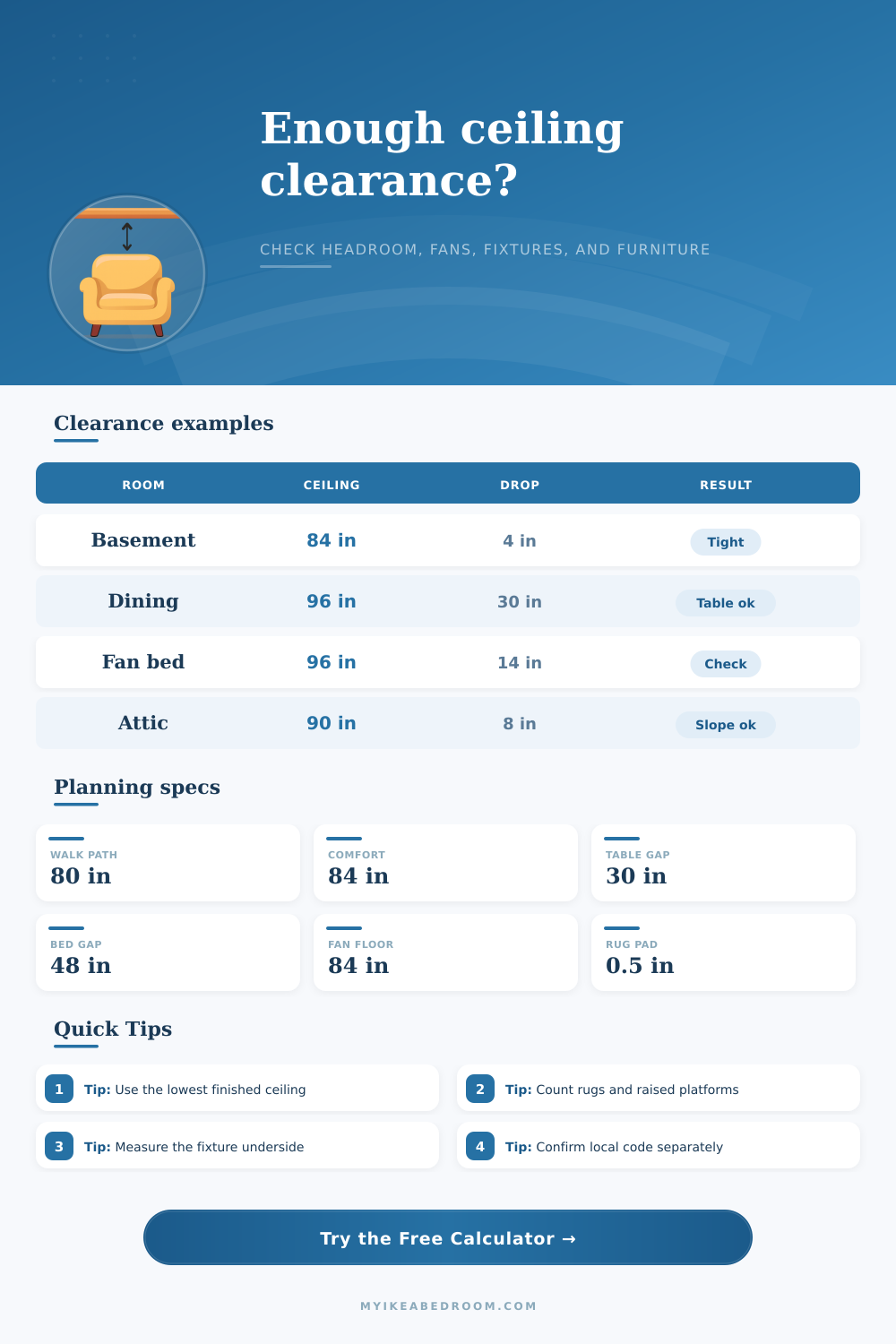
Ceiling Height Clearance Calculator
Plan finished ceiling headroom after fixture drops, fan blade depth, beds, tables, rugs, mats, raised platforms, and sloped ceiling reductions.
Choose a common room situation, then adjust the exact finished ceiling height and obstructions you measured on site.
| Zone | Minimum planning target | Comfort target | Use this when |
|---|---|---|---|
| Main walking path | 80 in / 203 cm | 84 in / 213 cm | People regularly pass under the ceiling or fixture. |
| Hallway approach | 80 in / 203 cm | 84 in / 213 cm | The fixture is near a door swing, closet, or room entry. |
| Occasional edge path | 78 in / 198 cm | 80 in / 203 cm | The low point is near a wall or infrequent traffic area. |
| Sloped attic low side | 76 in / 193 cm | 80 in / 203 cm | Only part of the room is at reduced height. |
| Item | Typical drop | Clearance check | Planning note |
|---|---|---|---|
| Flush mount light | 3-8 in | Underside to floor | Good for low bedrooms and basement ceilings. |
| Semi-flush light | 8-16 in | Underside to floor | Often tight below an 8 ft ceiling in walking paths. |
| Pendant over table | 24-36 in | Underside to tabletop | Usually evaluated above furniture, not as a pass-through. |
| Ceiling fan | 10-18 in | Blade sweep to floor | Check the lowest blade point, not the canopy. |
| Furniture zone | Typical height | Target gap above | What to watch |
|---|---|---|---|
| Dining table | 29-31 in | 30-36 in | Keep shades centered so no one walks into the pendant. |
| Bed mattress top | 22-30 in | 48 in or more | Consider sitting up, bedding loft, and fan blade sweep. |
| Upper bunk mattress | 55-65 in | 30-36 in | Measure guardrail height and the lowest ceiling point. |
| Desk or table lamp zone | 28-30 in | 24-30 in | Lower fixtures can work when they are outside head paths. |
| Scenario | Main deduction | Risk point | Best adjustment |
|---|---|---|---|
| Low basement bedroom | Rug plus flush light | Walking path margin | Use shallow fixtures and thin pads. |
| Pendant over dining table | Long fixture drop | Tabletop gap | Center over the table and avoid traffic lanes. |
| Ceiling fan over bed | Blade depth | Blade-to-floor height | Use low-profile fan hardware when possible. |
| Sloped attic | Low-point slope factor | Sidewall headroom | Keep paths at the taller portion of the room. |
Priority: floor-to-lowest-object clearance.
Use the strictest threshold because people move through it without looking up.
Priority: underside-to-tabletop gap.
A lower pendant can be comfortable when the table blocks the walking route.
Priority: sitting and blade clearance.
Include mattress height, bedding thickness, and the tallest person using the bed.
Priority: the lowest usable point.
The average ceiling height matters less than the exact path people use.
Measure finished surfaces: Include carpet, rug pads, exercise mats, platform floors, dropped ceilings, fan downrods, shade glass, and the lowest point of a sloped ceiling.
Use this as a planning estimate: This calculator helps compare layouts before buying or installing. Always confirm product instructions and local building requirements before final work.
Ceiling heights clearance is an important measurement for a person because it determine how much space there is for a person to move in the room. If a person enters a room with fixtures that hang too low from the ceiling, then the height of the ceiling will appear more smaller than the square footage of the room. The ceiling clearance calculator must measure the height of the ceiling to include any obstruction in the ceiling to the height of the ceiling, such as rug, slopes, and dropped ceiling.
The person using the calculator will first enter the finished ceiling height of a room as the first entry. The finished ceiling height include any drywall, beams, or soffits that are dropped into the ceiling to increase the height of the room. After entering the finished ceiling height, the calculator will ask for the height of any object that hang downward from the ceiling.
How to Measure Ceiling Height and Clearances
For instance, if the height of a pendant light is 30 inches from the ceiling, that will reduce the overall height of the ceiling. If the height of a ceiling fan is 14 inches from the ceiling, that measurement will reduce the height of the ceiling. Each of these objects must be specifically measured to ensure that the height of the ceiling are not guessed.
The rug and platforms that are located within the ceiling will also reduce the height of the ceiling. For instance, if the rug has a rug pad that is 0.5 inches thick, that will reduce the height from the floor to the ceiling by 0.5 inch. Similiarley, if the bed raise the mattress off the floor, that raises the mattress from the ceiling.
These deduction from the ceiling have the same effect upon the ceiling as the additions of the floor. Finally, if the ceilings of a room is sloped, those slopes will reduce the height of the ceiling; they will remove inches of space from the sidewalls of the ceiling. The furniture gap target will tell you which of the two surface is the most important for your scenario.
Based off the importance of each of the surfaces, the calculator will report to you the headroom that will be available in the space, the clearances that the fixtures will need to the floor, and the comfort of the space. Many people does not discover the importance of headroom and fixture clearances until they have installed some of their furnitures and fixtures. For instance, someone might install a fixture or a bed into the room and then discover that the fixture or bed create a problem in terms of clearances for the space.
It is for this reason that it is important to utilize the calculator in the early stages of designing your space to adjust for the installation of some of the fixtures. For instance, a decorative pendant might look good in the room but might prevent those walking through the space from using that portion of the lane as a walking space. Local building code will be important in determining the ceiling height requirement for the space.
While the planning threshold box will allow you to ensure that your measurements will meet the common target of eighty inches, the calculator will only provide an estimate of the headroom that will be available. Actual measurement of the space and an inspector will be required to ensure that the room will meet all local code. However, using the calculator will help to prevent individuals from purchasing the material that they will need for the installation of the fixtures.
The tables located on the page will provide context for the measurements that will be made in the space. For instance, one of the tables might include measurement for the height of a flush mount light fixture in a bedroom or the height of a ceiling fan that may be installed in a bunk bed. While these numbers will still need to be entered into the calculator, these tables will help individuals to understand the clearances that will be made by the fixtures in there room.
Because most room have very little margin for error, the addition of furniture and fixtures can quickly reduce the ceilings in many rooms. For instance, an eight-foot ceiling may appear to provide plenty of headroom for the inhabitant of the room; however, after the placement of a rug, a light fixture, and the height of the individuals that will occupy the space, the headroom may be quite limited. Considering the limited headroom that might exist after the installation of some of the furniture, it might be more comfortable for individuals to use a lower-profile ceiling fan or rug pad.
While the calculator will not design the room for the individual, the calculator will ensure that the calculation are accurate so that the individual can make an informed decision regarding the placement of the fixtures in the space.