🏗 Ceiling Framing Calculator
Calculate joist count, lumber linear footage, and total board feet for any ceiling framing project
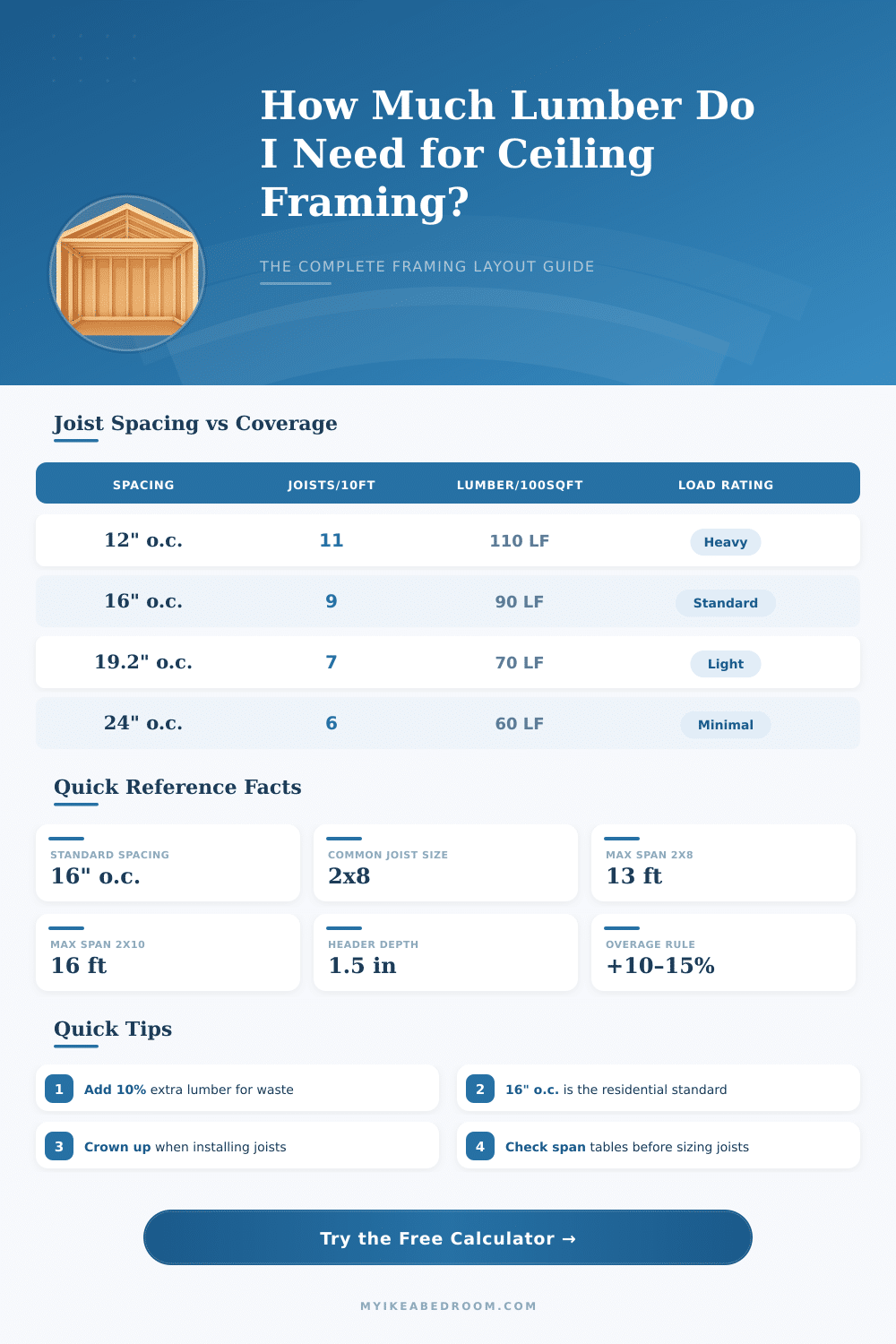
| Spacing (o.c.) | Joists per 10 ft | Joists per 20 ft | Metric (300 cm) |
|---|---|---|---|
| 12" | 11 | 21 | ~12 (25 cm o.c.) |
| 16" | 9 | 17 | ~10 (40 cm o.c.) |
| 19.2" | 7 | 14 | ~8 (48 cm o.c.) |
| 24" | 6 | 11 | ~7 (60 cm o.c.) |
| Joist Size | 12" o.c. | 16" o.c. | 24" o.c. |
|---|---|---|---|
| 2x6 | 11' 4" | 10' 4" | 9' 0" |
| 2x8 | 15' 0" | 13' 7" | 11' 10" |
| 2x10 | 19' 1" | 17' 4" | 15' 1" |
| 2x12 | 23' 3" | 21' 1" | 18' 4" |
| Spacing | Lin. Ft / 100 sq ft | Board Ft (2x8) | Board Ft (2x10) |
|---|---|---|---|
| 12" o.c. | ~108 LF | 162 BF | 202 BF |
| 16" o.c. | ~82 LF | 123 BF | 154 BF |
| 19.2" o.c. | ~69 LF | 104 BF | 130 BF |
| 24" o.c. | ~56 LF | 84 BF | 105 BF |
| Room / Project | Dimensions | Area | Joists Needed |
|---|---|---|---|
| Bedroom | 12 x 14 ft | 168 sq ft | 11 |
| Living Room | 15 x 20 ft | 300 sq ft | 16 |
| Kitchen | 10 x 14 ft | 140 sq ft | 11 |
| Garage | 20 x 24 ft | 480 sq ft | 19 |
| Basement | 24 x 30 ft | 720 sq ft | 23 |
| Sunroom | 12 x 16 ft | 192 sq ft | 13 |
Ceiling framing is made of wood or metal bits that create the basic structure. This framework is necessary to support the ceiling materials. Before you hang drywall, you need a solid frame to keep it in place The framework works as a skeleton that holds the drywall and all planned fixtures, like lights or fans.
Ceiling joists are structural elements that support everything added to the ceiling. That includes drywall, lights, air vents, smoke alarms, security cameras and fire sprinklers. If there is another floor above, those joists serve for the upper floor and the bottom ceiling.
Ceiling Frame Basics
If there is a roof above, they not only hold the ceiling, but also help keep the roof edges and walls tied, so they do not sprlay outside.
There is a cheap, hat-shaped framing part that you use for furring ceilings and masonry walls. Some folks think to use hat channel, but adding more joists often seems a easier and much cheaper way. When you hang ceiling joists, it is good to consider a top-mount hanger.
If you must install HVAC systems and keep low ceilings, you can build a special frame for a drywall ceiling. Just find the joists in the existing ceiling to attach the new frame to them. One way is to build it as long but shallow walls, with two-by-four plates up and below and short studs between them, like a ladder.
Those are placed perpendicular to the ceiling trusses, with distance of sixteen inches between centers. To the bare sides you can add OSB boards to have a better surface.
Other option is to fix a ledger board on the concrete wall and hang two-by-sixes parallel to the existing joists. Steel studs also can work for ceiling framing when you hang drywall.
When a heavy load reaches a hundred pounds, you should open the ceiling and install support using two or more joists with several screws. You may need to strengthen the existing joists end to end after you remove the drywall. Openings in the ceiling frames usually allow access to take care of the air systems, heating or electrical parts.
Systems like the FRAMEALL Drywall Grid are ready systems for drywall ceilings, that you can install three times faster than the traditional way. Other option is the RigidX grid from commercial suppliers. It works as a heavy grid for ceilings and is installed the same way, hung by wires.
The bottom edges are around one and a quarter inches wide, and you only screw the drywall directly to them. The best way is build all walls full height and use joists of right size, always following the codes about insulation thickness.