Span, motor, speed, and runtime aware fan energy planning
Ceiling Fan Wattage Calculator
Estimate running fan watts, total fixture watts, current draw, and annual energy for bedrooms, suites, porches, lofts, and two-fan layouts without mixing in pricing.
Each preset rewires the room size, blade span, motor type, layout count, speed, and runtime so a quiet nursery setup does not inherit the same watt profile as an open loft or porch room.
| Blade span | Motor class | High speed watts | Typical bedroom use |
|---|---|---|---|
| 42 in | AC standard | 25-45 W | Nursery, office sleeper, compact guest room |
| 48 in | AC efficient | 24-40 W | Guest room, square bedroom, porch room |
| 52 in | DC quiet | 18-32 W | Most 11 x 13 to 13 x 15 bedrooms |
| 56 in | DC premium | 24-40 W | Primary suites and warm upper-floor rooms |
| 60 in | DC premium | 28-48 W | Lofts, taller ceilings, larger sleeping zones |
| 2 x 52 in | DC quiet pair | 36-64 W total | Long linked suites or studio sleep zones |
| Speed setting | Relative speed | Draw fraction | What it means |
|---|---|---|---|
| Low | 58% | 20% | Great for overnight circulation with a big watt drop |
| Medium | 76% | 44% | Often the best balance for steady comfort |
| Medium-high | 88% | 68% | Useful for warmer rooms or higher ceilings |
| High | 100% | 100% | Reference point for the fan motor ceiling |
| Motor type | Base CFM per watt | Standby | Best fit |
|---|---|---|---|
| AC standard | 90 CFM/W | 0.6 W | Budget replacements and classic pull-chain fans |
| AC efficient | 110 CFM/W | 0.5 W | Balanced option when DC is not required |
| DC quiet | 150 CFM/W | 0.3 W | Best overall bedroom efficiency and low noise |
| DC premium | 175 CFM/W | 0.3 W | Large spans, loft ceilings, and low watt goals |
| Room scenario | Area | Likely fan setup | Expected running watts |
|---|---|---|---|
| Small nursery | 90 sq ft | 42 in AC or 44 in DC | 14-24 W |
| Guest room | 132 sq ft | 48 in AC efficient | 20-32 W |
| Main bedroom | 168 sq ft | 52 in DC quiet | 18-28 W |
| Primary suite | 224 sq ft | 56 in DC premium | 24-38 W |
| Loft bedroom | 270 sq ft | 60 in DC premium | 30-46 W |
| Long studio zone | 320 sq ft | 2 x 52 in or 2 x 56 in DC | 40-70 W total |
Ceiling fan use electricity to move air in teh room. Knowing how ceiling fans use electricity can save you money on your electricity bill. Many peoples use ceiling fans while sleeping in their bedroom.
However, many people dont realize how the speed and type of motor in the ceiling fan can change the amount of electricity that the ceiling fan consume. The different settings on the ceiling fan will change the wattage of the ceiling fan that is being use. The size of the blades on the ceiling fan are another important factor.
How Ceiling Fans Use Electricity
The size of the blades will determine the amount of air that the ceiling fan can move in the room. Using a ceiling fan with small blade in a large room will force the motor to work harder to move the air in the room, using more electricity. Using a ceiling fan with large blades in a small room will create too much movement of air in the room.
The shape of the room can also play a key role in moving air with the ceiling fan. In a long room, two medium size ceiling fans will work better than a large ceiling fan. The type of motors for the ceiling fan can also change the amount of electricity that the ceiling fan uses.
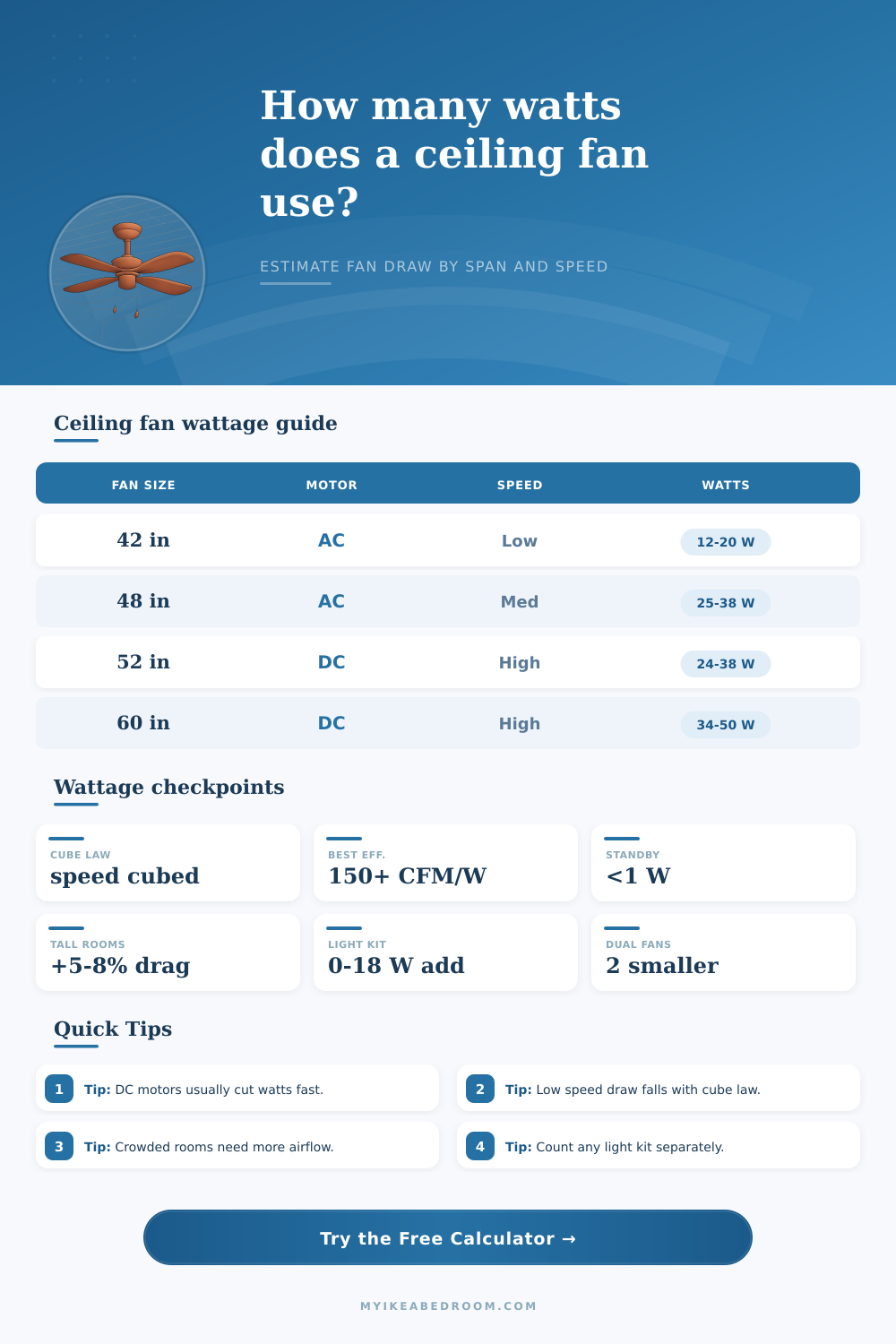
Old ceiling fans used AC motors. They are reliable but use more electricity then newer ceiling fans. Newer ceiling fans use DC motors that use less electricity and are quieter than AC motors.
Furthermore, the pitch of the blades can also affect the efficiency of the ceiling fan. Approximately 13 degree is the ideal blade pitch for ceiling fans to effectively move air in the room without create excess drag on the blades. Additionally, the light kit for ceiling fans are separate from the ceiling fan motor itself and will use a steady amount of electricity regardless of the speed of the ceiling fan.
The speed of the ceiling fan can also significant impact the amount of electricity that the ceiling fan will use. The cube law suggests that if the speed of the ceiling fan increase, the amount of electricity that the ceiling fan uses increases more significantly. Thus, if the fan is running at a high speed it will use much watts of electricity, but at a low speed will use very few watts of electricity.
For these reason, ceiling fans should of operate at a medium or low speed to minimize the amount of electricity use by the ceiling fan. Finally, the environment of the area in which the ceiling fan is used can also impact both the performance and electricity usage of the ceiling fan. For instance, rooms with tall ceiling will cause the air moved by the ceiling fan to move upward into the room, requiring the ceiling fan to move more air to provide comfort to those in the room.
Furnitures in the room can also create resistance for the air that moves through the room, again increasing the amount of load place upon the ceiling fan. Finally, because ceiling fans can help to reduce the use of air conditioning units in the room, the use of ceiling fans can save more electricity than just through reducing the wattage of the fans alone.