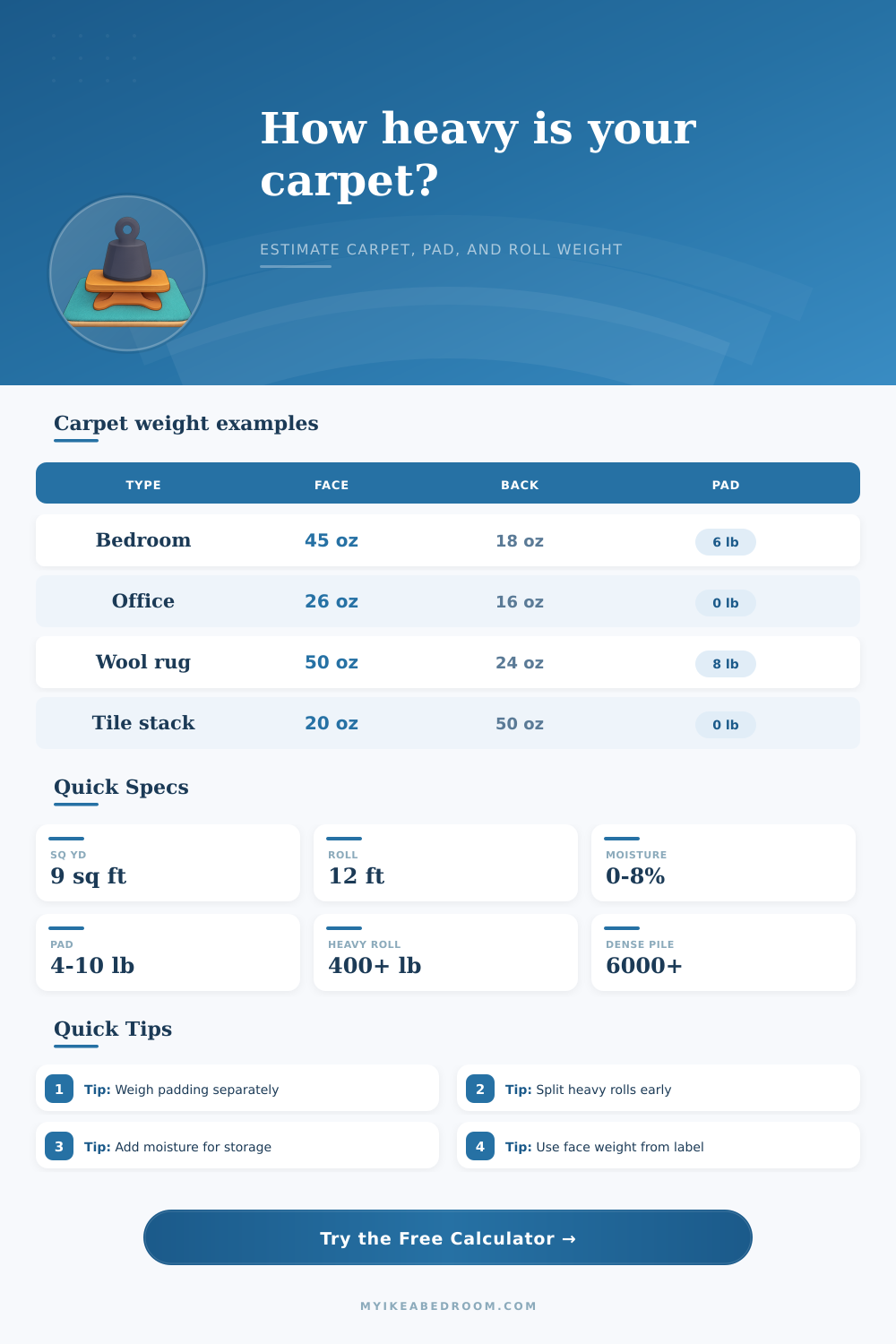
Carpet Weight Calculator
Estimate carpet-only weight, carpet plus padding weight, roll or piece handling weight, and weight per square yard from face weight, backing weight, pile density, moisture, roll width, and piece count.
Load realistic starting points for common bedroom, office, runner, area carpet, tile, and roll handling scenarios.
0 lb for pile, backing, allowance, and moisture.
Best for roll lifting when padding is carried separately.
0 lb including cushion layer by area and thickness.
Useful for room load and delivery planning.
0 lb when split across the selected piece count.
Use more pieces when stairs or tight turns are involved.
0 lb/sq yd with carpet layers only.
Compare broadloom, tile, and area carpet specs quickly.
| Carpet type | Face weight | Backing weight | Typical carpet-only weight |
|---|---|---|---|
| Light apartment or low-pile office carpet | 18 to 30 oz per sq yd | 14 to 20 oz per sq yd | 2.0 to 3.1 lb per sq yd |
| Standard bedroom plush or textured carpet | 35 to 50 oz per sq yd | 16 to 24 oz per sq yd | 3.2 to 4.6 lb per sq yd |
| Dense nylon, wool, or premium area carpet | 45 to 70 oz per sq yd | 20 to 32 oz per sq yd | 4.1 to 6.4 lb per sq yd |
| Carpet tile with bitumen, PVC, or heavy backing | 16 to 30 oz per sq yd | 45 to 90 oz per sq yd | 3.8 to 7.5 lb per sq yd |
| Pad density | Thickness | Approx pad weight | Where it is common |
|---|---|---|---|
| 4 lb per cubic ft | 3/8 in | 1.1 lb per sq yd | Light-use rooms and temporary installs |
| 6 lb per cubic ft | 7/16 in | 2.0 lb per sq yd | Bedrooms and general residential rooms |
| 8 lb per cubic ft | 7/16 in | 2.6 lb per sq yd | Heavier traffic rooms and dense cushion |
| 10 lb per cubic ft | 1/2 in | 3.8 lb per sq yd | Premium cushion and specialty padding |
| Roll length | Area | Light carpet | Heavy carpet plus pad |
|---|---|---|---|
| 6 ft cut | 8.0 sq yd | 18 to 25 lb | 45 to 70 lb |
| 12 ft cut | 16.0 sq yd | 36 to 50 lb | 90 to 140 lb |
| 25 ft roll | 33.3 sq yd | 75 to 105 lb | 185 to 290 lb |
| 50 ft roll | 66.7 sq yd | 150 to 210 lb | 370 to 580 lb |
| Density rating | Read as | Weight clue | Handling note |
|---|---|---|---|
| Under 2500 | Looser or taller pile for its face weight | May feel bulky without being very heavy | Rolls can be large but manageable by weight |
| 2500 to 4000 | Typical residential range | Balanced pile height and yarn weight | Check pad weight before carrying together |
| 4000 to 6000 | Dense residential or commercial pile | More fiber weight in each square yard | Split long cuts for stairs or corners |
| Over 6000 | Very dense pile or short heavy construction | Compact but heavy for its area | Plan smaller pieces and clear pathways |
Separate product weight from handling weight. Face weight and backing weight describe the carpet by square yard, while padding, moisture, and cut allowance change what actually gets carried into a room.
Use piece count to test safer splits. A full 12 ft wide roll can look manageable by area but become awkward at corners, stairs, elevators, or narrow bedroom doorways.
When you are preparing to move carpet, you must understand the weight of the carpet that you intend to move. The weight of the carpet is often underestimate by those that are preparing to move carpet. Many individual understand the square footage of the carpet that they will be installing, but many individuals dont understand the weight of the carpet once it has been cut and carried.
As a result of this underestimation of the weight of the carpet, individuals often experience some difficulty during the moving of the carpet. The calculator will handle the math for you. The calculator will assist you in avoiding guesswork in regard to the total weight of your carpet installation.
How Much Will Your Carpet Weigh
The calculator will show the results of splitting a roll into multiple piece, as well as the results of adding a moisture allowance to the total weight of the carpet installation. Each of these variables can become a difficult task for the carpet mover if you are not aware of these variables and the way in which they can impact the installation of the carpet. The total weight of the carpet is comprised of the face weight and the backing weight of the carpet.
The face weight of the carpet is the weight of the pile of the carpet that is walked upon, as well as the total weight of the backing of the carpet. The backing weight consist of the primary and secondary fabric of the carpet. The combined weight of these two component is the weight of the carpet (excluding padding) that will be delivered to the installation site.
Carpet weights range from 30 to 60 ounces per square yard for residential area. Commercial loop carpets will often weigh less than wool area rugs. The weight of the padding will additionally add to the total weight of the carpet installation.
The density and thickness of the padding will determine the additional pound of the carpet installation. The calculator will calculate this measurement. Densities will add one or two additional pounds of weight per square yard.
This additional pound will make it more difficult to move the carpet up stairs. Moving the carpet may reveal another difficulty in that a single long piece of carpet may be difficult to turn around a corner. If you use the calculator to split the carpet into multiple pieces, it will calculate the weight of each individual load of carpet.
Cutting the carpet into smaller loads will make it easier to move the carpet through the doorway. This will avoid tearing the carpet, as well as make it easier on the individuals who must move the carpet. Another important variable is the moisture weight of the carpet.
Even a small percentage of moisture will add to the weight of the carpet. The calculator will apply the percentage of moisture to the total weight of the carpet, after the allowance for cutting the carpet into individual loads. This additional calculation will allow you to understand the total weight of the carpet that will be delivered to your location, and will allow you to avoid surprise by the weight of the carpet.
Another factor that may impact the total weight of the carpet is the cut allowance. Carpet that contains specific patterns may require cuts to be made along the edges of the carpet to allow the carpet to completely cover the area. Additionally, any carpet that must cover stairs or closets will require some extra material to be cut from the carpet to account for these areas.
The percentage of carpet that may be wasted during installation will change the total weight of the carpet that will be delivered; any change in the percentage of waste will impact each of the total weight estimates for the carpet installation. You can use the reference tables to compare the weights of two different types of carpet. The tables will allow you to determine the weight of carpet prior to installing it in your desired area.
For instance, a light office carpet will weigh more less than a dense wool rug. The carpet choices require some tradeoffs between weight and other features of the carpet. For instance, a carpet that weighs more may feel more luxurius when walked upon.
However, it may also be more expensive to install the carpet due to the increased weight. Conversely, a carpet that weighs less and features thin padding will be less expensive to deliver to the installation site. However, it may wear more quickly in high traffic area of the residence.
The width and length of the carpet rolls may impact the carpet installation process. The width of the carpet roll is usually 12 feet for broadloom carpet. The calculator will output the length of the carpet roll, based off the width that you choose for your carpet roll.
This will help you purchase the carpet from the supplier. The density of the carpet pile may increase the weight of the carpet. If the carpet features a high density of carpet fiber, the weight will be higher for the same size of carpet area.
The calculator will allow for you to enter the density of the carpet pile, as well as the measurements of the carpet that will result in that density. Each of the outputs of the calculator can be used individually. However, they are most effective if used together.
For instance, the weight of the carpet alone will tell you the weight of the carpet when the padding is separate from the carpet. The total combined weight will allow you to understand the total weight of the carpet installation after the padding has been installed in the carpet. The per-piece load will allow you to determine if you will need additional individuals to move the carpet up stairs.
Additionally, the weight of the carpet per square yard will allow you to compare two different products to determine which carpet will have the most desirable weight. For most individuals, carpet is a relatively infrequent home renovation. As such, it may be difficult for individuals to understand the process of installing carpet.
Many individuals tend to focus upon the color and price of carpet. The weight of the carpet is another factor that can impact the movement of the carpet from the delivery truck to the individual’s home. Before the carpet is delivered to the residence, the individual should measure the area for carpet twice.
Additionally, they should account for the padding that will be placed underneath the carpet and the cut allowance for the area.