Car Lift Ceiling Height Calculator
Estimate whether your garage ceiling can safely support lift travel, vehicle height, hood-open checks, and overhead obstructions before purchasing or installing a lift.
Garage presets
Lift and vehicle inputs
Clearance breakdown
Breakdown updates each calculation.
Lift mode comparison
Reference tables
| Lift type | Work range | Ceiling goal | Best fit |
|---|---|---|---|
| Low-rise | 20-30 in | 9 ft+ | Detail bays |
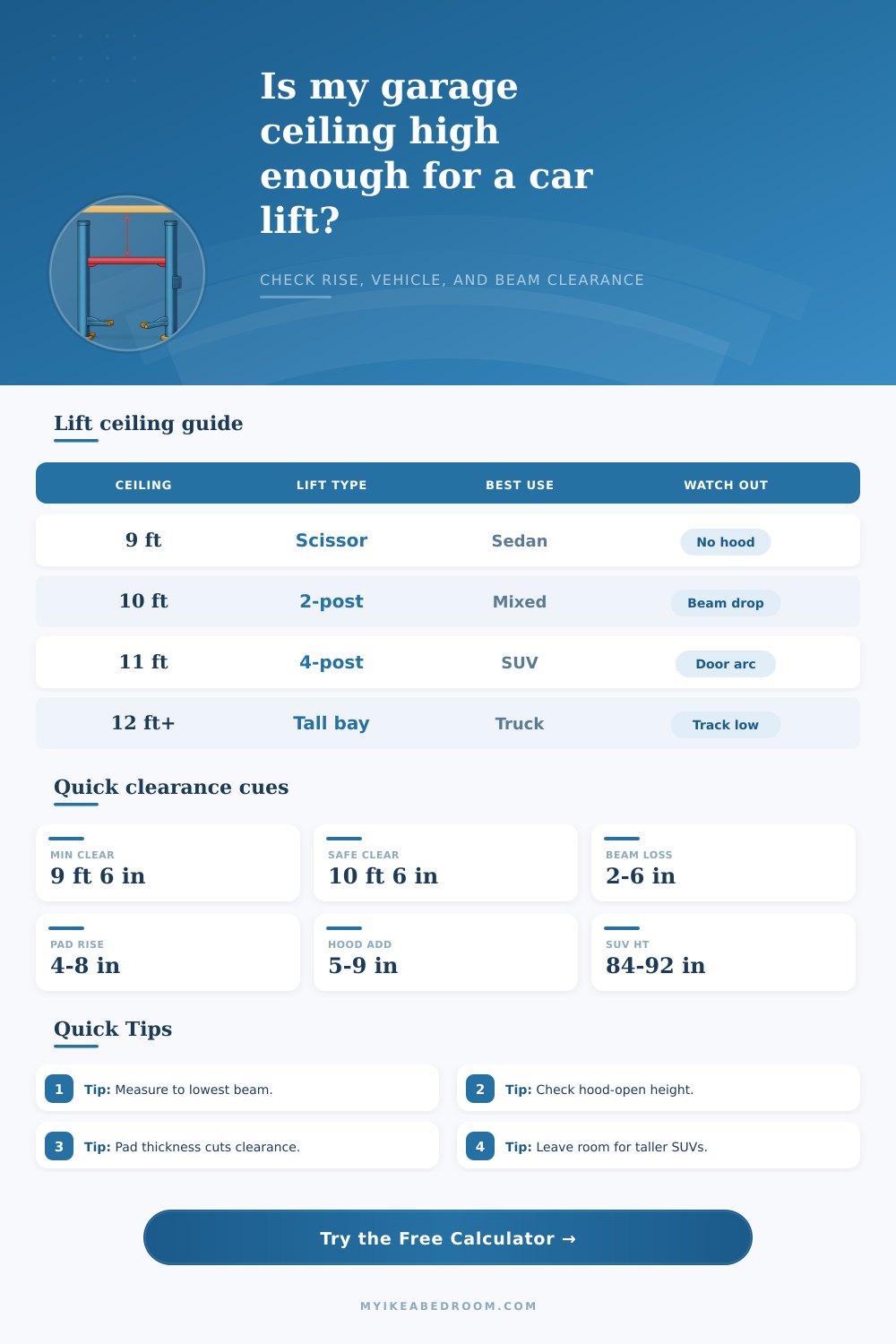
| Scissor | 40-55 in | 9 ft 6 in+ | Light svc |
| Two-post | 65-78 in | 10 ft 6 in+ | Daily svc |
| Four-post | 68-82 in | 11 ft+ | Storage |
| Class | Typical ht | Hood add | Planning note |
|---|---|---|---|
| Coupe | 52-57 in | 4-6 in | Most flexible |
| Sedan | 56-61 in | 5-7 in | Common target |
| SUV | 67-76 in | 6-8 in | Needs margin |
| Truck/van | 74-86 in | 7-10 in | High risk zone |
| Element | Loss band | Where seen | Action |
|---|---|---|---|
| Beam/soffit | 2-8 in | Old garages | Shift bay |
| Door track | 3-7 in | Sectional dr | Hi-lift kit |
| Opener rail | 4-10 in | Center line | Side mount |
| Pad/platform | 1-4 in | Lift base | Include math |
Planning tips
When installing a vehicle lift in a garage, the first thing that you must do is measure your ceiling to determine if the lift will fit. Many peoples tend to want to install a vehicle lift into there garage without considering the measurements of their garage ceilings. This can result in the vehicle and the vehicle lift hitting the ceiling.
There is a variety of different measurements that you must take into consideration when determining whether or not your vehicle lift will function corectly in your garage. The first measurement that you must take is the height of the vehicle that you intend to lift. The second measurement that you must take into consideration is the rise of the vehicle lift.
How to Measure Your Garage Ceiling for a Vehicle Lift
The rise is the distance that the lift travel from the ground to the highest point of the lift. This adds to the height of the vehicle that is being lift. The third measurement that you must take into consideration is the height of the hardware that is attached to the vehicle lift.
Any bar or platforms that is attached to the lift add to the height of the vehicle that is being lifted. In addition to these three measurements, you must also consider any obstructions in your garage. Obstructions in the garage that you must consider include the ceiling joists, the support beams, and the garage door tracks.
For instance, if there is a ceiling joist or a garage door track in your ceiling, you must measure the distance from that structure to the vehicle rather than from the ceiling itself. Additionally, you must also consider the height of the hood of the vehicle. If you will be lifting the vehicle in order to work on the engine, the open position of the hood will add to the height of the vehicle.
If you dont account for the height of the hood, the vehicle may hit the ceiling when lift. To calculate the total height that will be required for your vehicle, you must add the height of the vehicle, the rise of the vehicle lift, the height of the hardware on the vehicle lift, and the height of the hood of the vehicle when in an open position. Compare that total height to the height of the ceiling of your garage.
If the total height is less than the height of the ceiling, then you will have a positive margin which indicate that the lift will fit in your garage. However, if the total height is higher than the height of the ceiling, you will have a negative margin which indicates that the lift will not fit in your garage. It is always best to include a safety buffer in these calculations in case for the sway of the vehicle or movement of the mechanic within the lift.
There are different types of vehicle lifts with different height requirement. For example, two-post vehicle lifts are common in garages and shops but require a minimum height of 10.5 feet because of the arms that extend out from the lift. Scissor lifts is another common type of lift but often used in areas with less room because they remain in close proximity to the ground.
Four-post lifts are often used for storing vehicles but must take into consideration the arc of the doors of the vehicles. Each type of lift have its own height requirements that you must consider before installation. Some of the common error include the failure to consider all of the dimensions of the garage.
For instance, people might measure the height of the ceiling but ignore the low points created by the beams. In some instances, people will plan for a specific size of vehicle but purchase a larger vehicle than they planned for. Additionally, you might also overlook the placement of garage door opener or ventilation ducts in the ceiling.
To avoid any issue, model the vehicle that you are considering lifting and take note of any protrusions in your garage. This will ensure that you can find the best fit for the vehicle lift that you require for your garage. You should of checked the heights twice.