Candle Wax Quantity Calculator
Estimate wax weight, fragrance oil, batch volume, and per-candle fill from vessel volume, wax density, fill line, fragrance load, and optional wick count.
✨Candle presets
📏Batch inputs
Wax batch estimate
⚖Wax density reference
📋Reference tables
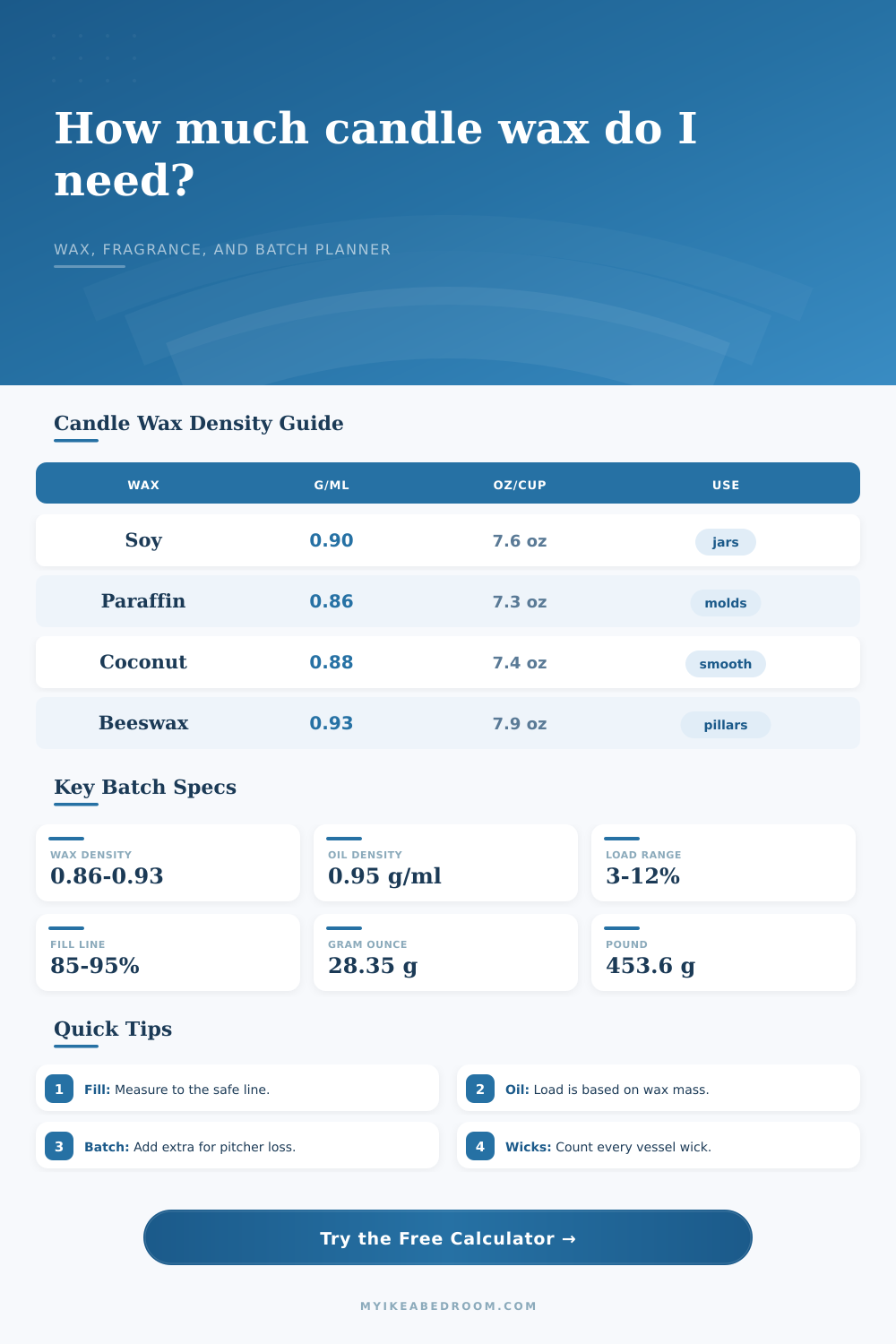
| Wax type | Planning density | Approx. g per 100 ml | Approx. oz per cup |
|---|---|---|---|
| Soy container wax | 0.90 g/ml | 90 g | 7.6 oz |
| Paraffin wax | 0.86 g/ml | 86 g | 7.3 oz |
| Coconut soy blend | 0.88 g/ml | 88 g | 7.4 oz |
| Rapeseed wax | 0.91 g/ml | 91 g | 7.7 oz |
| Palm wax | 0.89 g/ml | 89 g | 7.5 oz |
| Beeswax blend | 0.93 g/ml | 93 g | 7.9 oz |
| Gel wax | 0.92 g/ml | 92 g | 7.8 oz |
| Vessel style | Typical rim volume | 90% fill line | Common wick count |
|---|---|---|---|
| Tea light cup | 15 ml / 0.5 fl oz | 14 ml | 1 wick |
| Votive glass | 60 ml / 2.0 fl oz | 54 ml | 1 wick |
| Small tin | 120 ml / 4.1 fl oz | 108 ml | 1 wick |
| Straight jar | 180 ml / 6.1 fl oz | 162 ml | 1 wick |
| Large tumbler | 340 ml / 11.5 fl oz | 306 ml | 1-2 wicks |
| Bowl candle | 500 ml / 16.9 fl oz | 450 ml | 2-3 wicks |
| Fragrance load | Oil per 100 g wax | Oil per 1 lb wax | Planning use |
|---|---|---|---|
| 3% | 3 g | 0.48 oz | Light scent or testing |
| 6% | 6 g | 0.96 oz | Moderate container candle |
| 8% | 8 g | 1.28 oz | Common soy candle target |
| 10% | 10 g | 1.60 oz | Strong, if wax allows |
| 12% | 12 g | 1.92 oz | Only for compatible wax |
| Conversion | Metric value | Imperial value | Calculator use |
|---|---|---|---|
| Fluid ounce | 29.5735 ml | 1 fl oz | Vessel volume |
| Ounce weight | 28.3495 g | 1 oz | Wax and oil mass |
| Pound weight | 453.592 g | 16 oz | Bulk batch weight |
| US cup volume | 236.588 ml | 8 fl oz | Water test measure |
Calculator estimates are for quantity planning. Always check the wax maker's maximum fragrance load and leave safe headspace below the vessel rim.
💡Batch tips
The chart above shows how to calculate gram amounts by measuring size of your vessels. That way you don’t waste any wax and know exactly what amount is going to fill each jar.
Remember that weight is not the same as volume. For example, a hundred milliliters (mL) of water will weigh a hundred grams (g). But if you have a jar with a volume of one hundred mL and pour one hundred g of wax, it won’t fill the jar.
How to Calculate Wax Amounts
Here is the reason. Wax is less dense than water. Soy wax are approximately 0.90 grams/milliliter. Paraffin is less dense at 0.86 grams/milliliter.
When pouring a given amount of wax, the wax doesn’t fit tightly. There is actualy a dip or sunken pool of wax in the middle. Why? Because we didn’t take density into account when making recipe. To tweak the weight calculation, select your wax type from the tool.
You’ll need to take fragrance oil into account as well, because the oil increases both volume and weight of the batch. For instance, an eight percent fragrance load consist of eight grams of fragrance oil per one hundred grams of wax. That alters final combined weight of the mix. Without accounting for weight of the oil, it’s possible that you could exhaust your wax supply prior to filling the final jar. Keep this factor in mind if you’re scaling up your operation, say, from four candles to forty.
Then there’s wax lost to the spoon, thermometer, and pitcher. That’s what we call overage. Wax spread out in a thin layer everywhere it goes. By adding a ten percent buffer to your calculations (which is normal for smaller runs), you cover both spillage and wax sticking to stirrer. The calculator handles this buffer for you automaticly.
Now you can concentrate on pouring rather than wasting wax. Fill your jars less then all the way up. Wax expand when heated. If you try to fill the jar completely, the wax will spill over as it cools and shrinks.
Generally speaking, leave about five or so percent of headspace (eighty-five to ninety-five percent of the total volume of the container) so that the wax doesn’t form a crater after settling but still has enough space to settle down easy. Plus, it looks better that way too.
The table at right indicates how many ounces of wax should be used to fill various jar sizes. Use it to help you estimate what you’ll need instead of having to guess.
Not all waxes is equal. Not all oils have equal fragrance loads. Some hold more than others. For example, soy wax may be able to burn cleanly with eight percent oil. But perhaps 12% causes poor adherence to the glass or sooting.
You need to know what the fragrance load is in your particular blend of wax. That is why the calculator will allow you to change that percentage. But it won’t know if your wax can take that much load, that’s up to you after some experimentation and testing.
Making candles is a patient business. It’s precise work. The candle maker must manage everything from size of container to the amount of oil it holds and density of the wax itself. Learn this, and you’ll be able to predict the outcome of your next batch. Guessing becomes something of the past. Crafting is now in the present. Knowing what’s going on in that jar when you melt some wax and pour, makes it less of a hobby and more of a craft.