Candela to Foot Candle Calculator
Convert center-beam candela into foot-candles and lux using inverse-square distance, beam angle, aiming tilt, surface angle, fixture count, and unit system.
Load a common fixture scenario, then adjust candela, throw distance, beam angle, surface angle, and fixture count for your measured point.
Distance choice: Use direct fixture-to-point distance when you know the actual throw. Use perpendicular throw when you know mounting offset and tilt, because the calculator will lengthen the inverse-square distance.
Candela source: For directional fixtures, center-beam candela is not the same as total lumens. Candela estimates the bright point; beam angle helps estimate spread and approximate lumens.
To calculate the brightness of a surface, it is essential to understand the difference between lumen and candelas. Lumens measure the total amount of light that leaves a light fixture. However, candelas indicate how much of that light are directed in a specific direction.
Many people often confuse the lumens output of a fixture with the brightness of a specific surface. However, to calculate how many foot candles will reach a specific object, you must calculate the candelas of that object. Foot candles indicate how many candles is required to illuminate a specific area of a surface.
How to Calculate Light on a Surface
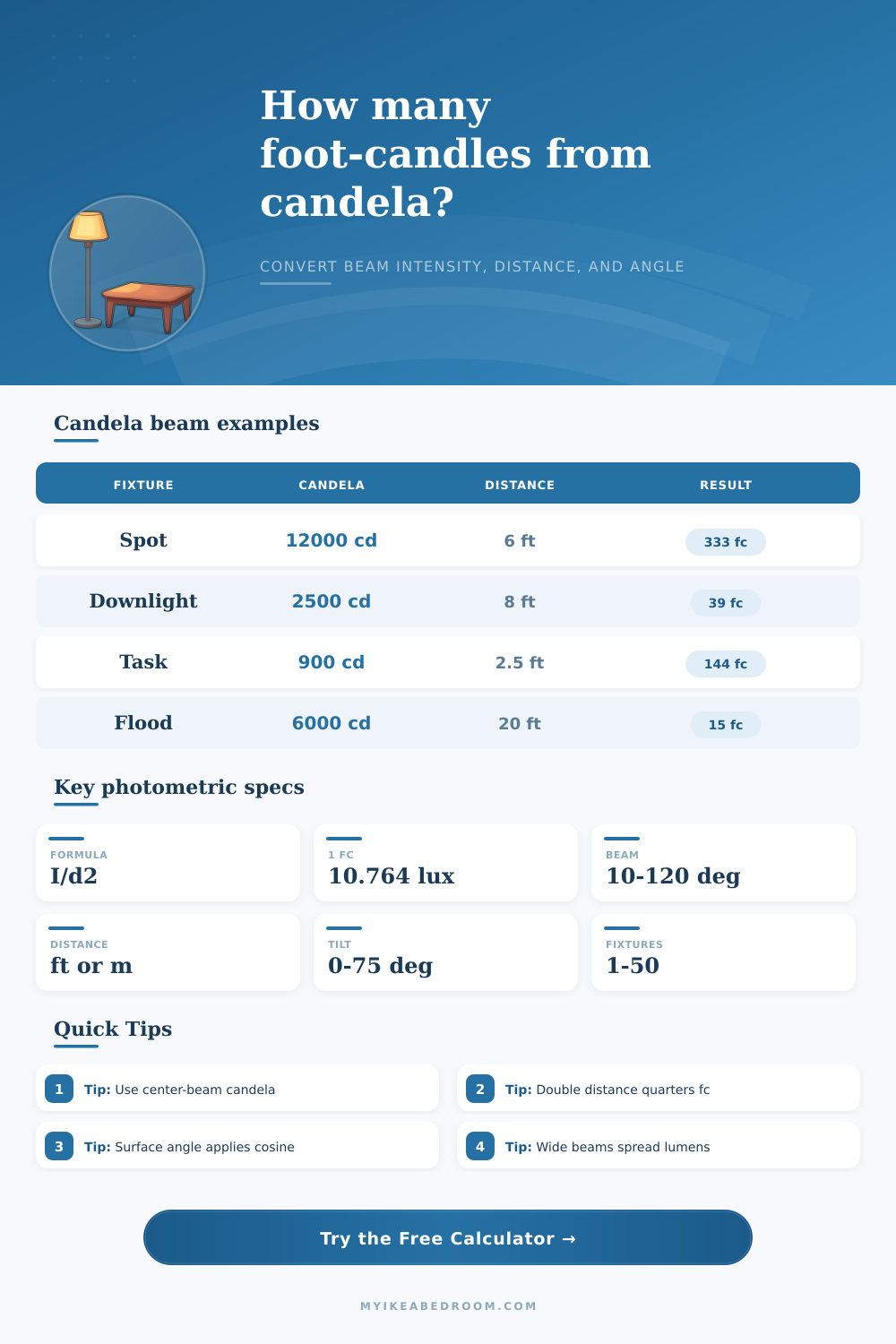
The intensity of light that shines on a surface will drastically change according to the distance between the light fixture and the target surface. This is referred to as an inverse square law. According to the inverse square law, if the distance between the fixture and the object is doubled, the intensity of the light will not halve.
Instead, the light intensity will decrease to one-quarter of the original amount. Based off this law, even the slightest movement of a light fixture will drastically decrease the amount of foot candles that will shine on the target. When calculating the distance between the light fixture and the target, it is essential to calculate both the direct distance and the perpendicular throw of the light.
The direct distance is the distance that the light travels. However, the perpendicular throw of the light is the distance from the light fixture to the target object. For instance, if a light fixture is tilted such that the light does not hit the target object perpendicularly, the light will travel a longer distance to the target object.
As the light travels a longer distance, its intensity will naturaly decrease. Thus, calculating the perpendicular throw of the light is a crucial measurement in lighting design. The angle at which the light shines on the target object will drastically change the amount of foot candles that land on that object.
If the light shines on the object at a 90-degree angle, the intensity of that light will be the highest. However, if the angle at which the light hits the object is smaller then 90 degrees, the intensity of the light will naturally decrease. This is referred to as the cosine correction in lighting design.
If a spotlight shines on a floor at a 30-degree angle rather than a 90-degree angle, it will produce more fewer foot candles. Another light measurement that will drastically change the number of foot candles a target object will receive is the beam angle. If a light fixture has a narrow beam angle, it will emit more foot candles onto a target object than a light fixture with a wide beam angle.
A narrow beam will emit the same amount of light into a smaller area then the light from a wide beam. This means that the beam angle determine the area that the light fixture will illuminate. In most lighting layouts, there will be more than one light fixture aimed at the same area.
The foot candles from each light fixture cannot simply be added together. The center of each beam of light is the brightest part of that light beam. Thus, the overlap of beams will have dim lights at the edges of those beams.
To account for this, an overlap factor will be used when calculating the total number of foot candles that will land on the target object. Using multiple light fixtures will help even out harsh shadows on the target object. However, the beams must overlap correcty to maintain an even number of foot candles on that area of interest.
Finally, another factor to consider in calculating the brightness of a surface is the loss of light over time. The lenses of light fixtures may become more dusty with use. Additionally, the light bulb naturally age over time.
Both of these factors will lead to a natural reduction in the intensity of the light fixtures. To account for this, a light loss factor can be used in the calculation of the number of foot candles that will land on the target object. For example, if the intention of the light fixture is to illuminate a target with ten foot candles on the first day of operation, the light may only provide eight foot candles after the light fixtures naturally age.
To account for this loss of light, it is better to plan for more foot candles than are necessary to illuminate the target area.