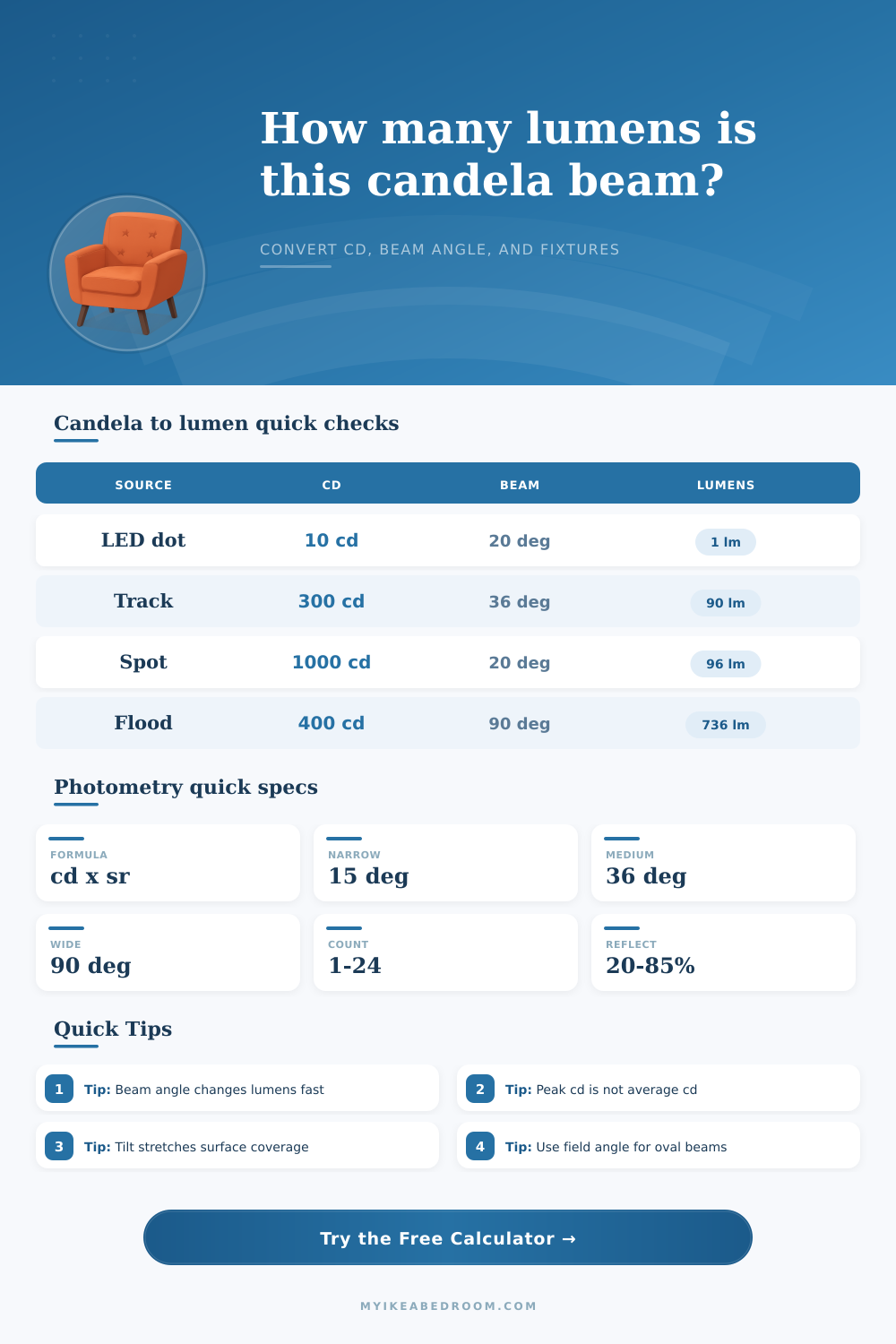
Candela to Lumens Calculator
Convert peak candela into estimated lumens using beam angle, beam shape, field angle, intensity distribution, fixture count, aiming tilt, distance, surface reflectance, and imperial or metric coverage.
Load a lighting example, then tune the candela rating, shape, beam angle, field angle, distance, count, and distribution to match your lamp or fixture data sheet.
Peak versus average: A candela rating is often the center beam peak. The distribution setting estimates how much lower the average intensity is across the beam.
Coverage check: Lumens do not depend on distance, but beam footprint and illuminance do. Use the distance field to compare spread on a wall, desk, floor, or ceiling.
Candela and lumens is two different measurements of light. You need to understand the difference between candela and lumens in order to determine how much light will land on the surfaces within your space. Candela measure the intensity of light in a specific direction.
However, it does not inform you of the total amount of light that the fixture will create. Lumens, on the other hand, measures the total amount of light that a fixture will produce. A fixture may emit a significant amount of candelas in the center of it’s beam; however, the narrow beam will emit less lumen than a fixture with the same candela rating but with a wide beam.
What Is the Difference Between Candela and Lumens
The beam angle for the fixture will have an impact on the relationship between candela and lumens. Therefore, you must take into account the beam angle when you calculate the total light that will land on your surfaces. The shape of the beam that a fixture emit will also have a bearing on the path that the light takes to the surface.
A circular beam can behave differently then an elliptical beam. An elliptical beam may behave differently from an asymmetric beam. The shape of the beam will determine the way in which the light covers the area of interests to you.
Furthermore, the shape will also determine how many lumens will be derived from the peak candela measurement of the beam. If the beam is tilted away from the surface of interest, the footprint of the beam will stretch to cover a larger area, but the average candela will decrease for the surface. You must account for the beam shape to ensure that your light fixtures do not create dark corners or bright spots that may be uncomfortable for the individuals who are within the area of interest.
The distance between the light fixture and the area of interest will also have a bearing on the light that falls on that area of interest. The total number of lumens that the fixture emit will not change with the increasing distance between the light and the area. However, the size of the area that is illuminated will increase with the increasing distance between the fixture and the area.
The illuminance on the area of interest will decrease with the increasing distance from the fixture. The light that will fall on the area at eight feet from the fixture will not provide the same amount of light per square foot on the area at twenty feet. Therefore, you must take into account the distance between the fixture and the area of interest when calculating the amount of light that will fall on that area.
Furthermore, the distribution of the light within the beam will determine how much light will reach the edges of the area of interest. Some light fixtures will emit light of even intensity from the center of the beam to the edges. However, other light fixtures will emit most of the light in the center of the beam.
If the light fixture emits most of its light in the center, the intensity will drop rapid towards the edges of the beam. A fixture may emit a high amount of candela. However, if the beam is designed to emit most of the light in the center, the average intensity of light that falls on the area will be low.
To calculate the light falling on the area, you should use the average intensity of the beam instead of the peak candela measurement of the light fixture. Another parameter that you should consider before calculating the total light that will fall on the area of interest in the room is the reflectance of the surfaces. Surfaces that have a high amount of darkness will absorb the light.
Dark surfaces will make the area of interest within the room appear dark. Surfaces that have a high reflectance of light will reflect the light back into the area of interest. These light reflecting surfaces will make the area appear brighter.
You should select the values of the reflectance for each surface according to the finish of each surface in the room. You must account for the reflectance of the surfaces to ensure that the lights are not either too bright or too dim for the area. Glare can be caused if the area includes a number of shiny object that will reflect most of the light from the fixture directly into the eyes.
When you calculate the total light falling on the area of interest in your space, you will have to use a multiplier in your calculation based off the number of light fixtures that you have. If you know the number of lumens that one fixture will emit, you can simply multiply that value by the total number of fixtures in your installation to calculate the total amount of lumens that will be emitted into the area of interest. However, you must make sure that the calculation for one fixture is correct.
Your total lumens will not be correct if you make an error in calculating the amount of light from a single fixture. Many people make the mistake of treating candela and lumens as if they represent the same value. A high candela rating for a fixture does not necessarily mean that the fixture will emit a large amount of light onto the area of interest.
However, you should treat these two values as separate measurements of light. The candela value of a fixture indicates where the light will be brightest. The lumen value indicates the total amount of light that the fixture emits.
By treating these two values separately, you can calculate the proper amount of light and brightness for your area of interest. You should of checked the lumen rating first. Its a common mistake, but you’ll recieve better results if you do.
Actually, the light fixtures is very important for the rooms size.