Cafe Shutter Height Calculator
Size the lower shutter tier for privacy, daylight, frame clearance, rail alignment, and louver spacing before ordering or templating panels.
📌Room Presets
Presets load common cafe shutter layouts and calculate immediately. Fine-tune the privacy line, frame type, and louver pitch to match your window.
⚙Height Settings
Cafe shutter height result
Enter your window dimensions to calculate a lower-tier shutter height.
📊Calculated Specs
📑Reference Tables
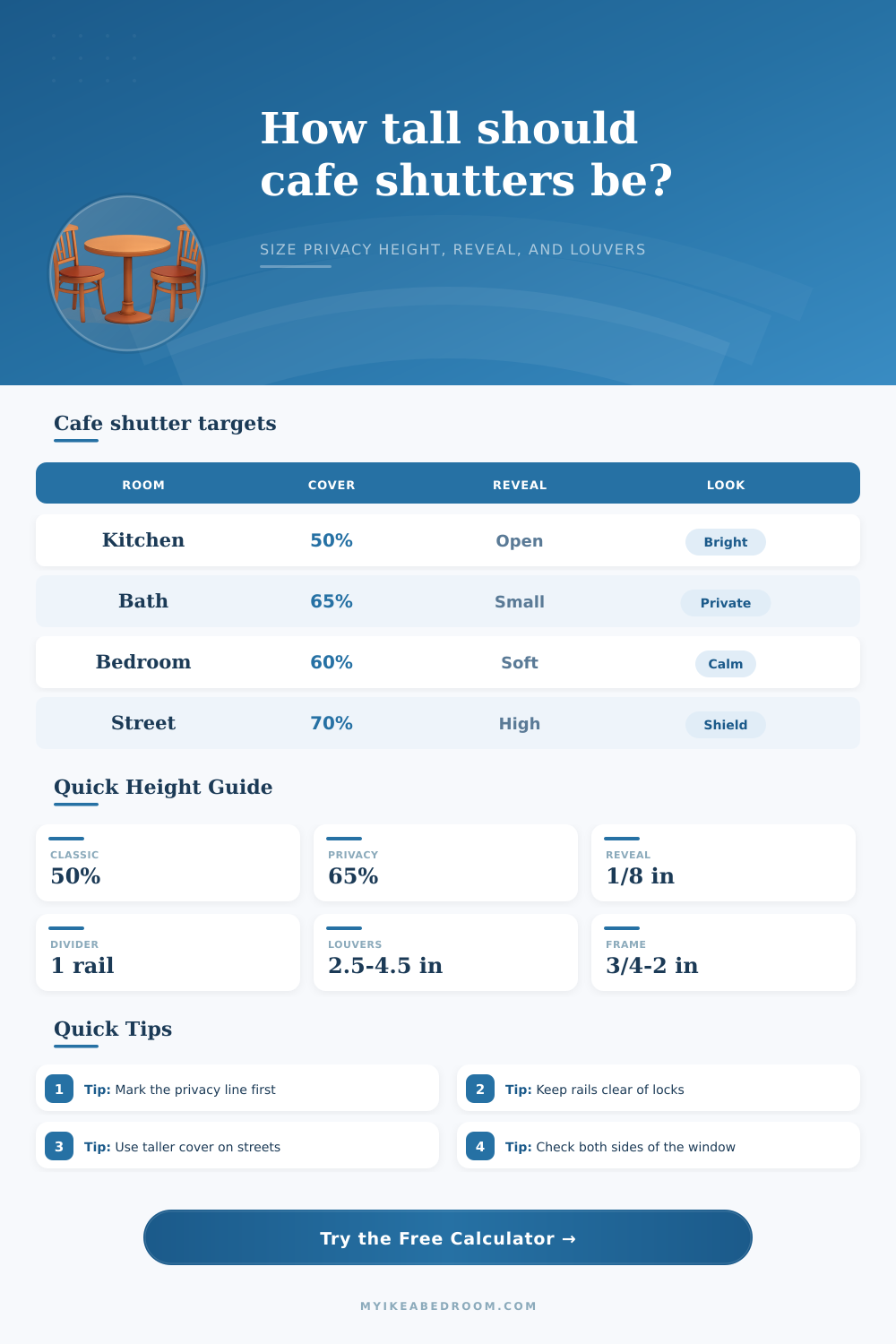
| Use Case | Target | Best For | Daylight |
|---|---|---|---|
| Classic cafe | 50% | Kitchens | High |
| Balanced privacy | 55-60% | Bedrooms | Good |
| Street privacy | 65-70% | Front rooms | Moderate |
| High cover | 70-75% | Bathrooms | Lower |
| Frame | Build Add | Clearance | Use |
|---|---|---|---|
| Inside L-frame | 1.50 in | 1/8 in | Square openings |
| Inside Z-frame | 2.00 in | 1/8 in | Small cover trim |
| Outside frame | 3.00 in | 1/4 in | Uneven returns |
| Frameless | 0.25 in | 1/8 in | Minimal reveal |
| Sill only | 0.75 in | 1/8 in | Simple cafe tier |
| Louver | Pitch | Look | Best Height |
|---|---|---|---|
| Traditional | 2.5 in | Detailed | Short panels |
| Balanced | 3.5 in | Classic | Most cafes |
| Wide view | 4.5 in | Open | Tall lower tier |
| Solid | No rows | Opaque | Maximum privacy |
| Window | Clear Height | Cafe Height | Reveal |
|---|---|---|---|
| Sink window | 36 in | 20-22 in | 14-16 in |
| Bedroom sash | 54 in | 31-34 in | 20-23 in |
| Street sash | 60 in | 39-42 in | 18-21 in |
| Tall window | 72 in | 40-48 in | 24-32 in |
💡Practical Tips
I don’t want my view blocked, but I also don’t want people looking in. The solution is cafe shutters that covers the bottom half of the window so you can still look out (the upper pane remains open), but no one on the street can see inside. Simple design, but it’s all about the height. Too high, and you block your own sightline. Too low, and there’s a gap through which someone across the street can look inside. The goal is to strike correct balance between transparency and opacity.
Half window height isn’t good enough. I know that privacy isn’t necessarily a matter of screening the entire window. It’s all about controlling sight lines. For example, if your kitchen sink is thirty-six inches off the ground and you’re sitting there, somebody walking down the sidewalk have no problem seeing over your hips. Generally, most folks think they have to go from the top of the window downward. That’s backwards thinking. What you have to do is measure upward from floor to where you naturaly look when using the space. Then you input those eye heights into the calculator and it does the math for you. This lets you know what you’d like to hide before buying any wood.
How to Choose the Right Cafe Shutters
Then there’s the frame itself: hinges have depth; wood shrinks; sashes doesn’t fit snugly on the jamb. A shutter ordered to exact height might gap in humid seasons or jam when weather gets drier. That’s where inside mount and outside mount come in. Inside mount needs careful measurements to fit the frame. Outside mount conceals irregularities of the wall but increases the shutter’s bulk outside. The tool takes those structural tolerances into consideration. It eliminates any guesswork about hinge gaps and clearance.
You should also consider louver size. A lot of DIYers don’t think about proportion, but that can be a big mistake: Small, two-and-a-half inch louvers on a tall panel look cluttered. Large, four-and-a-half inch louvers on a small panel looks unbalanced and heavy. You want to make sure your louver size matches the scale of the opening. Keep it airy by using wider spacing for taller lower tiers. Tighten up the pitch for smaller strips above a sink. This makes everything feel solid and finished, get the ratio right and you have design element instead of a barrier.
There’s also the matter of light. This gets overlooked till post-installation day too. Café shutters has an interesting effect on light. They filter it horizontally through slats, which shift their shadow as sun moves across the sky. On a south facing space, it can be gorgeous. In your west-facing home office, it could mean glare off your monitor. Think about the angle between the louvers and what you’re doing throughout the day. Do you need to hide from morning commutes or afternoon sun? The solution will change where you want privacy; sometimes by mere inches.
Shutter sizing is always a compromise. It involves trying to show something while hiding something else. There is no one size that fits all houses. You have to understand what dimension you’re working with. What is most important to you: Style, security, comfort? Pick one and the others falls into place. Figuring this out doesn’t require being a carpenter. It does mean knowing where your eyes will go in the space. Before ordering, take some time to tape off the line where your eyes would of rest. This simple step saves regret down the road.