Cabinet Handle Quantity Calculator
Plan knobs, pulls, screw sets, drilling marks, and spare hardware for IKEA kitchen cabinets, wardrobes, drawer fronts, and storage units.
🗄Choose a cabinet layout
🔧Handle count inputs
📊Project totals at a glance
🚪Real cabinet and drawer counts
| IKEA context | Typical fronts | Handle rule | Example handle count |
|---|---|---|---|
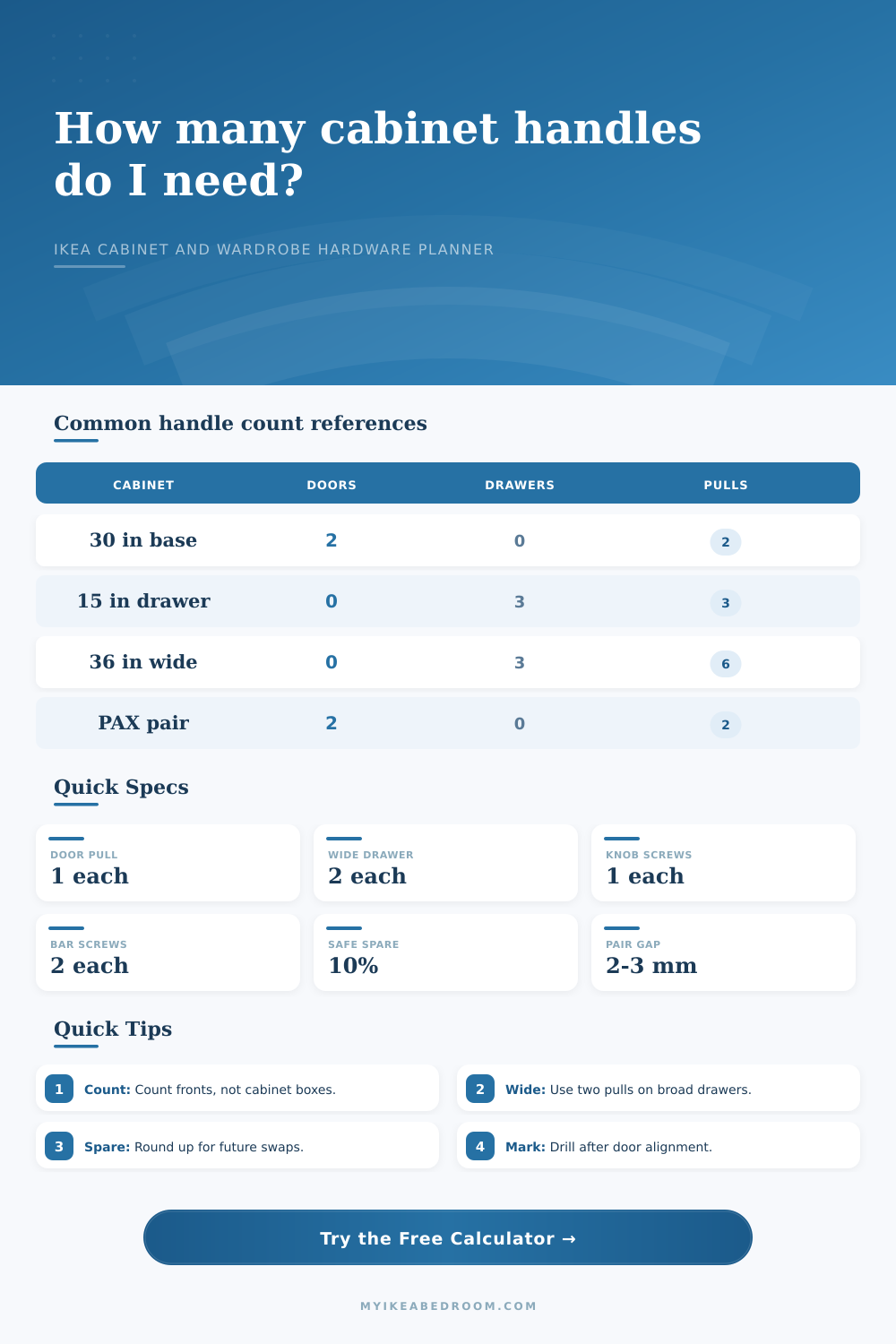
| SEKTION 15 in drawer base | 3 drawer fronts | 1 pull per drawer | 3 handles |
| SEKTION 30 in base cabinet | 2 doors | 1 pull per door | 2 handles |
| SEKTION 36 in wide drawer base | 3 wide drawers | 2 pulls per wide drawer | 6 handles |
| SEKTION 30 x 40 in wall cabinet | 2 doors | 1 handle near lower corner | 2 handles |
| PAX 39 in hinged wardrobe pair | 2 tall doors | 1 vertical pull per door | 2 handles |
| BESTA 47 in frame with doors | 2 doors or 4 fronts | Count visible fronts | 2-4 handles |
📍Handle and pull placement reference
| Front type | Common placement | Measured from | Count rule |
|---|---|---|---|
| Base cabinet door | Upper rail or stile corner | Top and opening side | 1 handle per door |
| Wall cabinet door | Lower rail or stile corner | Bottom and opening side | 1 handle per door |
| Tall pantry door | Comfortable standing reach | Opening side stile | 1 long pull per door |
| Standard drawer front | Centered horizontally | Front width and rail height | 1 handle per front |
| Wide drawer front | Two pulls balanced left and right | Quarter points or equal margins | 2 handles per front |
| PAX wardrobe door | Vertical pull near meeting edge | Opening side and floor reach | 1 pull per hinged door |
🔩Screw spacing and drilling reference
| Hardware style | Common spacing | Screws per handle | Planning note |
|---|---|---|---|
| Round knob | Single hole | 1 screw | Fastest replacement style |
| Short bar pull | 64 or 96 mm | 2 screws | Common for small drawers |
| Medium bar pull | 128 or 160 mm | 2 screws | Common for kitchen fronts |
| Long wardrobe pull | 192 or 320 mm | 2 screws | Good for tall PAX doors |
| Cup pull | 64 or 96 mm | 2 screws | Usually used on drawers |
| Edge pull | Varies by length | 2 screws | Check back-mount holes |
🏠IKEA cabinet and wardrobe contexts
| System or item | Fronts to count | Where errors happen | Calculator input |
|---|---|---|---|
| SEKTION base run | Doors, drawers, sink fronts | Forgetting hidden drawer fronts | Base doors and drawers |
| SEKTION wall run | Upper doors and glass fronts | Counting boxes instead of doors | Wall and tall doors |
| PAX wardrobe wall | Each hinged door panel | Missing paired wardrobe doors | Wall and tall doors |
| BESTA storage | Doors and drawer faces | Mixed push-open and pull fronts | Custom IKEA mix |
| GODMORGON vanity | Large horizontal drawers | Wide fronts needing two pulls | Wide drawer fronts |
| Bedroom dresser | All visible drawer fronts | Assuming one pack covers all fronts | Standard drawers |
So counting cabinet hardware should be easy, right? Wrong: Ikea’s products come in boxes; they don’t come with fronts. So you might buy a single thirty-inch base cabinet, but if it has two doors, you need two handles. This means you will need 2 handle. This little detail is where most people lose budget dollars when renovating their kitchen.
To understand these numbers, how they add up and what makes them work, you have to look beyond the product label. You must understand moving parts. Counting door panels as opposed to cabinet boxes was biggest trap. You might see what looks like a single piece of furnitures (like a wall unit) but if that wall unit have two doors (left and right), then you have two doors that require their own hardware.
How to Count Kitchen Handles
To account for this, the tool breaks apart wall/tall cabinets and base doors. It makes you think about openings, not units. This switch from thinking helps avoid embarrassment of being at the register in aisle holding five handles and realizing you actualy needed twelve.
The other thing that will change everything is width. Typically, narrow drawers takes a single centered knob or pull. But when a drawer front get wider than about 30 or 36 inches, a single pull just looks unbalanced and feels weak. Most designers will choose to have two pulls (one on each side) on wide drawers so they not only get good grip but also spreads out the weight.
Because doubling up here can really throw you for a loop, we has a special entry on the calculator for wide drawers. If you don’t account for it you may end up with fewer handles then you need; or worse, an unbalanced appearance.
Another quiet killer is screw spacing. Knobs are drilled into cabinets using one screw, whereas bar pulls require two. This measurement is called center-to-center. It should of match the pre-drilled holes in your cabinet fronts or where you plan to drill them. So if you purchase a pull that has ninety-six millimeter spacing, but your template is set for sixty-four, it won’t line up at all.
When you choose your hardware, the tool will help you track this by adjusting number of screws and drilling marks to match. And it isn’t just about looking good, it’s about whether the hardware physically attaches.
There is a spare pile. Hardware breaks. Screws strip. A pull gets dropped on a tile floor and shatters. That’s why it’s standard practice to have a ten percent buffer. Why would you wait two years for a single handle to be ordered based off a discontinued line after its finish no longer matches? Our calculator has an option called “spares” which rounds your total up to the next nearest multipack so you’ll have what you need for installation and repairs in the future.
Door hardware is typically placed in the corner of the door, inline with the stile (or rail) so it doesn’t block the opening. That means it is not centered on the face of the door. Drawer hardware is often center-aligned on its face. Mixing and matching without forethought results in a crazy looking kitchen. The layout is clear on the page in the reference tables, illustrating which types of fronts typically gets what sort of hardware. It’s little stuff, but important. Visual consistency pulls everything together.
All told, however, handles are less decorative than practical. They’re simply the thing that enables you to operate your storage. So get the number correct; there will be no mismatched finish, no last minute run to the store, no stripped-out hole when you try to cram in a handle too small for the space.
Respect the width, count the fronts, keep a couple spares in the drawer. It’s basic math. What saves you is the thinking.