Cabinet Door Overlay Calculator
Size cabinet doors and drawer fronts from the finished opening, overlay mode, reveal gap, face frame width, hinge overlay range, pair-door gap, and door count.
Start with a common cabinet layout, then adjust the measured opening and reveal values from your actual cabinet.
Overlay and clearance breakdown
These cards reuse your current opening, door count, pair gap, and face-frame inputs so you can compare inset, partial overlay, and full overlay at the same time.
Partial overlay
Width: 16 in
Height: 31 in
Uses the entered overlay per side.
Full overlay
Width: 17.25 in
Height: 32.25 in
Uses face frame minus reveal.
Inset
Width: 14.75 in
Height: 29.75 in
Subtracts reveal from the opening.
Drawer front
Width: 16 in
Height: 7 in
Applies the same horizontal overlay.
| Mode | Width formula | Height formula | Best use |
|---|---|---|---|
| Inset | (opening - 2 reveals - center gaps) / doors | opening - 2 reveals | Face-frame cabinets with visible frame around the door |
| Partial overlay | (opening + 2 overlays - center gaps) / doors | opening + 2 overlays | Traditional face-frame doors with exposed rails and stiles |
| Full overlay | (opening + 2(frame - reveal) - center gaps) / doors | opening + 2(frame - reveal) | Modern face-frame doors with small visible reveal |
| Frameless full | (opening + 2 overlays - center gaps) / doors | opening + 2 overlays | Euro-style boxes with concealed hinges |
| Hinge type | Typical overlay | Minimum gap | Notes |
|---|---|---|---|
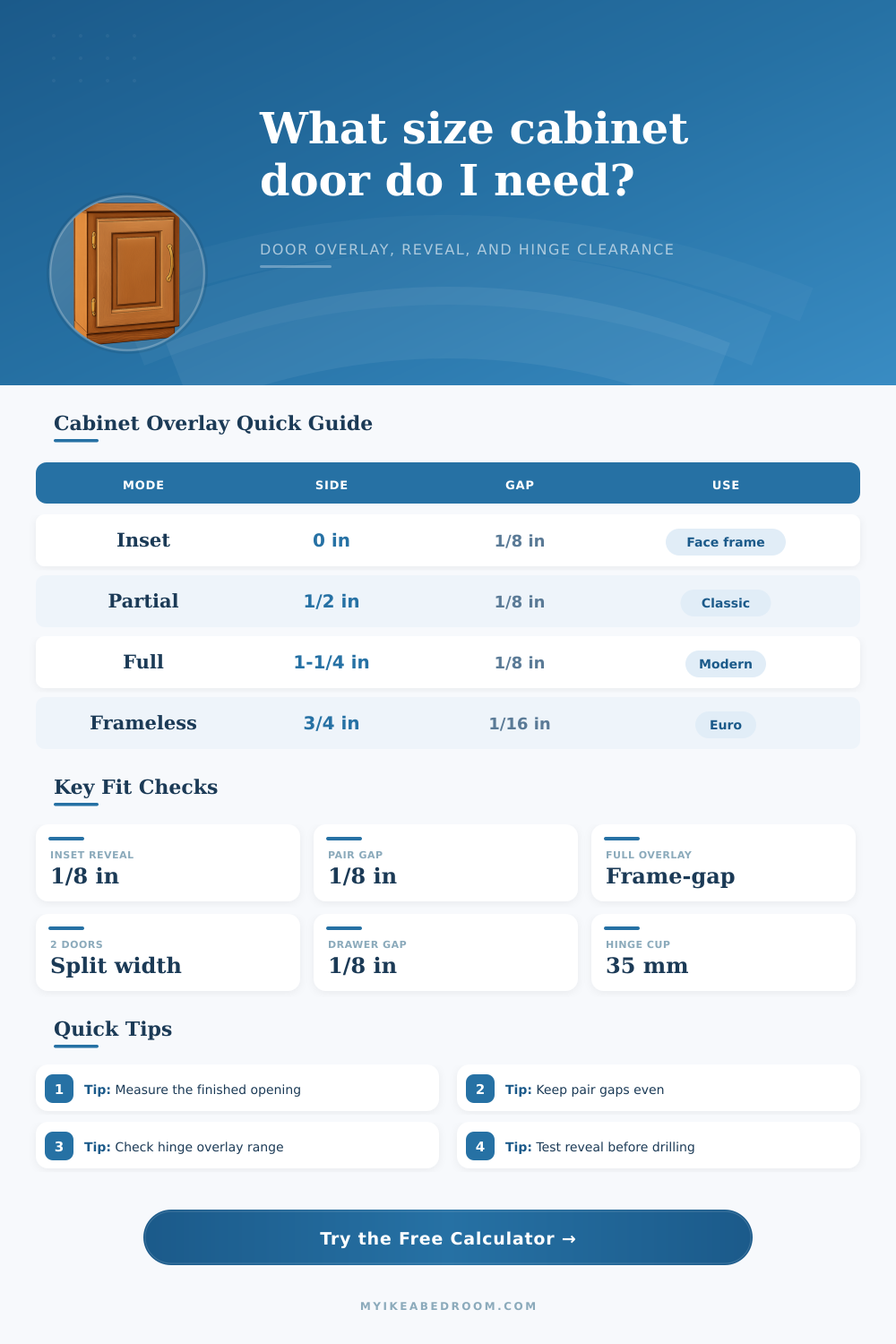
| Face-frame compact hinge | 1/2 in | 1/16 in | Common for partial-overlay shaker and slab doors |
| Face-frame full overlay | 1-1/4 in | 1/8 in | Check the hinge chart against stile width |
| Frameless full overlay | 3/4 in | 1/16 in | Often uses 35 mm cup hinges on cabinet sides |
| Frameless half overlay | 3/8 in | 1/8 in | Used when two doors share a partition |
| Inset concealed hinge | 0 in | 1/8 in | Reveal must be even around the door |
| Front count | Center gaps | Use this when | Check before drilling |
|---|---|---|---|
| 1 door | 0 center gaps | Single base, wall, or pullout opening | Wall-side swing clearance |
| 2 doors | 1 pair gap | Wide wall, base, vanity, or pantry opening | Meeting stile alignment |
| 3 fronts | 2 stack gaps | Equal drawer stack or appliance panel fronts | Rail line spacing |
| 4 fronts | 3 stack gaps | Tall drawer bank with equal faces | Consistent reveal from top to bottom |
| Drawer layout | Width rule | Height rule | Reveal focus |
|---|---|---|---|
| Drawer front only | Same as door width formula | Opening height plus overlay, or inset minus reveal | Top and bottom lines |
| Drawer above door | Same cabinet width as the door | Drawer height is calculated separately | Gap between drawer and door |
| Equal drawer stack | Usually one front per opening width | Total front span minus stack gaps divided evenly | Parallel horizontal reveals |
| Inset drawer bank | Opening width minus two side reveals | Each front leaves a reveal on every edge | Clearance before finish buildup |
The appearance of the cabinet door is dependent upon the gap between the cabinet door and the cabinet box. The gap between the cabinet door and cabinet box is referred to as an overlay. The overlay will determine if the cabinet door will be set into the cabinet opening, if the cabinet door will be set onto the frame of the opening, or if the cabinet door will cover the frame of the opening.
If the overlay for the cabinet door is incorrect, the cabinet doors will not appear even with one another, and will appear incorrect regardless of the quality of the wood of the cabinet doors. In order to determine the size of the cabinet door that is to be constructed, it is necesary to measure the finished opening of the cabinet. The finished opening of the cabinet will not provide the necessary information to determine the size of the cabinet door, however.
How to Measure Cabinet Doors and Overlays
It is additionally necessary to determine the amount that the cabinet door should overlap the frame of the opening, the amount of space that is to be left as a reveal out of the cabinet door, and whether the cabinets are to be constructed as face-frame cabinets or frameless boxes. These different choices will impact the mathematics that is necessary to determine the size of the cabinet door. The calculator will handle the mathematics of determining the size of the cabinet door once you have entered those values into the calculator, saving the individual the mathematics of performing those separate calculations for the width and height of the cabinet door.
Additionally, by utilizing the calculator, the individual can ensure that the overlay for the paired cabinet doors will remain within the specific range of the hinge manufacturer. There are three main types of cabinet door styles: partial overlay, full overlay, and inset doors. With the partial overlay cabinet door styles, the cabinet door will overlap the frame of the opening by a small amount, such as half of an inch on each side of the cabinet door.
With the partial overlay style, the line of the frame that is visible is actualy part of the look of the partial overlay door. Full overlay cabinet door styles include the concept that the cabinet door will cover the entire frame of the opening, leaving only a thin line of the frame that is visible from the opening. Because the cabinet door will cover the frame of the opening with full overlay cabinet door styles, the hinge must extend further into the opening to allow for the door to open and close.
For this reason, full overlay cabinet door styles utilize full overlay hinges in their construction. Finally, inset doors are constructed such that the cabinet door exists entirely within the opening of the cabinet. With inset doors, the reveal of the opening is even around the entire cabinet door, and the frame is completely exposed from the inset cabinet door.
The style of the cabinet door impacts the measurements that is taken of the opening of the cabinet. The overlay value for the cabinet doors is important, as the overlay value will control the finished width and the finished height of the cabinet doors that the calculator calculates. If the overlay is increased for a cabinet door with a partial-overlay door design, for instance, the cabinet door will become larger.
If the user is to construct the cabinet doors with a full overlay and the dimensions of a face-frame are to be used, the user will calculate the overlay value by subtracting the reveal that is to be exposed from the frame of the opening from the width of the face-frame. This calculation will ensure that the cabinet door does not fully cover the frame with which the doors are associated, and will ensure that the cabinet doors do not leave an awkward portion of the frame of the opening exposed. The same concept applies to inset doors.
In the inset door style, the reveal of the opening is the controlling dimension for the size of the cabinet doors. Thus, the cabinet doors will be smaller to allow for the even reveal of the opening. Additionally, if the cabinets include paired doors, another variable must be considered in the calculation of the size of those doors.
The gap between the two paired cabinet doors must be accounted for in the calculations, as that gap must be consistent with the reveal that is chosen for the outer edges of the cabinets. If the gap between the two paired cabinet doors is too narrow, the two cabinet doors may rub against one another. If, however, the gap between the two paired cabinet doors is too wide, the center line of the paired doors will look empty.
The calculator accounts for this center gap by dividing the total span by the number of doors that you select. The same principle applies to stacked drawer fronts. Each drawer front requires the same amount of overlay as the doors below the drawer fronts, but you must consider the number of gaps in the drawer fronts in determining the placement of those drawer fronts.
The choice of hinges to be used on the cabinet doors is another factor to consider in these calculations. A compact face-frame hinge requires an overlay of approximately half an inch, and a compact face-frame hinge requires that the door have a small minimum gap for the hinge to swing freely. A frameless full-overlay hinge extends further than a face-frame hinge, and a frameless full-overlay hinge allows for a tighter reveal on the door.
Should the overlay calculation produce a result outside of the range of reveals that the chosen hinges allow for, the hinge calculator will flag this for the user. This flag helps to catch the discrepancy between the chosen hinges and the calculated overlay before any holes are drilled in the location where the hinge cups will be placed. Drawer fronts have the same overlay calculations as the cabinet doors, but introduce one additional calculation into the equation.
Each drawer front can be considered as an opening in and of itself, or the drawer front can be sized to match the door that shares the same cabinet width. These options can be selected with the calculator. The vertical calculation will adjust according to the height of the chosen drawer.
The edge clearance allows for the doors and drawers to be sized such that they will not interfere with another cabinet or wall when opened. The edge clearance input performs the same function on the outside of the cabinet as it does on the inside. It is important to remember that the measurements that are made when constructing the cabinets often dont match the calculations performed by the calculator.
The thickness of the paint that is applied to the cabinets will add to the width of the cabinets. Edge banding can also alter the size of the opening by a small amount. Additionally, any shelf that is placed too far forward of the opening will also impact the reveal of the cabinet doors.
These measurements should be taken after the doors are assembled, and the hinge calculator can apply the overlay and reveal values to these actual measurements instead of the calculated measurements. Some of the most common mistakes with this calculation are caused by the mixing of measurement systems, or the forgetting that there are two different measurements to consider: the overlay and the reveal. For example, one of the most common mistakes is measuring the overlay from the edge of the cabinet door instead of from the edge of the opening.
Another of the most common mistakes is the use of the overlay measurement for the hinge that is printed on the hinge packaging, instead of ensuring that the calculated overlay matches the hinge range. It is important to ensure that the pair gap or the stack gap is at least as large as the minimum gap for the chosen hinges. With the hinge calculator, the results will display themselves once the cabinet doors are hung on the cabinets.
Each of the cabinet door reveals will line up with each other, each gap will be even, and the hardware will not rub against the edges of the doors when the doors are opened. The hinge calculator does not replace the need to have an even cutting of the door edges and the need for a well-executed installation of the hinges, but the calculator does remove the arithmetic that occurs between the workbench and the tablesaw. Thus, if all of the calculations performed with the calculator match the measurements of the cabinet opening, the rest of the installation process will go smoothly.