Buffet Table Skirt Yardage Calculator
Estimate fabric yardage for buffet table skirts using table size, skirt layout, finished drop, floor gap, fullness, fabric width, repeats, hems, seams, table count, and waste.
Pick a real serving-table setup, then adjust the dimensions and sewing allowances to match the actual table and fabric.
Flat tailored
Use 1.0x to 1.2x for crisp panels, boxy display tables, or minimal event skirting.
Light gather
Use 1.5x for casual buffet covers where some movement is wanted without heavy bunching.
Standard gather
Use 2.0x for most home buffet skirts, banquet tables, dessert tables, and simple pleats.
Rich pleat
Use 2.5x to 3.0x for formal event skirts, shirred tops, or deeply pleated fabric.
| Layout | Covered edge formula | Best for | Measuring note |
|---|---|---|---|
| All four sides | 2 x length + 2 x width | Freestanding buffet tables and round-room layouts | Add overlap where the skirt begins and ends. |
| Front plus sides | Length + 2 x width | Buffets pushed near a wall or backed by servers | Measure side returns to the wall or table back edge. |
| Front only | Length | Tasting tables, trade show fronts, and display counters | Use side hems at both ends for a finished edge. |
| Round full skirt | Diameter x pi | Cake tables, dessert tables, and highboys | Use the actual tabletop diameter, not linen size. |
| Setup | Typical size | Layout | Usual fullness |
|---|---|---|---|
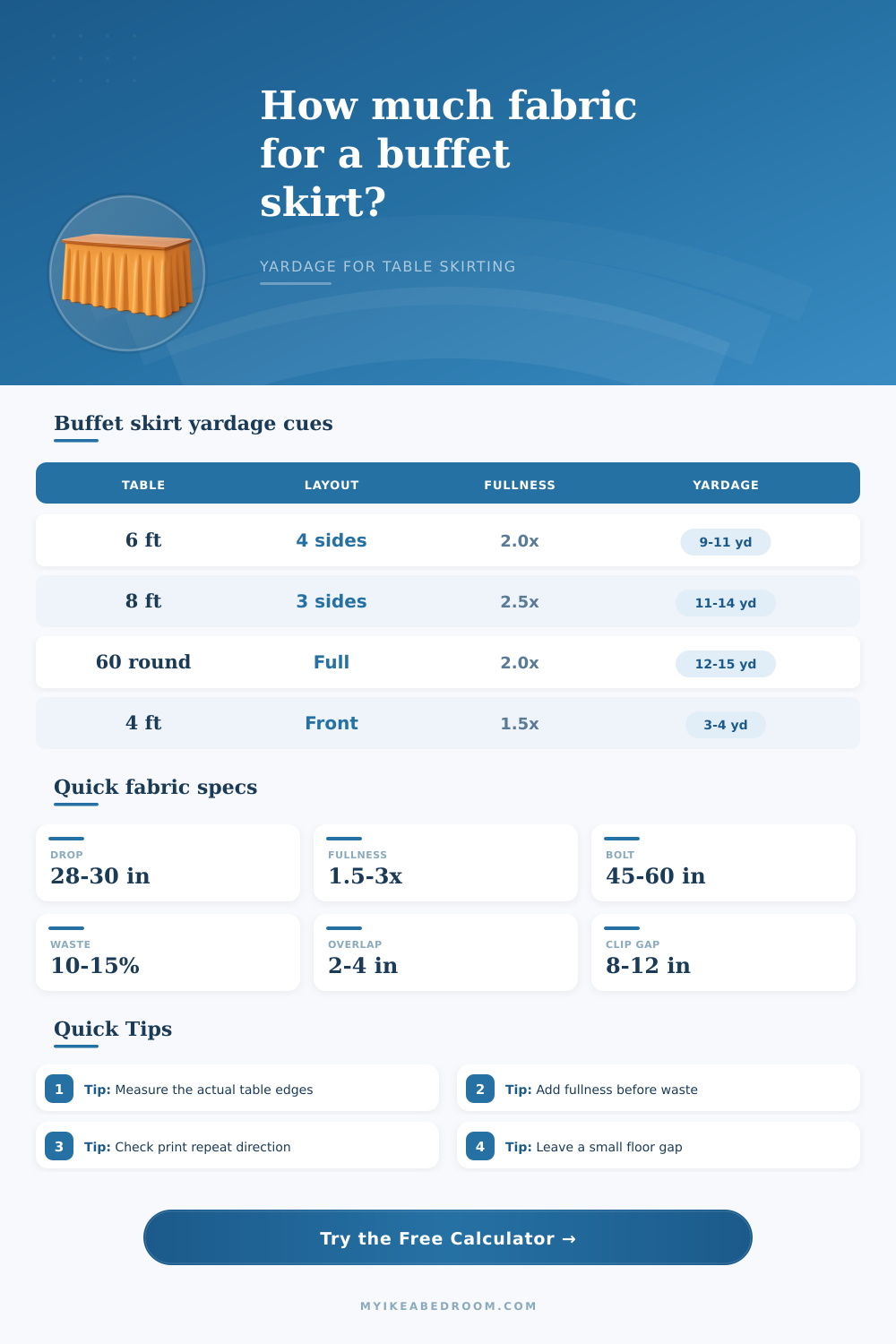
| 6 ft banquet buffet | 72 x 30 x 30 in | Four sides or front plus sides | 2.0x to 2.5x |
| 8 ft serving line | 96 x 30 x 30 in | Front plus sides | 2.0x to 2.5x |
| 60 in round cake table | 60 in diameter x 30 in high | Full perimeter | 2.0x to 3.0x |
| 30 in cocktail highboy | 30 in diameter x 42 in high | Full perimeter | 1.5x to 2.0x |
| 4 ft tasting table | 48 x 24 x 30 in | Front only or three sides | 1.5x to 2.0x |
| Fabric width | Comfortable cut drop | Typical finished drop | Planning note |
|---|---|---|---|
| 45 in fabric | Up to about 42 in | 28 to 38 in | Works for standard tables and many highboy skirts. |
| 54 in fabric | Up to about 51 in | 30 to 45 in | Common decorator width with room for hems. |
| 58 to 60 in fabric | Up to about 56 in | 30 to 50 in | Helpful for long drops, deep hems, and repeats. |
| Cut drop over width | Piecing needed | Varies | Plan horizontal seams or choose wider fabric. |
| Item | Rule of thumb | Calculator input | Why it matters |
|---|---|---|---|
| Skirt sections | 1 to 4 for most single tables | Planned skirt sections | Each section adds side seams and handling breaks. |
| Clip spacing | 8 to 12 in apart | Covered edge result | More fullness and heavier fabric need closer support. |
| Opening overlap | 2 to 4 in | Skirt overlap | Prevents a gap where the skirt starts and ends. |
| Pattern repeat | Add per cut | Pattern repeat allowance | Directional prints need extra fabric to align panels. |
Measure the covered path, not the tabletop area. Buffet skirt yardage is driven by the front edge, side returns, round perimeter, and fullness multiplier, then adjusted for hems and repeat matching.
Confirm the drop before cutting. A skirt that just kisses the floor can drag on uneven rooms. A 1 inch clearance usually looks clean while making setup easier.
The buffet table’s metal frames, wires and clamps is covered by a skirt. The rental becomes an actual dining table.
When purchasing your own linens, you’ll make a mistake if you buy based off guesswork. How do I know? Sometimes you have too much linen; other times, not enough. To get it right, you need to learn how fabric hangs.
How to Measure Table Skirt Fabric
The typical method is that most folks uses end-to-end measurements (floor to table edge). Oops! That’s typically incorrect. Measure all fabric for allowances. Allowances are the finished drop PLUS a little more. That’s the ‘structure’ part. Keeping the top band from sliding, and the hem from unraveling. Then add the header allowance for sleeve or hook tape. Finally, add the bottom hem to clean up edge.
The calculator does all that math while handling conversions so there’s no concern for bolt width. Understanding those added inches make sense. Skipping the hem allowance yields an incomplete-looking skirt. Ignore the header and you’ll see it slides down as guests lean forward.
The amount of fabric used over the table depend on fullness. One times edge length is a flat tailored skirt. This is good for moddern tables with clean lines. Most events need something softer. Standard gather are two times the edge length. It look generous and hides slight imperfections. Deep pleats can be up to two point five or three times the edge. Toggle the multiplier in the tool. Here’s what it’ll cost you for that extra fabric. It’s a budget vs. It is an aesthetics trade-off.
The length is also important, but so is the layout. Do you have to cover front and sides? Do you only have to cover the front and two side if it’s against a wall? That would change the formula. How does it work with round tables? We use pi times the diameter. Why does that matter? Sometimes you don’t have a flexible tape measure. If your table is rectangular, how do you figure out what size to get? Again, it depends on which parts of the table are exposed. Don’t just split the total length in half. Measure the actual part that will show.
Because of how much fabric is used for fullness, even a small error in width become a big problem. Patterns can lead to much more fabric waste. Big motif or directional prints needs matching on the seams. That means a lot gets wasted at the end of the bolt. Enter the repeat allowance field into the calculator. You can add some wiggle room here. It gives that skirt an intended look. More solid color = less waste = forgiving. Prints = not so much.
Don’t forget about floor space. If your skirt touches the floor, then it gets dirty. It also tends to rip up at bottom and get in people’s way, causing them to trip. Leave a little breathing room (an inch or two is fine) to keep the skirt clean. This allows for easy adjustments and clips when putting table together. You wouldn’t of had to wash all those furnitures after each use.
It’s about covering the mechanics but doing so in a way that doesn’t draw attention. The fabric needs to drape softly; whether it be for a backyard BBQ or a wedding reception. It should blend in with background. If you need to make allowances, measure twice. Let the tools does the math. Let the skirt finish off the look instead of distracting from it.