🧱 Brick Wall Measurement Calculator
Calculate bricks needed, mortar volume, and wall dimensions for any project
Bricks / sq ft
Bricks / sq ft
Bricks / sq ft
sq meter
cubic yard
Mortar Joint
per 100 bricks
standard brick
| Bond Pattern | Bricks/sq ft | Bricks/m² | Mortar Use | Wythe Factor |
|---|---|---|---|---|
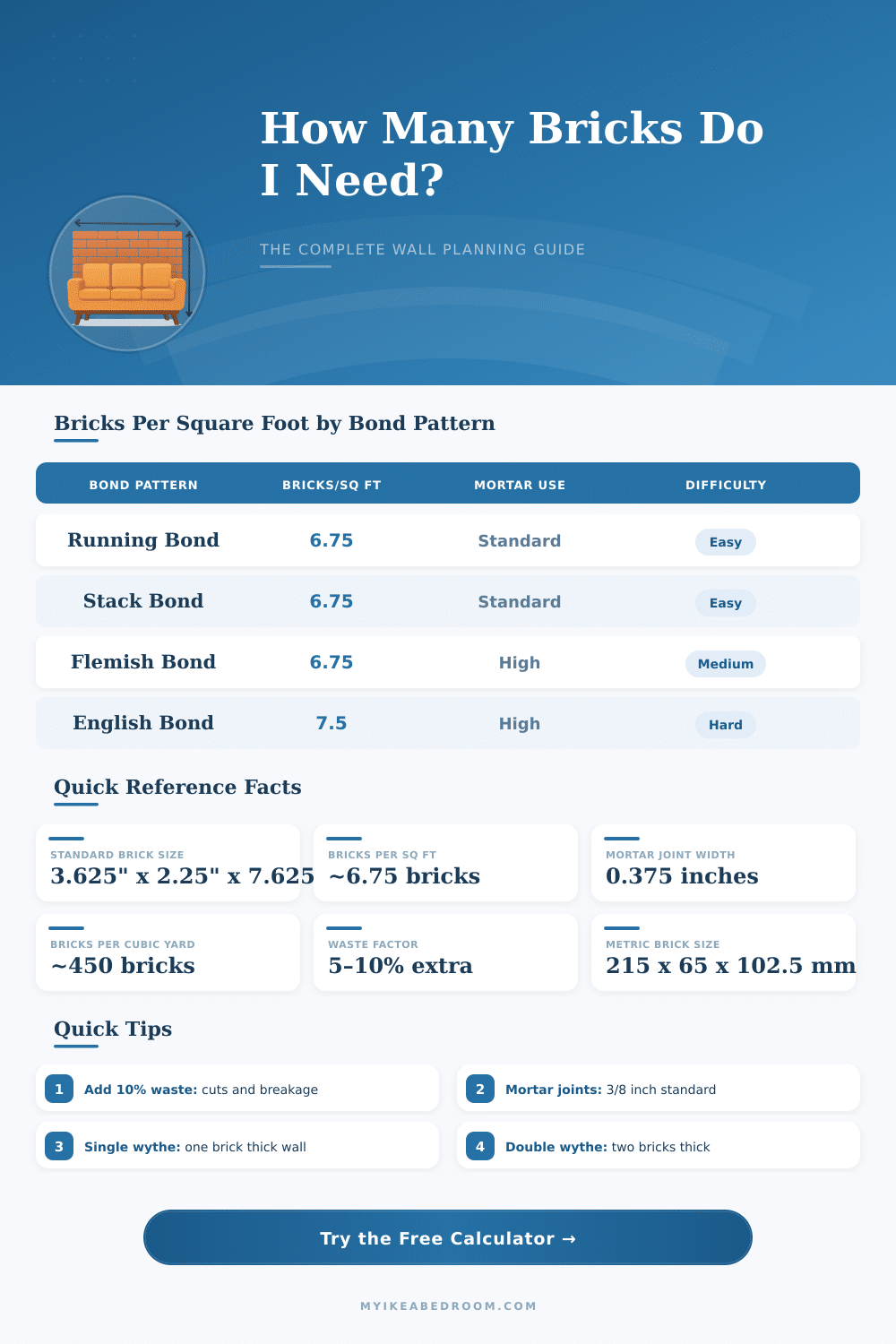
| Running Bond | 6.75 | 72.7 | Standard | x1 (single) |
| Stack Bond | 6.75 | 72.7 | Standard | x1 (single) |
| Flemish Bond | 6.75 | 72.7 | High | x1.5 (mixed) |
| English Bond | 7.5 | 80.7 | High | x2 (double) |
| Header Bond | 13.5 | 145.3 | Very High | x2 (solid) |
| Diagonal/Herringbone | 7.5 | 80.7 | High | x1.1 (cut waste) |
| Brick Type | Dimensions (L x H x W) | Bricks/sq ft | Weight (lbs) |
|---|---|---|---|
| Standard US | 7.625" x 2.25" x 3.625" | 6.75 | 4.5 |
| Modular | 7.625" x 2.25" x 3.625" | 6.75 | 4.2 |
| Queen | 9.625" x 2.75" x 2.75" | 5.8 | 4.8 |
| King | 9.625" x 2.625" x 2.75" | 5.5 | 4.7 |
| Engineer | 7.625" x 2.75" x 3.625" | 5.6 | 5.1 |
| Jumbo | 9.625" x 2.75" x 3.625" | 4.5 | 5.9 |
| Metric (UK) | 8.46" x 2.56" x 4.02" | 5.9 | 4.4 |
| Project | Wall Area (sq ft) | Bricks Needed | With 10% Waste |
|---|---|---|---|
| Small Garden Wall (10x4 ft) | 40 | 270 | 297 |
| Retaining Wall (20x3 ft) | 60 | 405 | 446 |
| Standard Room Wall (15x8 ft) | 120 | 810 | 891 |
| Garage Wall (25x10 ft) | 250 | 1,688 | 1,857 |
| House Exterior (40x10 ft) | 400 | 2,700 | 2,970 |
| Boundary Wall (30x6 ft) | 180 | 1,215 | 1,337 |
| BBQ Surround (10x3 ft) | 30 | 203 | 223 |
Counting how many bricks you will need for a wall is easier than you think. Here is how it works: simply divide the surface area of the wall by the area of one brick and you already have a solid base to plan your project.
Brick calculator is a useful internet tool that does the hard work for you. It counts how many bricks and mortar are needed for your wall. You only must enter the length and height of the wall (or the total area if you already know it).
How to Count How Many Bricks You Need
Most calculators have a section where you can put the dimensions of the brick and the thickness of the mortar joints. After that is done, the calculator almost does everything itsef.
To find the area of your wall, simply multiply the length by the height. For instance, if your wall is 6 metres long and 1.5 metres high, that gives 9 square metres. Here it becomes practical: if you use 60 bricks per square metre as standard, that gives around 540 bricks for that wall.
Even so, most folks use a simpler method; around 48 bricks per square metre is the standard. Just add some extra for possible breaks. And if you build a 9-inch wall?
Only double those numbers to around 96 bricks per square meter.
The formal calculation works like this: you take the length of the wall, multiply it by the height, and then divide that by the brick length plus mortar, multiplied by the brick height plus mortar. Assume that you work with a wall of 5 metres long and 3 metres high, using standard Indian bricks (190 x 90mm) with 10mm of mortar. That calculation gives about 750 bricks.
It would be smart to add 10 percent more for waste.
Also the thickness of the wall matters. Half brick walls are around 100mm (or 10cm) thick, and they are measured in square metres like any other wall. A standard 9-inch wall, that measures 230mm, actually has 200mm of actual brick when you remove the thickness of the plaster from the total width.
In the United Kingdom, standard bricks measure 65 x 102.5 x 225mm, and most builders use 10mm of mortar. The mortar thickness commonly is set so that it creates nice finishes or columns (sounds strange), but it helps the look. One odd thing: the last brick in every row does knot have a joint, because it reaches the end of the wall.
So, a wall 10 bricks long would extend to a bit less than 80 inches.
Do not forget to reduce the area for openings. Doors and windows must be removed from your total. The volume of every hole, length, height and width, is subtracted from the general amount.
You also should consider a percentage for waste, because materials always can damage during the installation.