🧱 Masonry takeoff and drainage planning
Brick Veneer Calculator
Estimate net veneer area, brick count, mortar volume, anchor ties, cavity volume, and approximate wall load for facades, gables, privacy walls, and chimney chases.
Each preset loads a realistic facade condition so you can compare brick formats, bond patterns, cavity depth, and exposure assumptions quickly.
Detailed breakdown
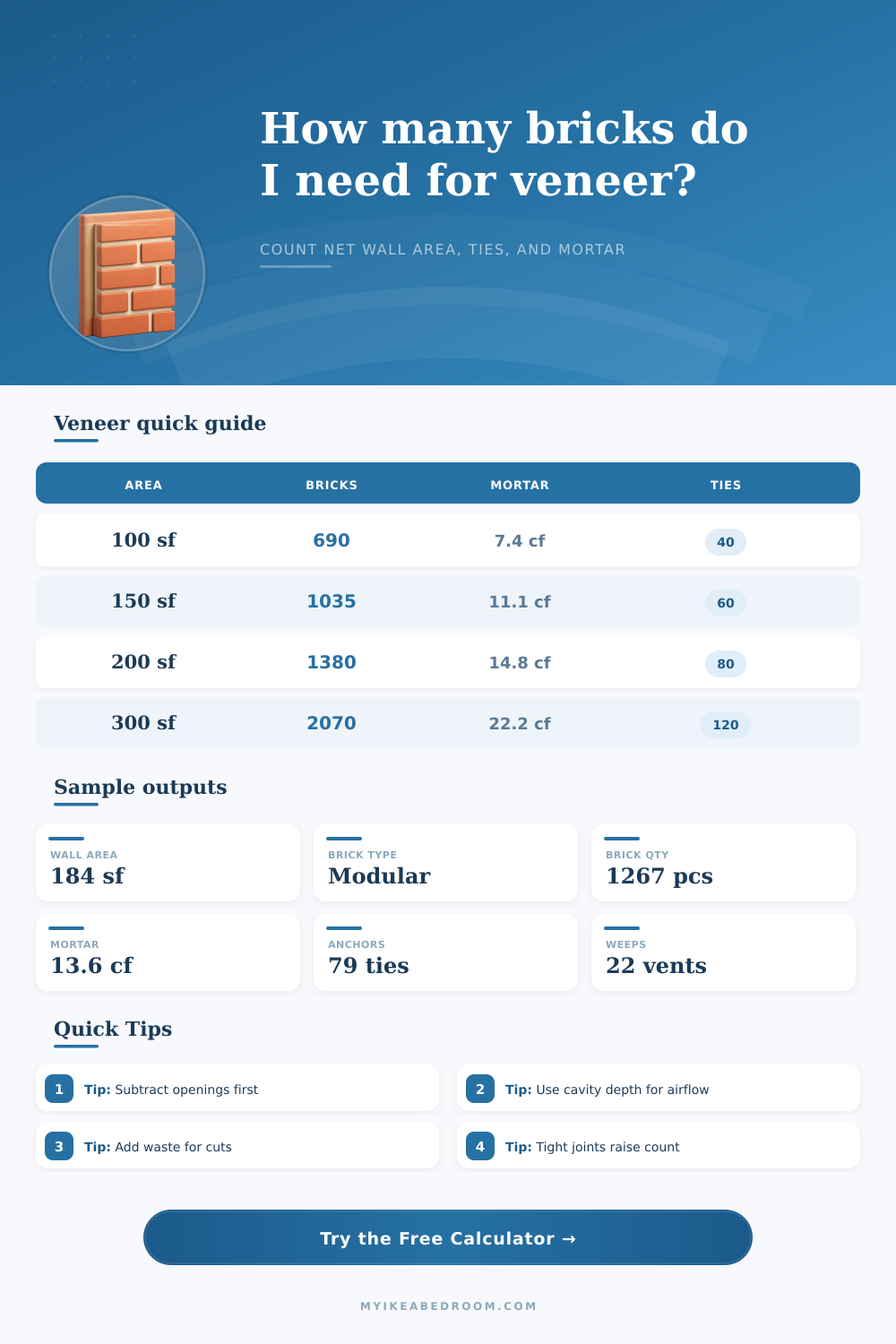
These quick-reference tables use standard face dimensions, common joint assumptions, anchor spacing bands, and cavity depths used in brick veneer planning.
Compare module size, face rhythm, approximate weight, and where each brick format usually fits best in veneer work.
This calculator is a planning tool for veneer quantities and layout assumptions. Final detailing should match your project drawings, local code, anchor schedule, and structural design.
In order to calculate the number of bricks that are necesary to build a brick veneer, it is first necessary to calculate the net area of the veneer. The net area of the veneer is calculated by taking the gross area of the veneer (calculated as the length of the veneer multiplied by the height of the veneer) and subtracting the area of the openings in the veneer (such as windows and doors). The worker subtracts the area of the windows and doors from the gross area of the veneer because windows and doors does not require bricks to fill those areas.
Once the net area of the veneer is calculated, the number of bricks that are necesary to build the veneer can be calculated. The number of bricks that is necessary to build the veneer also depends upon the dimensions of the bricks that the worker will utilize in the veneer, as well as the type of bond pattern that is to be utilized. For instance, one of the most common types of bricks is modular bricks, which have a nominal size of 8 inches in length by 2 and 5/8 inches in height (including the mortar joint between bricks).
How to Calculate Bricks for a Brick Veneer
If these types of bricks is used in a veneer with a running bond pattern, then approximately seven modular bricks will be required to cover one square foot of the veneer. However, if the worker use bricks of a larger height, such as queen size bricks (which are approximately 2 and 3/4 inches in height), fewer bricks will be required per square foot of veneer. With queen size bricks, for instance, there will be approximately six bricks per square foot of veneer.
Although bricks of a taller height (such as queen size bricks) will result in fewer horizontal joints formed by mortar between the bricks, the taller veneer require more effort to level the bricks to ensure that the veneer will be even. Another factor that will impact the number of bricks that is required to build the brick veneer is the type of bond pattern that will be used for the veneer. For instance, patterns in which the worker places the bricks one at a time into each module area of the veneer (such as a running bond) will require fewer bricks than patterns that may include a vertical or horizontal gap between some of the bricks (such as a stack bond or a decorative pattern like a Flemish bond).
Decorative patterns will often require more cuts of the bricks than will a veneer with a more basic pattern. As a result, the worker will cut more of the bricks during construction of the veneer, and some of those cut bricks can be discarded if the remaining portion of the brick is not sufficient to fill a mortar joint. In order to account for these cut bricks, some extra bricks must be ordered for the veneer.
In most cases, an extra five to twelve percent of the total number of bricks that are calculated for the veneer should be ordered, though more may be required if the veneer has numerous windows or decorative features. In addition to the number of bricks that is required to build the veneer, the volume of mortar that is required to build the veneer must also be calculated. The mortar that is used to build the veneers fills the spaces between the bricks, such as the bed joints between the bricks, and the voids behind the face shell of the bricks.
If larger bricks are used in the veneer, such as utility bricks, less mortar will be required per square foot of veneer. However, utility bricks are typically much heavier than modular bricks. Another consideration for the building of a veneer is the installation of a proper drainage system for the veneer.
A proper drainage system for a veneer includes establishing an air cavity behind the veneer (between the veneer and the wall frame). If the air cavity is too shallow, the moisture that condenses against the veneer may become trapped against the wall frame, which can cause damage to the frame. Therefore, weep holes must be established in the veneer (typically at the bottom of the veneer walls and over the lintels of window openings) to allow moisture to escape from the air cavity.
Additionally, some type of ties is required to attach the veneer to the frame of the wall. The worker must space the ties correctly along the wall frame in order to ensure the stability of the veneer. In addition to ensuring that the veneer is constructed correctly and is stable once built, control joints must be installed into the veneer to allow for the veneer and the bricks to expand and contract according to the changes in the temperature within the area in which veneer is to be installed.
If control joints are not installed every 20 feet along a long veneer wall, the veneer may crack due to the expansion of the bricks in response to changes in temperature. Finally, in addition to the number of bricks that are calculated for the veneer, extra bricks should of be ordered to account for any breakage of the bricks during construction of the veneer. When cutting bricks, some cuts may result in uneven portions of the bricks that cant be used in the veneer.
By having extra bricks, the veneer construction process will not be delayed due to the lack of sufficient bricks.