🧱 Brick Size Calculator
Calculate exactly how many bricks you need for walls, patios, paths & more
bricks/sq ft
bricks/sq ft
bricks/sq ft
bricks/sq ft
bricks/sq ft
bricks/sq ft
bricks/sq ft
bricks/sq ft
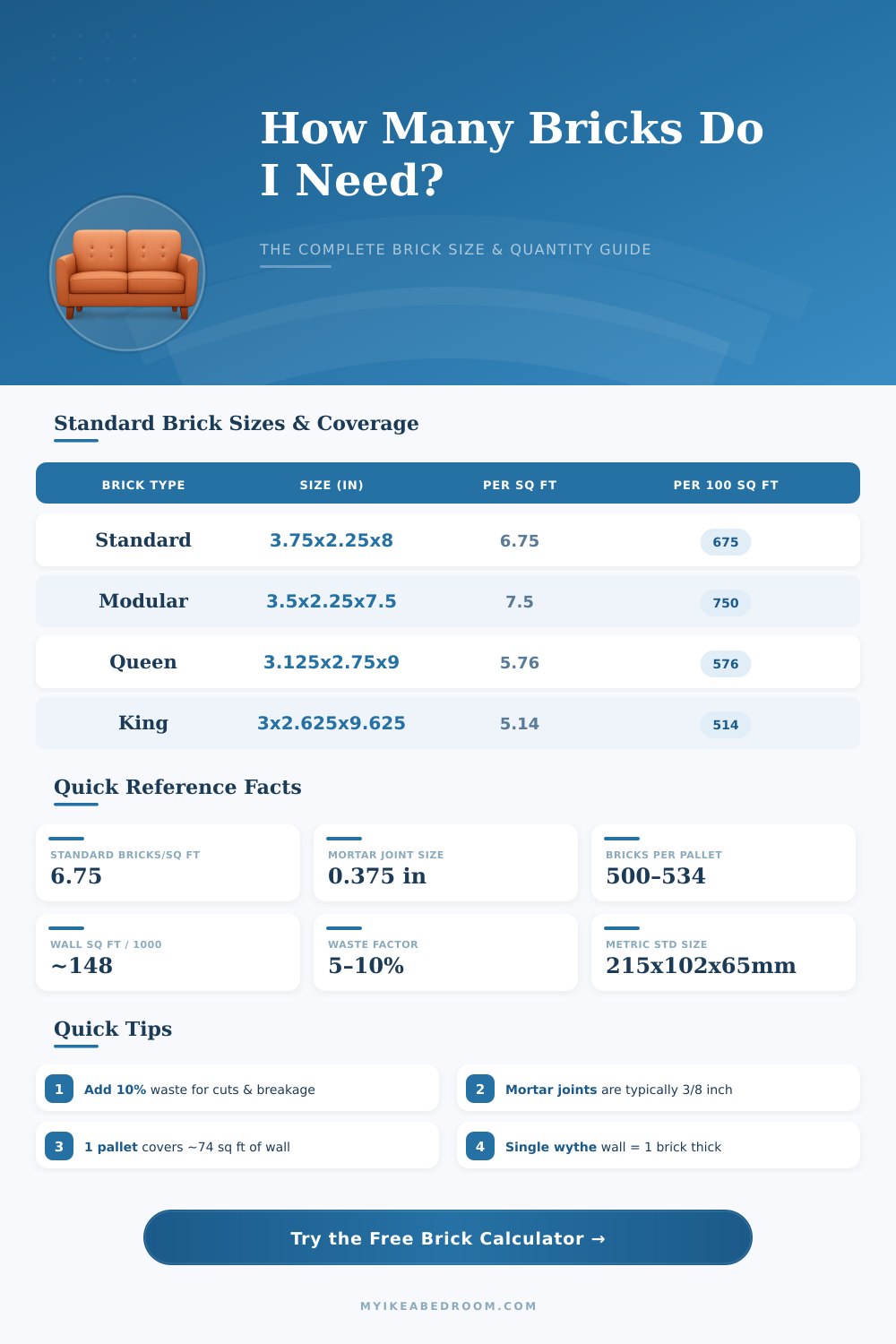
| Brick Type | Size (L x H x W) in | Size (mm) | Bricks/Sq Ft | Weight (lbs) |
|---|---|---|---|---|
| Standard | 8 x 2.25 x 3.75 | 203 x 57 x 95 | 6.75 | 4.5 |
| Modular | 7.5 x 2.25 x 3.5 | 194 x 57 x 92 | 7.5 | 4.2 |
| Queen | 9 x 2.75 x 3.125 | 229 x 70 x 79 | 5.76 | 5.1 |
| King | 9.625 x 2.625 x 3 | 244 x 67 x 76 | 5.14 | 5.6 |
| Face Brick | 7.625 x 2.25 x 2.625 | 194 x 57 x 68 | 9.0 | 3.8 |
| Engineer | 8 x 2.75 x 3.75 | 203 x 70 x 95 | 5.5 | 5.8 |
| Closure | 8 x 3.75 x 3.75 | 203 x 95 x 95 | 4.5 | 7.2 |
| Roman | 11.625 x 1.5 x 3.5 | 295 x 38 x 89 | 3.0 | 3.1 |
| Brick Type | Bricks / Pallet | Pallet Coverage (sq ft) | Pallet Weight (lbs) |
|---|---|---|---|
| Standard | 500 | 74 | 2,250 |
| Modular | 525 | 70 | 2,205 |
| Queen | 500 | 87 | 2,550 |
| King | 500 | 97 | 2,800 |
| Face Brick | 534 | 59 | 2,029 |
| Engineer | 500 | 91 | 2,900 |
| Closure | 400 | 89 | 2,880 |
| Roman | 350 | 117 | 1,085 |
| Project | Area (sq ft) | Standard Bricks (single wythe) | Pallets Needed |
|---|---|---|---|
| Small Garden Wall 10x4 | 40 | 297 (incl. 10% waste) | 1 |
| Feature Wall 20x8 | 160 | 1,188 | 3 |
| Driveway Pillars 2x(3x3) | 36 | 267 | 1 |
| Patio 12x12 | 144 | 1,069 | 3 |
| Boundary Wall 50x6 | 300 | 2,228 | 5 |
| Large Patio 20x20 | 400 | 2,970 | 6 |
| Fireplace Surround 8x4 | 32 | 238 | 1 |
| Garden Steps 6x3 | 18 | 134 | 1 |
Order at least 10% more bricks than calculated to account for cuts, breakage during transport, and future repairs. For complex patterns like herringbone, use 15–20%.
The standard 3/8 inch (10mm) mortar joint is included in coverage calculations. Changing joint size significantly affects how many bricks fit per square foot — tighter joints mean more bricks per row.
To calculate the number of brick that you need for your project, you must measure the area that the bricks will covers. Measuring the area of the project will tell you how many bricks is required to cover that area. If you dont measure the area correct, then you may order either too few or too many bricks.
Ordering too few bricks will make your building project last long, however, ordering too many bricks will cost you money. The number of bricks you need to calculate for your project will also have to include the thickness of the mortar joint. The mortar joints are the gaps between the bricks where mortar are placed.
How to Calculate the Number of Bricks You Need
These gaps take up the space that the bricks occupy. If the gaps is thick, you will require fewer bricks. However, if the gaps between the bricks are thin, more bricks will be required to fill the area.
Therefore, you have to account for the thickness of the mortar joints in the total numbers of bricks you will need. Another factor that will change the number of bricks that you need for your project is the type of brick that you will use. Bricks comes in many sizes.
If you use smaller sized bricks, you will need more of them to fill the same area as if you used large bricks. For instance, modular bricks are more smaller in size than standard bricks. Therefore, you will need more modular bricks to fill the same area as standard bricks.
The size of the bricks you use will affect the total number of bricks needed for your project. The shape of your project will also play a role in calculating the number of bricks needed. If your project use a rectangular structure, you must calculate the area by multiplying the length of the foundation by the height of the bricks.
However, if you are using a circular foundation for your bricks, such as for a fire pit, you will need to use the radius of the circle as part of your calculation. If your project is a flat area, such as a patio, the measurement you calculate is the area. However, if you are building a wall, you will calculate the area that your bricks will cover vertical.
Furthermore, if you are building a double wythe wall, you must double the total number of bricks you calculate since there will be two layer of bricks for your wall. Another factor to consider when ordering bricks for your project is to add a waste factor to the total number of bricks that you calculate. In any project, some of the bricks will break or need to be cut to fit specific area into your project.
To account for this, many people order bricks with a waste factor of ten percent added to the total number of bricks needed for your project. Without adding this factor, you may run out of bricks before your project are complete. When calculating the weight of the bricks that you order for your project, remember that bricks is very heavy.
Thousands of pound of bricks can be in one pallet of bricks. Knowing the total weight of the bricks is important to determine the type of vehicle that will need to deliver these bricks to your location. Finally, to order the correct number of bricks for your project, carefully measure your project and follow the steps listed above.
Measure the length and the height of the area that your bricks will cover. Calculate the total area that your bricks will cover. Account for the size of the bricks, the thickness of the mortar joints, and the waste factor for your project.
By following these steps, you will calculate the total number of bricks that you need for your project.