Box Pleat Valance Fabric Calculator
Estimate face fabric, lining, cut widths, pleat spacing, returns, seams, and pattern-repeat allowance for a tailored box pleat valance.
📌Real Valance Presets
🧵Valance Measurements
🧶Fabric Comparison Grid
📊Reference Tables
Pleat Depth and Fullness Guide
| Finished Width | Suggested Pleats | Fold Depth | Added Fabric |
|---|---|---|---|
| 30 to 42 in | 3 box pleats | 3 to 3.5 in | 18 to 21 in |
| 43 to 60 in | 4 box pleats | 3.5 to 4 in | 28 to 32 in |
| 61 to 84 in | 5 to 6 box pleats | 4 to 4.5 in | 40 to 54 in |
| 85 to 108 in | 7 box pleats | 4 to 5 in | 56 to 70 in |
| 109 to 144 in | 8 to 10 box pleats | 4.5 to 5.5 in | 72 to 110 in |
Fabric Width and Cut Planning
| Usable Fabric Width | Best Use | Seam Planning | Notes |
|---|---|---|---|
| 45 in | Small valances | More joins on wide runs | Common cotton print width |
| 54 in | Most decorator fabrics | Often 2 to 4 widths | Good for lined bedroom work |
| 60 in | Wide solids and canvas | Fewer vertical joins | Check bolt label after washing |
| 108 in | Railroaded fabric | May avoid joins | Confirm pattern direction first |
Pattern Repeat Allowance
| Vertical Repeat | Planning Rule | Waste Risk | Use For |
|---|---|---|---|
| 0 to 2 in | Round lightly | Low | Solids, textures, tiny checks |
| 3 to 6 in | Round each cut to repeat | Moderate | Stripes, small botanicals |
| 7 to 13 in | Add one repeat per cut | High | Medallions, medium motifs |
| 14 in plus | Center motifs before cutting | Very high | Large florals and scenic prints |
Common Box Pleat Valance Starting Points
| Project | Face Width | Drop | Typical Cut Widths |
|---|---|---|---|
| Small bathroom window | 30 to 36 in | 12 to 14 in | 1 width |
| Single bedroom window | 42 to 54 in | 14 to 16 in | 2 widths |
| Primary bedroom window | 66 to 84 in | 16 to 20 in | 2 to 3 widths |
| Bay or triple window | 90 to 120 in | 18 to 22 in | 3 to 4 widths |
| Wall-to-wall treatment | 132 to 180 in | 18 to 24 in | 4 to 6 widths |
💡Cutting Tips
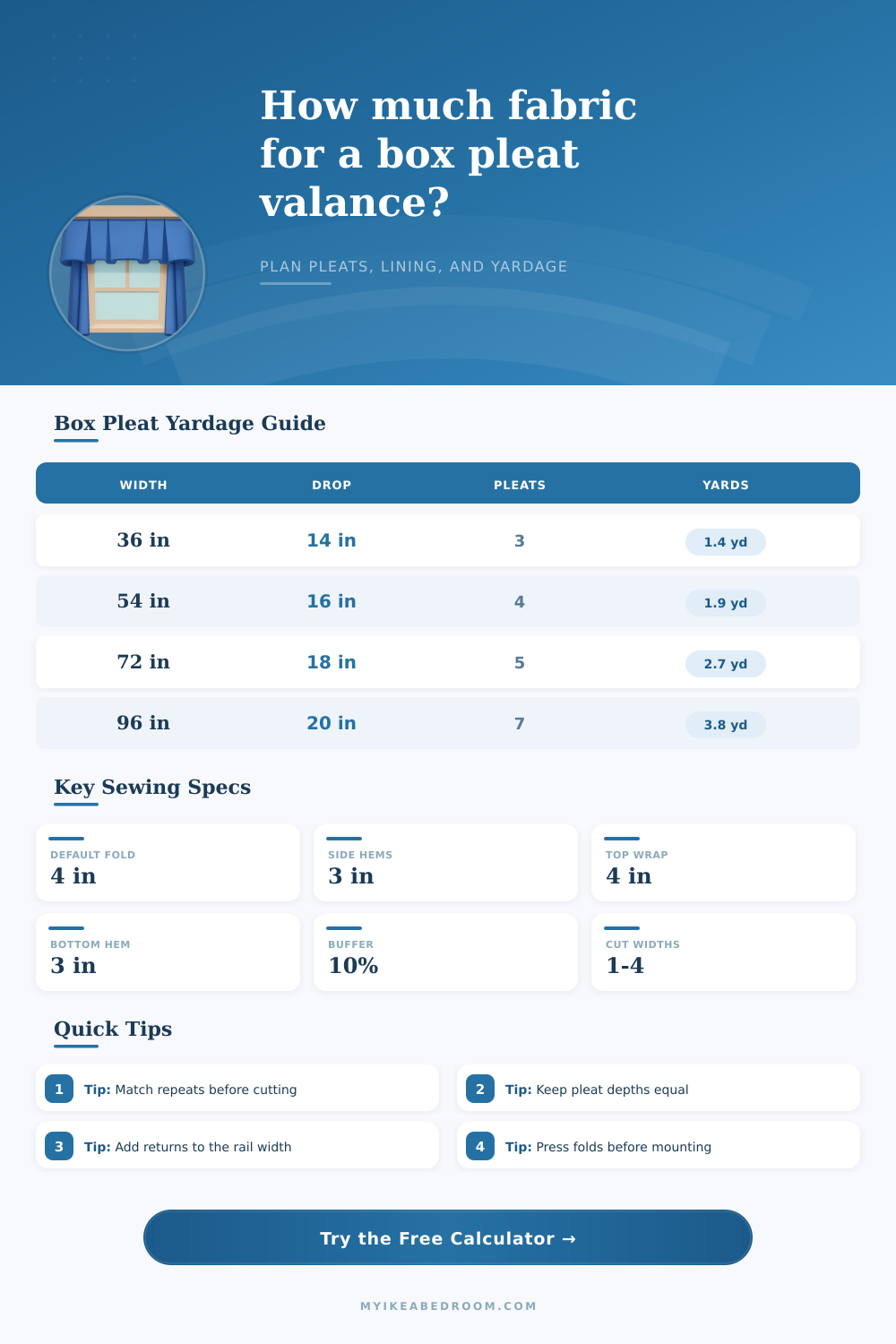
A box pleat valance use folds to create the finished valance. Because a box pleat valances requires specific measurement of the fabric needed to create such a valance, it is necesary to calculate the amount of fabric that is required prior to begin to create the valance. A box pleat valance require fabric for the width of the valance, the depth of the pleats, and the returns of the valance.
A calculator can aid in determining each of these measurement for the valance such that the individuals creating the valance doesnt have to guess at the amount of fabric that is required. To calculate the amount of fabric required for the valance, you must first determine the width of the valance face. The width of the valance face can be measured from rod to rod, but returns of the valance must also be account for in this measurement.
How to Measure Fabric for a Box Pleat Valance
The returns are the portion of the valance that turn the corner of the valance to the wall. Additionally, it is also necesary to account for the depth of the pleats. The deeper the pleat of the valance, the more yardage will be used in the creation of that valance.
The depth of the pleat can be accounted for in the amount of yardage that is purchase for the valance. The width of the fabric that will be used in the creation of the valance should also be considered. Most decorator fabric are 54 inches in width.
Should the total width of the valance and the pleats of the valance be greater than 54 inches, then more than one width of fabric will be require. Because more than one width of fabric will be required, a seam will be required to join the fabric pieces together. An amount of fabric will be required for these seams, and the calculator accounts for that additional amount of fabric in the determination of the total yardage required for the valance.
The length of the valance that is to be cut from the fabric will also need to be calculate. The length of the valance can be determined by the drop of the valance, the height of the mounting on the rod, and the amount that is required for hemming the valance. If the valance contain a pattern, the length will need to be rounded to the nearest full pattern repeat.
Additional to the amount of fabric for the valance face is the amount of lining for the valance. Standard linings will add weight to the valance and protect the valance from sunlight damage. Blackout linings will block the light from the valance and add to the weight of the valance.
Flannel interlinings will add insulation to the valance and make the folds of the valance soft to the touch. Each of these linings will require additional yardage of fabric to the yardage that is required for the valance face. A multiplier will be provide in the calculator to reflect the yardage required for each of these linings.
Additionally, a buffer percentage can be chosen. Should the percentage be higher, there will be additional yardage purchased for the valance. A higher percentage is suggested for individuals who is using patterned fabric or for individuals who are sewing the valance for the first time.
Another factor that will influence the amount of fabric for the valance is the method in which the valance is to be mounted. Should the valance be mounted on a board, the valance will need to be wide enough to allow it to be wrapped around the board and staple to the board. Should the valance have a rod pocket, the valance will need to be longer to provide for the header of the valance, such that the header does not sag below the rod.
Should the valance be mounted on a track system, the valance will need to include an area on the valance for the hook tape that is utilized to attach the valance to the track system. Each of these methods are taken into consideration in the determination of the amount of fabric required for the valance. Common mistake made by individuals creating a box pleat valance are to forget to include the returns or the fabric for the pleats in the measurement of the width of the valance.
It is also common for individuals to ignore the pattern repeat of the valance, which could lead to the valance looking as though it is sewn in section. Tables can be used to determine the width of the valance in relation to the size of the window that the valance will cover. The type of fabric that is selected for the valance will influence the way in which the valance is created.
Velvet has a nap; all of the velvet pieces that are to be used for the valance must be cut in the same direction to maintain the color of the valance. Linen fabrics may stretch when they is washed or hung on the window. Canvas is a heavier fabric that will maintain its fold; however, because it is a heavy fabric, it may be difficult to wrap the valance around the returns of the valance.
Each of the fabrics can be sample prior to purchasing the amount of fabric that is required for the valance. Once the fabric is purchased, the pleats should be marked on the back of the valance fabric prior to pressing the valance to create the pleats. The pleats should be pressed, and it is always a good idea to ensure that the width of the valance face is as measured.
The lining should be attach to the valance fabric. Following these step will ensure that the pleats are even and that the returns of the valance will meet the wall at the same angle. Should the valance be constructed in this manner, it will be easier to correct any issue created during the construction of the valance; any attempts to fix these issues after the valance is mounted will be more difficult.
A correctly constructed valance will have even, rectangular fold of the valance.