🛋 Box Cushion Calculator
Calculate exact fabric yardage for top panel, bottom panel & boxing strip
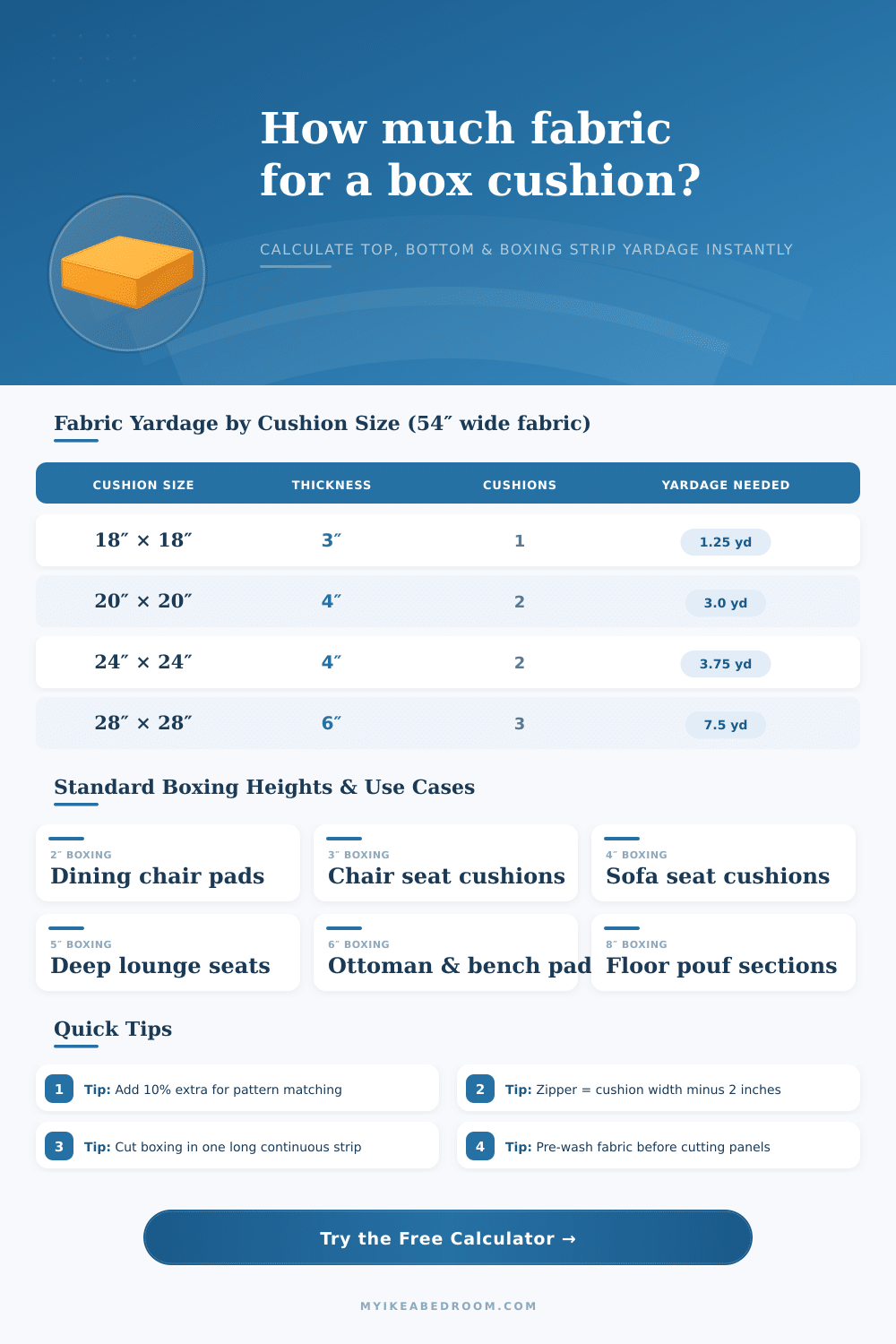
| Cushion Size | Boxing Height | 1 Cushion | 2 Cushions | 4 Cushions |
|---|---|---|---|---|
| 16″ x 16″ | 2″ | 0.75 yd | 1.5 yd | 3.0 yd |
| 18″ x 18″ | 3″ | 1.0 yd | 2.0 yd | 4.0 yd |
| 20″ x 20″ | 3″ | 1.25 yd | 2.5 yd | 5.0 yd |
| 24″ x 24″ | 4″ | 2.0 yd | 4.0 yd | 8.0 yd |
| 28″ x 28″ | 4″ | 2.5 yd | 5.0 yd | 10.0 yd |
| 48″ x 18″ | 4″ | 2.75 yd | 5.5 yd | 11.0 yd |
| 60″ x 20″ | 4″ | 3.25 yd | 6.5 yd | 13.0 yd |
| 24″ x 24″ | 6″ | 2.5 yd | 5.0 yd | 10.0 yd |
| Perimeter | Boxing Height | Strip Area (sq in) | Approx. Yards (54″ fabric) |
|---|---|---|---|
| 64″ (16x16) | 2″ | 128 sq in | ~0.25 yd |
| 72″ (18x18) | 3″ | 216 sq in | ~0.35 yd |
| 80″ (20x20) | 3″ | 240 sq in | ~0.40 yd |
| 96″ (24x24) | 4″ | 384 sq in | ~0.60 yd |
| 112″ (28x28) | 4″ | 448 sq in | ~0.70 yd |
| 132″ (48x18) | 4″ | 528 sq in | ~0.85 yd |
| 96″ (24x24) | 6″ | 576 sq in | ~0.90 yd |
| 160″ (60x20) | 4″ | 640 sq in | ~1.0 yd |
| Cushion Size | Perimeter | Seams x2 + Join | Piping Yardage |
|---|---|---|---|
| 16″ x 16″ | 64″ | 128″ + 12″ | ~1.55 yd |
| 18″ x 18″ | 72″ | 144″ + 12″ | ~1.78 yd |
| 20″ x 20″ | 80″ | 160″ + 12″ | ~1.89 yd |
| 24″ x 24″ | 96″ | 192″ + 12″ | ~2.33 yd |
| 28″ x 28″ | 112″ | 224″ + 12″ | ~2.78 yd |
| 48″ x 18″ | 132″ | 264″ + 12″ | ~3.11 yd |
| 60″ x 20″ | 160″ | 320″ + 12″ | ~3.67 yd |
Box cushions are basic skill because they are useful in many places. They work for window chairs, benches, banquettes, patio furniture, boat cockpits and much more. The simplest model is the boxed cushion, where top and bottom is sewed to side panels, called boxing.
By means of this style you can easily customize various chairs.
How to Make and Fit Box Cushions
Cushions with sewed corners are made of four separate boxing strips, that you sew together and later to the upper and bottom plates. Basically, box cushions have two facing bits, usually rectangular, bound by two trim strips, one of which has a zipper. When the first side is attached to the boxing, folding the fabric outside of the corner, you do a little clip on the unsewn side.
That mark helps to line the corners of the second side. Ensure that the clip is inside the seam allowance, so that it is not visbile.
Finding the right size can be a difficult task. If you use high-density foam, the cover must be slightly smaller than the foam itself, instead of being exactly same. That gives a clean, tailored look with sharp edges without loose fabric.
There is a magic number that you subtract from the dimensions so that the fabric sits tightly (that is called negative ease). It also helps to make a template of the chair with kraft paper. To match the pattern, you can cut the foam with an electrical knife.
The density of the foam is important. Search for material with density of 3.0 or higher. Something less quickly pancakes and will lose its form.
If you want more puffy cushions, wrap the foam in one or two layers of Dacron, that is sold as quilt batting, but not the felt kind. Spray glue helps to set these layers directly to the foam.
The Kova Box Cushion has a deeper frame and box-style cushions, which gives it clean, tailored lines. It offers a more structured look, that well completes various interior styles. These cushions well keep their form, providing lasting comfort without the need to permanently fix the fluff.
For less formal cushions, it is possible to use a bullet nose with only side boxing. Contrast welt from leather can add a nice touch. You can also make covers without sewing by means of sticky fabric seals, which avoids the hassle of a zipper.
For sewing rugged zippers, a piping foot is perfect. Prime covers for chairs and sofas commonly use elastic bottom designs, that keep the cover firmly in place and protect the furniture.
Ensure that the cushions are entirely dry before you lay them in a storagebox.