Books Per Shelf Calculator
Estimate how many books fit on one shelf using shelf width, measured spine width, book type mix, bookend allowance, divider gaps, and a lean buffer.
Same shelf with only 3% lean buffer.
Uses your selected allowances.
Same shelf with 15% lean buffer.
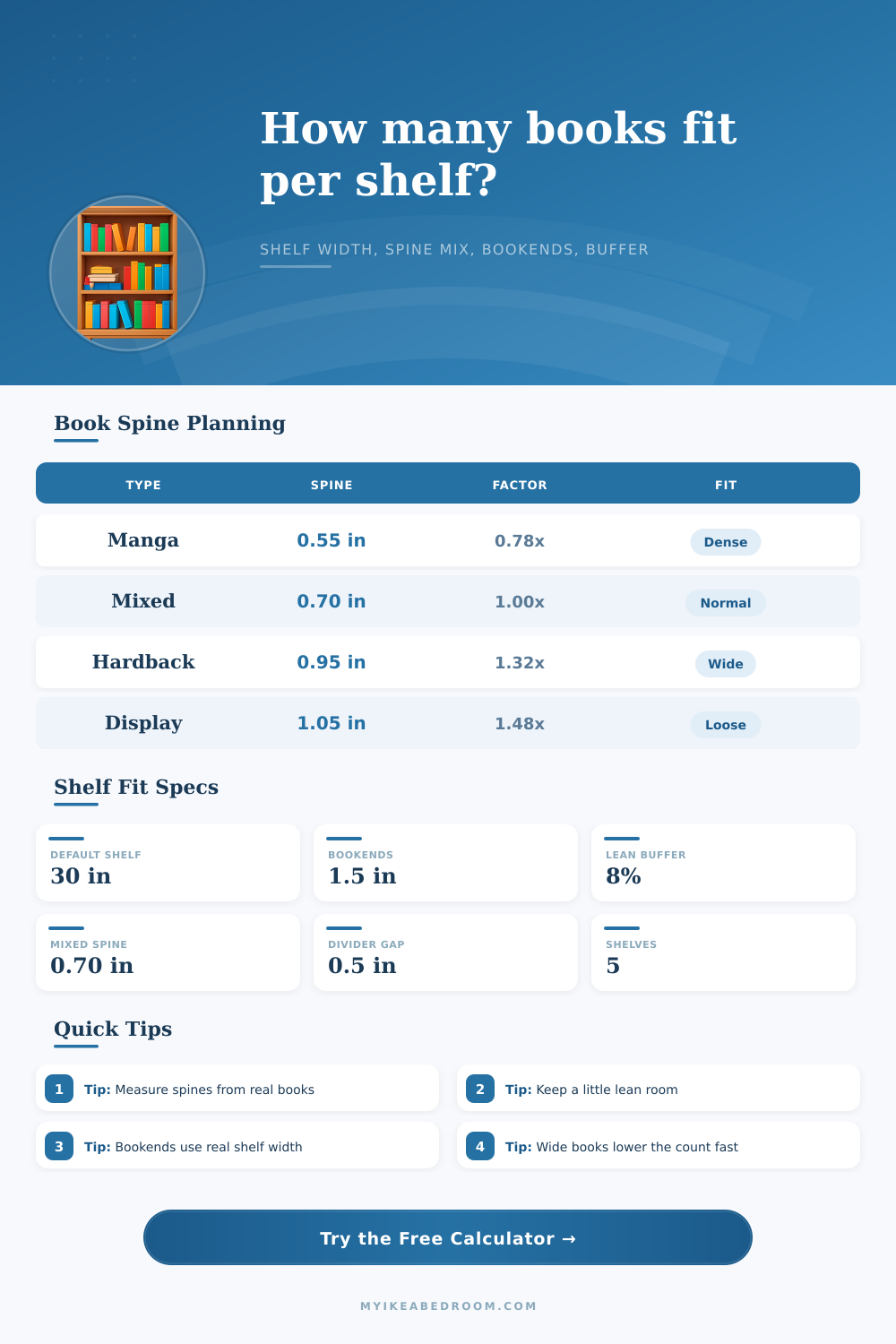
| Book type mix | Typical spine range | Calculator factor | Best use |
|---|---|---|---|
| Mass-market paperbacks / manga | 0.45 to 0.65 in | 0.78x measured average | Dense fiction rows and series runs. |
| Trade paperback dominant | 0.60 to 0.85 in | 0.92x measured average | Modern novels, nonfiction, and mixed paperback shelves. |
| Mixed paperback and hardcover | 0.60 to 1.00 in | 1.00x measured average | Everyday home shelves with varied formats. |
| Hardcover dominant | 0.80 to 1.20 in | 1.32x measured average | Jackets, boards, and wider bindings. |
| Cookbooks and art books | 0.90 to 1.50 in | 1.55x measured average | Oversized, coated-paper, or reference-heavy rows. |
| Kids picture books | 0.70 to 1.25 in | 1.20x measured average | Thin picture books with uneven spine behavior. |
| Loose display styling | 0.75 to 1.40 in | 1.48x measured average | Rows with face-out covers or decorative gaps. |
| Custom measured spines only | Use your measurement | 1.00x measured average | Best when you measured the exact books going on the shelf. |
| Clear shelf width | At 0.55 in spines | At 0.70 in spines | At 0.95 in spines |
|---|---|---|---|
| 13 in cube shelf | 20 to 22 books | 16 to 18 books | 12 to 13 books |
| 24 in narrow shelf | 38 to 40 books | 29 to 31 books | 21 to 23 books |
| 30 in bookcase shelf | 47 to 50 books | 36 to 39 books | 27 to 29 books |
| 36 in wide shelf | 57 to 60 books | 44 to 47 books | 32 to 34 books |
| 48 in built-in shelf | 76 to 80 books | 59 to 62 books | 43 to 46 books |
| Allowance choice | Width reserved on 30 in shelf | Books lost at 0.70 in | When to use it |
|---|---|---|---|
| No bookends, 3% lean | 0.9 in | 1 book | Built-in side walls or very straight rows. |
| 1.5 in bookends, 8% lean | 3.8 in | 5 books | Most everyday shelves with reachable books. |
| 2.5 in bookends, 12% lean | 5.8 in | 8 books | Freestanding bookends and heavier hardcovers. |
| 1.5 in bookends, 20% display | 7.2 in | 10 books | Styled shelves with objects or cover-forward books. |
| Shelf scenario | Input profile | Expected books per shelf | Planning note |
|---|---|---|---|
| 30 in mixed bookcase shelf | 0.70 in spines, 1.5 in bookends, 8% buffer | About 36 books | Comfortable row for mixed everyday reading. |
| 13 in cube shelf | 0.58 in spines, 0.5 in allowance, 6% buffer | About 19 books | Short shelves are sensitive to bookends. |
| 48 in built-in shelf | 0.75 in spines, 2 in allowance, 7% buffer | About 58 books | Long runs benefit from one or two divider gaps. |
| 24 in hardcover shelf | 0.78 in measured spines, hardcover mix, 2 in bookends | About 19 books | Wider bindings reduce count more than expected. |
| 36 in display shelf | 0.72 in measured spines, display mix, 16% display gap | About 24 books | Display styling trades capacity for easier viewing. |
Ten books measured together gives a better average spine width than one favorite book. Mixed shelves often include a few wide spines that change the final count.
A row that mathematically fits edge to edge may be hard to use. Keep enough allowance for bookends, hand access, and a slight lean.
To calculate an number of books that will fit on a shelf in a bookcase, you must understand how to determine the capacity of that shelf. The capacity of the shelf is not based on an dimensions of the outside of the bookcase; instead, measuring the usable horizontal distance within the bookcase determine shelf capacity. To find the capacity of the shelf, you must take the width of the shelf bay, taking into account the space taken up by the side walls.
If you include the side walls in your measurement, you will obtain an incorrect measurement of the books that will fit on the shelf. Another measurement that must be determined is the width of the books’ spine. The width of the spine of a single book doesnt represent the average width of the books that you own.
How to Find How Many Books Fit on a Shelf
To find the average spine width, you must measure the width of ten different books‘ spines and divide the total width by ten to find the average. The type of books that you own may have different spine widths. For instance, mass-market paperbacks have different spine widths than hardcover books, and hardcover books has different spine widths than oversized art books.
To account for this difference, the bookcase calculator include a multiplier so that the average spine width that is entered into the calculation reflect the actual average spine width of the books that you own. The books that are placed on the shelf will take up some of the available space on the shelf. Books that are placed on the shelf with bookends will not take up the entire shelf because the bookends will occupy some of the shelf’s width.
Furthermore, books may not be placed directly against each other. A lean buffer must be left between the books to account for the fact that the books will not remain neatly lined up on the shelf; without this space, the books may collapse toward the center of the shelf when a book is removed from that shelf. Depending off the size of the lean buffer, the space that is occupied by the books will decrease as the lean buffer increase.
Additionally, the books that are placed on the shelf face out may take up more of the shelf’s width than books that are placed with the spine of the books facing outward. Furthermore, if the dividers divide the shelf into separate sections, those dividers will take up some of the shelf’s available width. These different factors is considered by the bookcase shelf calculator to determine the number of books that will fit on the shelf.
The calculator divides the available width of the shelf by the width of the books’ spines to calculate the number of books. This number is rounded down to the nearest whole number because it is not possible to place a fraction of a book on a shelf. The density of the books on the shelf will depend upon the lean buffer that is provided between the books.
For example, if a three-percent lean buffer is provided between the books, the books will make up a dense row on the shelf. In this situation, there will be very little empty space between the books. In contrast, if a fifteen-percent lean buffer is provided, the books will make up an airy row on the shelf.
An airy row will have significant empty space between the books. Both these arrangements of books on the shelf are acceptable; a dense row will contain the maximum number of books on the shelf, and an airy row will allow their owner to access the books more easily. External environmental factors can impact the way in which books fits on a shelf.
For example, if the humidity in the area where the bookshelf is located increases, the paper of the books will swell. This increased swelling of the books will increase the thickness of each book. Furthermore, if the floor on which the bookshelf rests begin to sag, the shelves may become slightly tilted relative to the books that are on that shelf.
These different environmental factors mean that some books may need to be allowed for; providing for these environmental variables will ensure that the books will not become too cramped on the shelf. When shifting from one shelf to a whole wall of shelves, each shelf should be considered individually if the books on each shelf are of different types. For example, if shelf one contains mostly art books and shelf two contains mostly paperbacks, the number of books that will fit on each shelf must be calculated separately.
The bookcase shelf calculator allow for the number of books that will fit on a shelf to be multiplied by the number of shelves that there are in the bookcase; however, this only applies if each shelf contain the same types of books. Many people make various mistake when they are attempting to calculate the number of books that will fit on their shelves. These mistakes include using the outside dimensions of the bookcase to determine the number of books that will fit on the shelf.
In addition, many people use the spine width of a single book to calculate the average spine width that will take up the shelf’s space. Furthermore, many people do not account for the space that will be taken up by bookends when they are calculating the number of books that will take up the shelf space. Each of these mistakes may make the shelf that is created with these books either too crowded or too unstable to support the books.
By avoiding these mistakes and using the bookshelf calculator to determine the number of books that will fit on the shelf with these considerations in mind, you can avoid the problems caused by these mistakes. Reference tables help to demonstrate the impact of the different factor on the number of books that will fit on a shelf. These tables demonstrate that books with wide spines will take up more of the shelf’s space than books with narrow book spines.
In addition, books with a large lean buffer will take up more of the shelf’s space than books with a small lean buffer. The reductions of space that these factors take up can be seen in the tables. These tables dont need to be memorized but individuals should understand them to determine the number of books that will fit on a shelf.
To calculate the number of books that will fit on a shelf, it is first necessary to measure the books and the shelves that will be populated with those books. Using a ruler to measure the books will allow you to provide accurate data to the bookcase shelf calculator. Based off the calculator’s indication of the number of books that can fit on a shelf, it may be possible to adjust the parameters of that calculation to obtain the desired number of books on that shelf.
For instance, if the calculator indicate that there will not be enough space for the number of books that you would like to own, it may be possible to adjust the lean buffer that is provided between the books or to change the average spine width of the books that are to be placed on that shelf. By calculating the number of books that can fit on a shelf prior to placing the books on that shelf, it is possible to determine how the shelf space will be used before you place the books on the shelf.