Linear Feet of Books Calculator
Convert book count into shelf run using spine-width distribution, packing density, shelf tiers, and expansion allowance.
✨Collection Presets
📏Book Count and Shelf Run
📚Spine Width Reference Grid
📘Spine Distribution Table
| Book Group | Typical Spine | Approx Books per Foot | Best Use in Calculator |
|---|---|---|---|
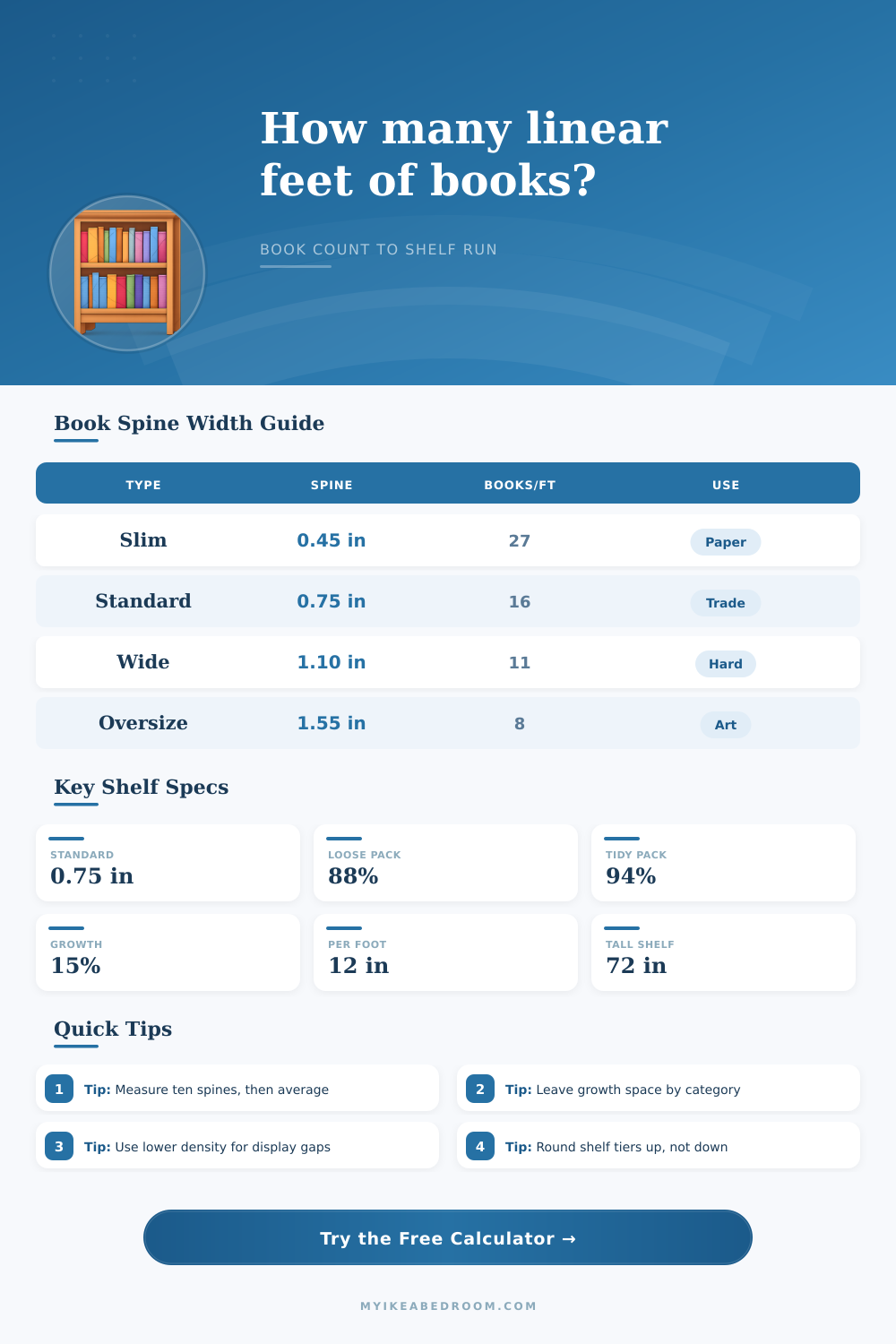
| Slim paperbacks | 0.35 to 0.55 in | 22 to 34 | Mass-market paperbacks, thin workbooks, slim volumes |
| Standard books | 0.60 to 0.90 in | 13 to 20 | Novels, trade paperbacks, general nonfiction |
| Wide books | 0.95 to 1.25 in | 9 to 13 | Hardcovers, textbooks, dense reference books |
| Oversize books | 1.30 to 1.80 in | 7 to 9 | Cookbooks, art books, atlases, photo books |
📋Packing Density Table
| Density Setting | Meaning | Multiplier Effect | When to Use |
|---|---|---|---|
| 82% airy display | 18% of run kept open | Needs about 1.22 times raw spine width | Books mixed with objects and face-out display |
| 88% loose browsing | 12% of run kept open | Needs about 1.14 times raw spine width | Collections handled often or grouped by topic |
| 94% tidy everyday | 6% of run kept open | Needs about 1.06 times raw spine width | Most bedroom shelves and home offices |
| 98% tight archive | 2% of run kept open | Needs about 1.02 times raw spine width | Dense storage shelves with minimal gaps |
📐Expansion Allowance Table
| Allowance | Extra Run Added | Planning Style | Useful For |
|---|---|---|---|
| 0% | No future gap | Exact-fit shelf | Finished collections and short-term sorting |
| 10% | 1.2 in per foot | Light growth | Occasional new books or rotating stacks |
| 15% | 1.8 in per foot | Balanced growth | Most active bedroom or office shelves |
| 25% | 3.0 in per foot | Longer runway | Fast-growing hobbies, study shelves, kids books |
📏Shelf Run Conversion Table
| Shelf Width | One Tier Run | Five Tiers | Notes for Book Count |
|---|---|---|---|
| 24 in shelf | 2.0 linear ft | 10.0 linear ft | Good for bedside or narrow tower shelves |
| 30 in shelf | 2.5 linear ft | 12.5 linear ft | Common compact bookcase width |
| 36 in shelf | 3.0 linear ft | 15.0 linear ft | Useful for wider storage and study shelves |
| 48 in shelf | 4.0 linear ft | 20.0 linear ft | Best checked for sag and support separately |
🗂Collection Comparison Grid
Paperback Dense
Many books fit per foot because most spines are slim, so density and growth allowance drive the final shelf run.
Balanced Library
A mixed shelf usually lands near three-quarters of an inch per book before packing gaps are added.
Hardcover Heavy
Fewer books fit per foot, so a modest count can still need several wide tiers.
Display Mixed
Lower density protects face-out books, bookends, and empty breaks without hiding that space in the count.
💡Shelf Planning Tips
When you are planning book shelves for your books, you must consider the linear feet that your books will requires. The linear feet of your bookshelf is different than the number of books that you own, as some books will have wider spines than others. While many individual may attempt to calculate the number of books that they own, such a calculation will be inaccurate if the individual doesnt account for the different widths of the book spines.
Thus, individuals will need to calculate the linear feet that are required for there shelves in order to ensure that the shelves will be of sufficient length for their books. The spine width of the books is one of the primary factor to consider in calculating the linear feet of book shelves that are necessary to hold the books that you plan to acquire. For example, books with thin spines, like mass market paperbacks, will have more books per foot of shelf space than books with wide spines, like art books of large size.
How to Measure Shelf Space for Your Books
Therefore, an individual will want to use the calculator to enter the number of inches of spine width for slim books, standard books, wide books, and oversize books in order to provide an accurate calculation of the linear feet that will be required for the books that you own. The packing density that you select for the books on the shelf is another factor that will impact the linear feet of shelves that will be required. For example, selecting a high rate of packing density, like 94%, indicates that there will be little space between the books that are place on the shelf.
In contrast, a lower rate of packing density, like 88%, will allow for books to have more space between them on the shelf. Thus, a lower packing density will require more linear feet of shelving to hold the same number of books as would be required with a higher packing density. Another factor to consider is providing an expansion allowance for the books that you plan to acquire in the future.
An expansion allowance allows for extra space on the shelves where you can place new books that you may acquire in the future. Therefore, if you make an expansion allowance now, you can avoid the need to purchase new book shelves in the near future if you acquire more books. Furthermore, an expansion allowance will prevent the shelves from being filled with books immediately after you have arranged all of your books.
The calculator allows you to separate the expansion allowance from the packing density for books to allow you to view the linear feet of book shelves that will be required with an expansion allowance. In addition to calculating the linear feet that are required for your books, you should also consider the dimensions of the shelves that will be used to provide such shelving for your books. For example, the usable length of the shelves may be less than the total width of the bookcase.
This is due to the fact that the shelves may have upright supports or tall items on the shelves may take up some of that length. Thus, you should use the calculator using the dimensions of your shelves to ensure that you accurately calculate the linear feet that will be required for your books. In order to provide an accurate calculation of the linear feet of shelving that will be required to hold all of the books in your collection, you should measure a sample of the books that you own.
For example, you can measure ten random books from your collection in order to determine the average spine width of your books. Considering that you measure ten random books from your collection allows you to avoid assuming that all of your books are the same size. Thus, you can enter the average spine width of your books into the calculator to determine the linear feet that will be required for your books.
Another factor to consider is the weight of the books that you will place on each shelf. For example, shelves made of particleboard that are longer than 36 inches may sag under the weight of books with thick covers unless the shelves includes center supports. Additionally, the metal shelves that are used for bookcases may bow if the shelves are too far apart.
Thus, you should consider the load ratings for each type of shelf that will be used. Furthermore, you should place the heaviest books on the lowest shelves. This will allow the bookcase to remain stable to avoid the bookcase tipping over.
Finally, the calculator will allow you to view the tradeoffs of spine width, packing density, and expansion allowance. For example, if you wish to browse your books while they are on the shelf, you will want to choose a lower packing density to allow for easy removal of books from the shelf. In contrast, if you plan to save space in your shelves, you will choose a higher packing density.
Thus, the calculator will allow you to make an informed decision about the linear feet of shelving that you should purchase for your books.