Bookcase Shelf Quantity Calculator
Plan how many shelves fit in a bookcase using inside height, shelf thickness, target spacing, adjustable pin holes, and top/bottom clearance.
1Choose a bookcase preset
2Enter bookcase and shelf details
Results update after calculation.
3Shelf profile reference
4Clear spacing capacity table
| Inside height | Target clear gap | Shelf thickness | Adjustable shelves | Likely use |
|---|---|---|---|---|
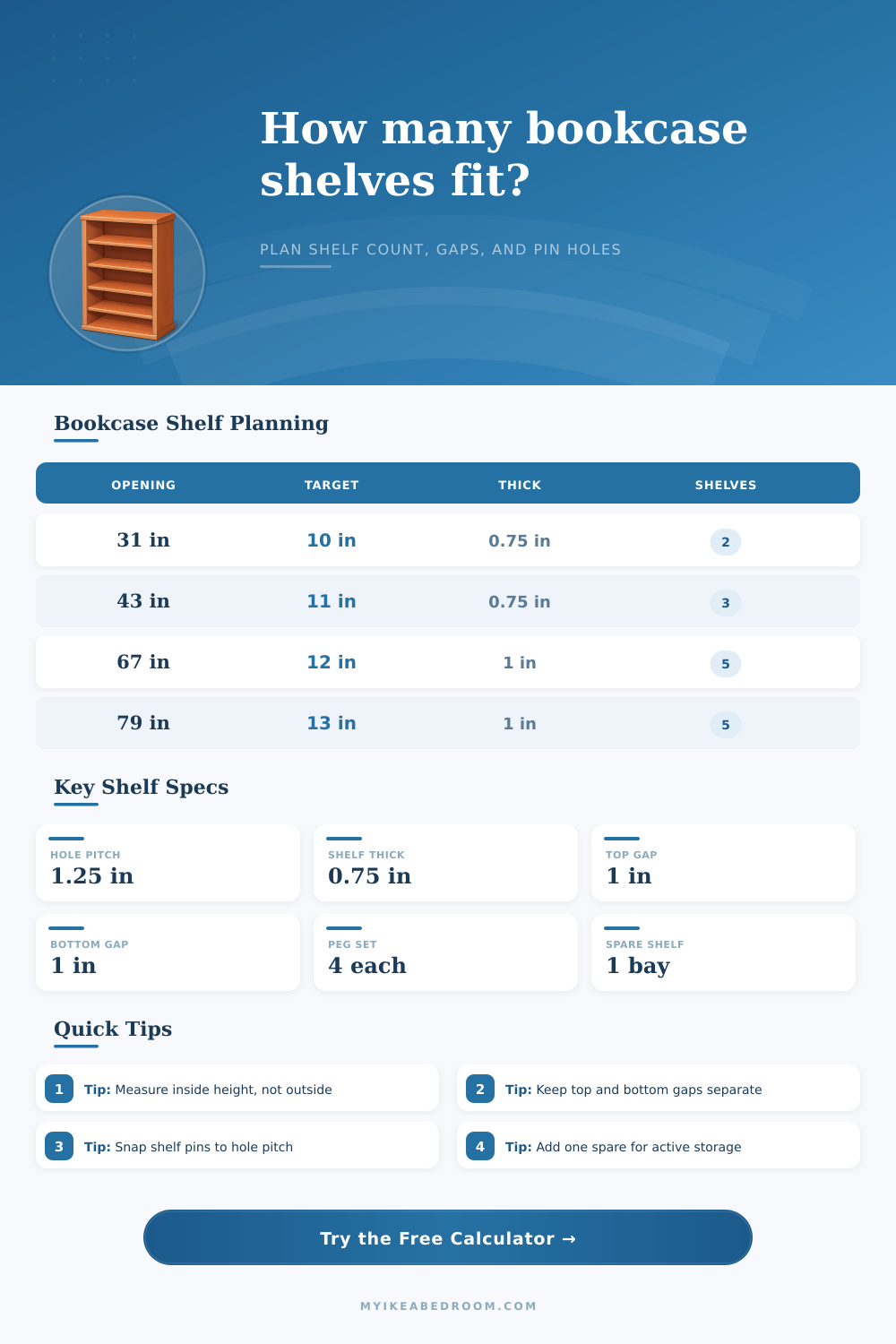
| 31 in / 79 cm | 9 to 10 in | 0.63 to 0.75 in | 2 per bay | Small paperbacks or display objects |
| 43 in / 109 cm | 10 to 11 in | 0.75 in | 3 per bay | Nightstand-height bookcase or kids books |
| 67 in / 170 cm | 11 to 12 in | 0.75 to 1 in | 5 per bay | Mixed bedroom books and folded storage |
| 79 in / 201 cm | 12 to 13 in | 0.75 to 1 in | 5 to 6 per bay | Tall bookcase with a balanced rhythm |
| 93 in / 236 cm | 13 to 15 in | 1 in | 5 to 6 per bay | Large books, boxes, or tall display stacks |
5Adjustable hole pitch guide
| Hole pitch | Metric match | Rows over 24 in | What it changes | Planning note |
|---|---|---|---|---|
| 1.00 in | 25.4 mm | 25 rows | Fine adjustment | Easy to tune display spacing closely. |
| 1.25 in | 31.8 mm | 20 rows | Common grid | Close to the 32 mm cabinet system pitch. |
| 1.50 in | 38.1 mm | 17 rows | Wider steps | Fewer choices; target gaps snap more visibly. |
| 2.00 in | 50.8 mm | 13 rows | Coarse steps | Works for storage shelves, not tight display layouts. |
6Shelf thickness and opening effect
| Shelf type | Typical thickness | Height used by 5 shelves | Best fit | Spacing effect |
|---|---|---|---|---|
| Thin melamine | 0.63 in / 1.6 cm | 3.15 in | Light display | Leaves the most open height. |
| Standard board | 0.75 in / 1.9 cm | 3.75 in | General books | Good balance of strength and spacing. |
| Thick board | 1.00 in / 2.5 cm | 5.00 in | Storage bins | Reduces clear gap faster in tall stacks. |
| Glass display | 0.38 in / 1.0 cm | 1.90 in | Collectibles | Thin shelf line keeps openings visually tall. |
| Metal utility | 0.90 in / 2.3 cm | 4.50 in | Heavy storage | Plan wider openings for the same contents. |
7Current layout comparison grid
These rows recalculate from your current bookcase height, shelf thickness, clearances, bays, fixed shelves, and hole pitch.
| Spacing mode | Target opening | Shelves per bay | Actual clear opening | Pin-hole cadence |
|---|---|---|---|---|
| Tight display | 9 in | 0 | 0 in | 0 rows |
| Balanced books | 11 in | 0 | 0 in | 0 rows |
| Tall books | 13.5 in | 0 | 0 in | 0 rows |
| Storage bins | 15.5 in | 0 | 0 in | 0 rows |
8Practical shelf planning tips
When planning a bookcase, one must calculate how many shelf will fit within the bookcase. People may think that planning a bookcase is a simple process. However, planning a bookcase are actualy quite difficult because the interior height of the bookcase is not the same than the exterior height of the bookcase.
The exterior height of the bookcase is the height of the bookcase from top to bottom, including the top and bottom panel of the bookcase. However, the interior height is the only measurement of the bookcase that is important to the planning of the bookcase. The thickness of the wood panel that make up the bookcase reduces the interior height.
How many shelves will fit in a bookcase
Another critical factor to consider when planning a bookcase is the thickness of the shelves that you will use for that bookcase. Thick shelf material will reduce the number of shelves that can be placed within the bookcase. However, thin shelf materials will allow for more book to be placed on the shelves.
The problem with thin shelf materials, though, is that they may sag under the weight of the books that is placed on the shelves. Therefore, it is important to consider the thickness of the shelf material, as the thickness will impact the height of the openings that are to be form within the bookcase. The third critical factor to consider when planning a bookcase is the spacing between the shelves that will be planned for the books.
It is important to decide on the spacing between the shelves, as well as the clearance that will be allowed at the top and bottom of the bookcase. The clearances are the distances between the shelves and the top and bottom panels of the bookcase. It is necessary to take into account both the top and bottom clearance for the same reasons that the spacing between the shelves is important.
If you dont account for these distances when building the bookcase, the shelves will not fit correct within the bookcase. Another important factor to consider in the planning of a bookcase is the use of adjustable pins systems for the shelves. Most bookcases have pre-drilled holes for the pins that will allow the shelves to be adjusted within the bookcase.
These pre-drilled holes are at specific intervals along the bookcase. Therefore, if you add shelves to the bookcase that are not at these specific intervals, the shelves will not be able to be placed within the bookcase at those desired height. Thus, it is important to consider the spacing of the pre-drilled holes in the bookcase.
Fixed shelves within a bookcase are another factor that will impact the total number of shelves that can be within the bookcase. Any shelves that are pre-planned within a bookcase will take up some of the interior height of the bookcase. Thus, the height of the fixed shelves will reduce the number of adjustable shelves that can be added to the bookcase.
Therefore, it is important to account for the fixed shelves within the bookcase when planning the bookcase. Additionally, it is important to consider the purchase of spare shelf. Spare shelves can be purchased to place within the bookcase in the event that one of the shelves is damaged, or in the case that one is to change the layout of the books within the bookcase.
Factor four to consider is the weight of the item that will be placed upon the shelves within the bookcase. Heavy books will require more support within the bookcase than that provide by light books. Additionally, if you do not construct the shelves within the bookcase to support the weight of the heavy books that are to be placed upon those shelves, the shelves may sag beneath the weight of the books.
Finally, another factor that should be considered in the planning of a bookcase is the use of a calculator. The calculator will allow for the input of the interior height of the bookcase, the thickness of the shelves, the spacing between the shelves, and the clearances. Based off these measurement, the calculator will display how many shelves will fit within the bookcase.
Thus, the use of a bookshelf calculator will help to avoid mistake in the building of the bookcase, and will allow for an understanding of the way in which altering any measurement will impact the total number of shelves that can be within the bookcase.