Bookcase Depth for Books Calculator
Size a bookcase by usable shelf depth, actual book formats, backing gap, face frame loss, glass door clearance, front reveal, and the number of books per shelf.
Choose a common book storage setup, then adjust the book mix and construction clearances to match the shelf you are planning or checking.
What the calculator checks
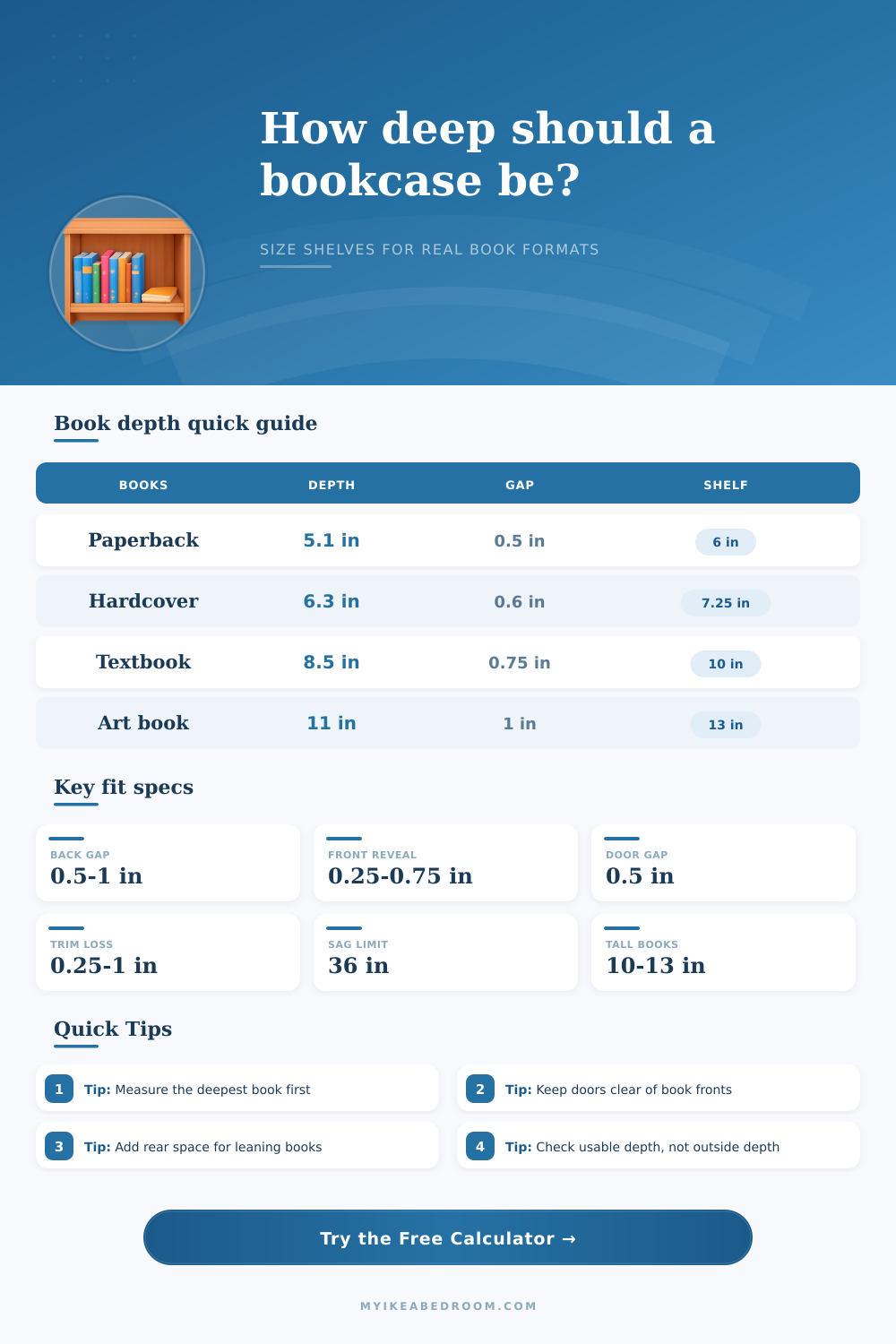
Book depth is the spine-to-front dimension that decides shelf depth, not the book height.
Usable depth is what remains after backing, doors, face frames, trim lips, and wall standoff are removed.
Outside depth is the cabinet or bookcase depth you see in a product listing. A 11 inch bookcase may have much less usable shelf space.
Capacity uses shelf width, average spine thickness, and a small hand-clearance allowance so shelves are not packed too tightly.
| Book type | Typical book depth | Minimum usable depth | Comfortable outside depth | Notes |
|---|---|---|---|---|
| Mass-market paperbacks | 4.2 to 4.5 in | 5.0 in | 6.0 to 7.0 in | Best for shallow hallway or bedroom shelves. |
| Trade paperbacks | 5.0 to 5.5 in | 6.0 in | 7.0 to 8.0 in | Add more depth if books lean or covers vary. |
| Hardcover novels | 6.0 to 6.8 in | 7.25 in | 8.0 to 9.5 in | Works well for most living room bookcases. |
| Textbooks and reference | 7.5 to 9.0 in | 9.25 in | 10.0 to 12.0 in | Use shorter spans or reinforced shelves. |
| Cookbooks | 8.0 to 10.0 in | 10.5 in | 11.0 to 13.0 in | Door and hinge clearance matter. |
| Art books and atlases | 10.0 to 13.0 in | 12.5 in | 13.0 to 15.0 in | Oversize books may be better stacked flat. |
| Feature | Typical loss | When to use it | Depth impact | Field in calculator |
|---|---|---|---|---|
| Thin hardboard back | 0.125 to 0.25 in | Flat-pack bookcases with a nailed-on back | Small but real | Back panel loss |
| Recessed back or wall gap | 0.5 to 1.5 in | Cases that sit proud because of baseboard or cables | Can decide the fit | Back panel loss |
| Face frame or front rail | 0.25 to 1.0 in | Framed bookcases, raised lips, or decorative trim | Reduces front clearance | Door or trim loss |
| Glass door swing clearance | 0.5 to 1.25 in | Doors that close in front of books or binders | Needs extra setback | Door or trim loss |
| Sliding door track | 0.75 to 1.5 in | Cabinets with overlapping sliding fronts | Can be severe | Door or trim loss |
| Intentional front reveal | 0.25 to 0.75 in | When you want spines behind the front plane | Improves appearance | Front reveal |
| Shelf span | Light paperbacks | Mixed books | Heavy textbooks | Practical note |
|---|---|---|---|---|
| 18 to 24 in | Very safe | Very safe | Usually safe | Good for adjustable bookcase sections. |
| 25 to 30 in | Safe | Good | Watch thickness | Common flat-pack shelf width. |
| 31 to 36 in | Good | Check sag | Reinforce | Use thicker shelf stock for hardcovers. |
| 37 to 42 in | Borderline | Reinforce | Avoid | Add center support or fixed shelves. |
| 43 in plus | Reinforce | Avoid | Avoid | Books are dense; long spans bow quickly. |
| Scenario | Book depth | Usable target | Outside target | Capacity cue |
|---|---|---|---|---|
| Bedroom novels | 5.5 to 6.5 in | 7.0 in | 8.0 to 9.0 in | About 25 novels on a 30 in shelf. |
| Home office reference | 8.0 to 9.0 in | 9.5 in | 10.5 to 12 in | Use shorter shelf spans. |
| Living room display | 6.5 to 10 in | 10.5 in | 11.5 to 13 in | Leaves room for objects and doors. |
| Kids picture books | 9.0 to 11 in | 11.5 in | 12.5 to 14 in | Allow hand clearance for browsing. |
| Compact paperback wall | 4.5 to 5.2 in | 5.75 in | 6.5 to 7.5 in | Efficient if books are uniform. |
Measure the deepest keeper book. A single cookbook, textbook, atlas, or record sleeve can set the whole shelf depth even if most books are smaller.
Compare usable depth, not catalog depth. Product listings often give outside depth before subtracting the back panel, door rail, face frame, and intentional setback.
Do not pack capacity to the mathematical maximum. A small hand gap keeps books removable and reduces damage to covers and dust jackets.
Depth and sag are linked. Deeper shelves invite heavier books, so long adjustable shelves may need shorter spans or a fixed center divider.
Before purchasing a bookcase, take note of how deep your books is. I know many people select piece of furniture by its width or height, then forget to consider depth of their own collections.
The average trade paperback measures approximately five inches in depth. An oversized art book might measure eleven inches deep. This six inch disparity affects not only the functionality of the shelf but also the appearance. A shallower shelf cause your books to stick out which creates an awkward look that you cannot fix.
Why Book Depth Matters
Real shelves also has physical limitations. The calculator requires some inputs. Consider how actual case will be built. How much does it take up?
A flat-pack bookcase have that annoying thin panel on the back. That’s a quarter-inch behind the books. What about adding set of glass doors? Those cost you another half-inch (or more). Then there are those pesky hinges that swing into the cabinet, stealing more depth. The calculator subtracts these away for you. It helps calculate actual usable depth with all the hardware and trim accounted for. No more textbooks lodged in behind a door rail.
Shelves can also sag. Long stretches of thin wood or particle board can’t stand up to heavy hardcover books. Over time, shelves full of, say, encyclopedias will start bowing in the middle… Even if it’s just a 36-inch span. That doesn’t matter whether your case has a six-inch deep shelf or a 12-inch one.
To get an idea about how vulnerable your build might be to this, the calculator take into account the stiffness of your shelves. Deep shelves tend to store more weighty books. So you may have to use reinforcement brackets and/or shorten your span length to maintain straight shelves. Letting them go causes spine warping and edge cracking of shelf itself.
Think about the books’ backsides, too. Some designs tightly pack the books up against the rear panel. Looks nice and neat that way. But humid weather can cause leather-bound classics to expand. Hard covers scraping against other hard surfaces will shred dust jackets. Give yourself some breathing room so covers aren’t damaged. So books have wiggle room, but are not squeezed. That’s good collection protection.
See how much depth you need for comfortable vs. See how much depth you need for comfortable vs. Minimum depths for different formats in the reference table.
To get the most out of your space, perhaps cram as many books as possible into each shelf. Don’t. Books require hand clearance, otherwise pulling one off the shelf will knock it over and mess up the ones next to it. The capacity calculation include a buffer. Having marginally less space than an overstuffed bookshelf is preferable to a shelf whose spines are all under pressure. Overstuffed shelves mean roughened edges. It is also frustrating to browse. Why? You’re allowing your library some breathing room. Treat this more like your bookshelf, not a warehouse shelf-rack.
It’s not really about the box when buying a bookcase; it’s about what goes inside it. Before shopping, measure how deep your deepest books are. Make sure there is enough clearance from wall. Be aware that wall baseboards can take up valuable interior space. If you want to avoid open shelving, factor in doors.
Having depth correct means that the spines will line up nicely. The shelves remains flat. Your collection appears curated, not crammed. This transforms a piece of furniture into a proper library.
Use the deepest volume in your hand as a starting point. That should of inform everything else. Nothing sticks out; that ruins the look of a room quicky.