Boiler Size for House Calculator
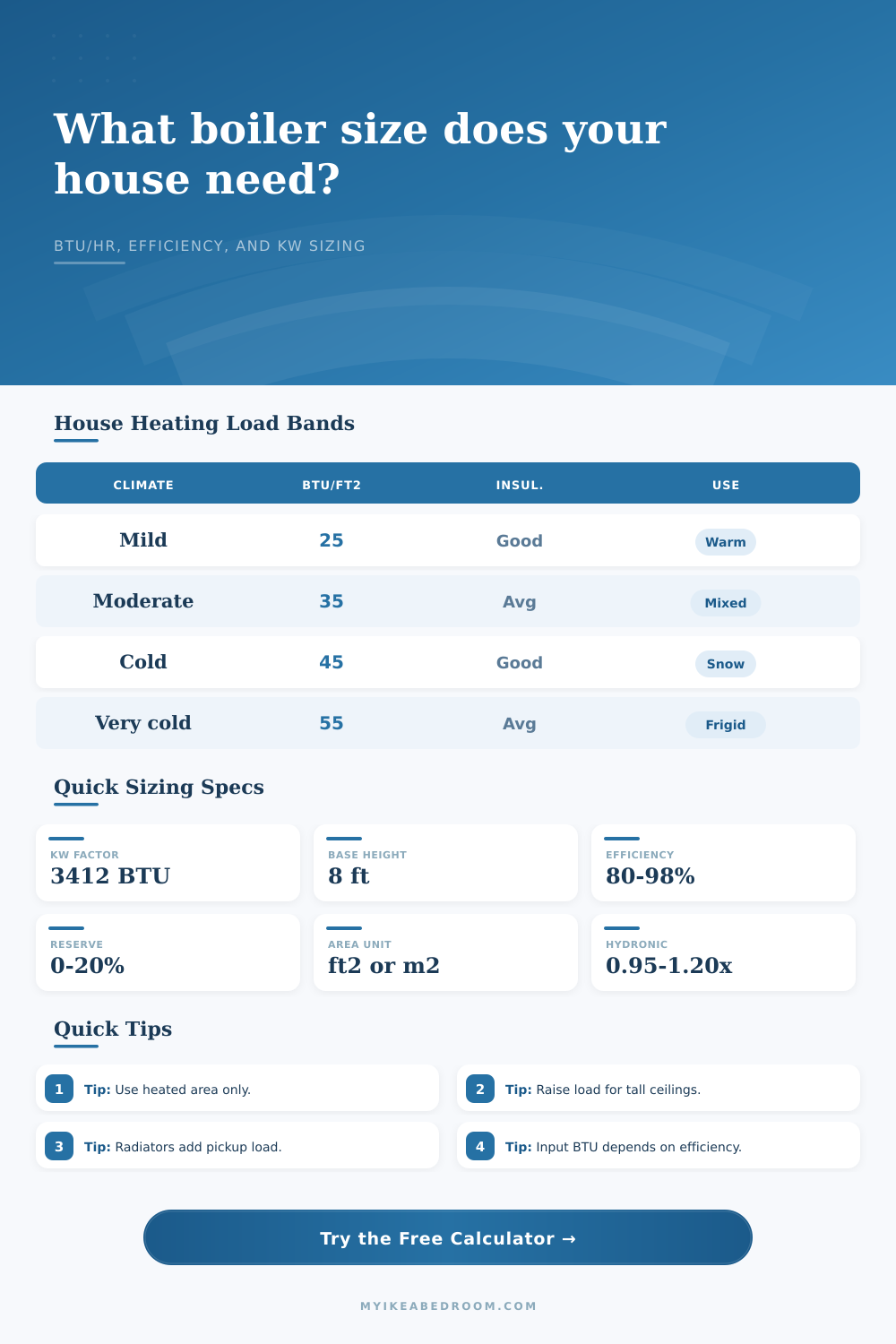
Estimate required boiler output from house area, climate load, insulation, ceiling height, hydronic pickup, efficiency, and the 3,412 BTU/hr per kW conversion.
🏠House presets
⚙Boiler sizing inputs
Boiler sizing result
🧮Core boiler formulas
📊Boiler sizing reference tables
| Climate | BTU/hr per ft² | Typical house match | Load note |
|---|---|---|---|
| Mild | 25 | Warm winter region | Lower design load |
| Moderate | 35 | Mixed seasonal climate | Common baseline |
| Cool | 40 | Longer heating season | Higher envelope demand |
| Cold | 45 | Snow and freezing periods | Strong heating load |
| Very cold | 55 | Low design temperatures | High output needed |
| Extreme | 60 | Exposed or severe winter | Use careful review |
| Condition | Factor | When to use | Effect |
|---|---|---|---|
| Excellent insulation | 0.85x | Modern tight envelope | Lower output |
| Good insulation | 0.95x | Updated windows and attic | Slight reduction |
| Average insulation | 1.00x | Typical existing house | Baseline |
| Fair insulation | 1.12x | Mixed upgrades | Adds load |
| Poor or drafty | 1.25x | Leaks or weak insulation | Raises load |
| Ceiling height | Height / 8 | Average heated height | Volume factor |
| System type | Factor | Best match | Reason |
|---|---|---|---|
| Radiant floor | 0.95x | Steady low-temp loops | Even delivery |
| Balanced radiators | 1.00x | Normal hydronic system | Baseline pickup |
| Baseboard | 1.05x | Fin-tube zones | Moderate pickup |
| Cast iron | 1.10x | Large old radiators | More mass |
| High mass loops | 1.15x | Long or slow zones | Slower response |
| Cold-start pickup | 1.20x | Frequently cooled house | Fast recovery |
| Output load | Efficiency | Input BTU/hr | Output kW |
|---|---|---|---|
| 40,000 BTU/hr | 80% | 50,000 | 11.7 kW |
| 40,000 BTU/hr | 90% | 44,444 | 11.7 kW |
| 60,000 BTU/hr | 80% | 75,000 | 17.6 kW |
| 60,000 BTU/hr | 95% | 63,158 | 17.6 kW |
| 90,000 BTU/hr | 90% | 100,000 | 26.4 kW |
| 90,000 BTU/hr | 95% | 94,737 | 26.4 kW |
| House scenario | Area | Climate | Approx output |
|---|---|---|---|
| Tight apartment | 850 ft² | Mild | 20,000 to 30,000 BTU/hr |
| Average townhome | 1,400 ft² | Moderate | 50,000 to 60,000 BTU/hr |
| Cold family home | 1,900 ft² | Cold | 80,000 to 95,000 BTU/hr |
| Older drafty house | 1,650 ft² | Cold | 95,000 to 115,000 BTU/hr |
| Very cold farmhouse | 2,400 ft² | Very cold | 145,000 to 170,000 BTU/hr |
| High ceiling home | 1,700 ft² | Moderate | 75,000 to 90,000 BTU/hr |
| BTU/hr | kW | BTU/hr | kW |
|---|---|---|---|
| 18,000 | 5.3 | 72,000 | 21.1 |
| 24,000 | 7.0 | 84,000 | 24.6 |
| 36,000 | 10.6 | 96,000 | 28.1 |
| 48,000 | 14.1 | 120,000 | 35.2 |
| 60,000 | 17.6 | 150,000 | 44.0 |
| 66,000 | 19.3 | 180,000 | 52.8 |
💡Sizing notes
Rarely do you have the furnace installed on the coldest night of the year. Typically, that happens three weeks after installation when the wind picks up and temperatures realy plummet. If your heating system hesitates then, you didn’t oversize it by accident; you undersized it by design. In fact, you undersized it by design.
A properly sized boiler is as much a matter of careful design as it is raw power. It’s a balancing act between efficiency and comfort that most homeowners don’t pay attention to…until the thermostat won’t move to the number where they want it.
How to Choose the Right Boiler Size
Once you input your insulation quality, your local climate severity and your square footage, the calculator does all the complicated math for you (above). You won’t have to guess and end up buying a unit that is too large or too small.
There’s a simple baseline: Start with the heated space in your home. But forget about that room in the basement that hasn’t been finished since the ’70s, or the garage where you keep all those old paint cans. From there add a climate load factor, here’s where importance of geography comes into play. If your winter weather is mild, you may only need twenty-five BTUs per square foot, but if your climate is really cold, you’ll need at least fifty-five or more.
It’s not simply a bunch of numbers on a spreadsheet. It’s the difference between a drafty icebox and a cozy living room.
Insulation acts as a multiplier that is either saving you money or draining it out of your bank account. The tool adjusts the load down if you’ve sealed off your attic and upgraded your windows. Your zero-point-eight-five envelope rating, that’s great! Like a thermos, your house are retaining heat.
On the other hand, if you live in an older drafty home with single pane windows, that factor gets pushed up to one-point-two-five. Air leakage is the silent killer of heating budgets; the calculator takes this reality into account. You may have the most powerful boiler on the block, but if your house has holes all over it, that heat’s just going to leak out of the cracks. The tool forces you to acknowledge what shape your building shell is in before spending money on equipment.
Another tripping point is ceiling height. By default, the size estimates assumes an eight-foot ceiling. High-beam kitchens and vaulted living rooms create a much larger volume of air that needs to be warmed. To account for this, the calculator compares how tall your average space is to that eight-foot baseline.
Taller spaces need not only more time to warm up to the target temp, they must also fight the natural tendency of warm air to rise, creating stratification where the bottom part of the room isn’t cold… even if you don’t feel like it’s cold on the floor. This is a minor change in the input field, but it makes a big difference for comfort.
Depending on the hydronic system (or radiator) you select there will be an expected output as well. For example, radiant floors are very stable and effective, generally requiring a bit lower peak output because they can retain heat through thermal mass and continue providing it even while the burner is off.
On the other hand, baseboards or cast iron radiators each has their flaws. They take time to warm up, and they also cool more slowly. The hydronic allowance factor takes into consideration the mass of these types of systems. A cold-start pickup allowance means you want the system to recover quickly after you return from vacation. Quick recovery has its price: required output capacity.
The last filter is efficiency. If your boiler has a ninety-five percent efficiency rating, it gives almost every BTU of energy that it draws to you; an eighty-percent one loses more heat up the flue. Your calculator uses the efficiency number to calculate the amount of BTUs needed for your required output. It then gives you the kilowatt equivalent in case you want to compare different types of energy or look at alternatives like an electric heat pump.
This is explained simply in table of references at the bottom of the page, with example calculations from a forty-thousand BTU load at various efficiency ratings.
The biggest error made by homeowners is oversizing their heat. Short cycling (a big furnace coming on and off repeatedly) makes the system inefficient; it uses more fuel, wears out parts faster, and doesn’t keep your house warm all the time. Imagine if you were driving a sports car through stop-and-go traffic. It is not efficient. And you paid a premium for the privlege. Don’t fall into the oversized trap!
Use an estimating tool to size the correct load. This directs you to a unit sized specifically to meet the needs of your home. Not some salesperson’s upsell plan.
So what’s the point? Comfort is not about having the highest possible BTU rating in the end. But rather the right amount of heat, delivered consistently, without waste. The key is that during extreme weather like a deep freeze, you simply want it to run smoothly and quietly all night long. It should maintain the temperature you set without fighting for it.
And if done right, sizing ensures that your home remains a quiet refuge from the storm when the wind howls outside. You should of checked this first.