Board Game Shelf Capacity Calculator
Estimate how many board game boxes fit in a shelf opening, cube unit, or storage bin using box dimensions, storage orientation, clearance, fill rate, box weight, and load rating.
Start with a common shelf or cube scenario, then adjust every measurement to match the real inside space.
Board game shelf capacity result
| Game type | Typical box size | Average weight | Shelf fit note |
|---|---|---|---|
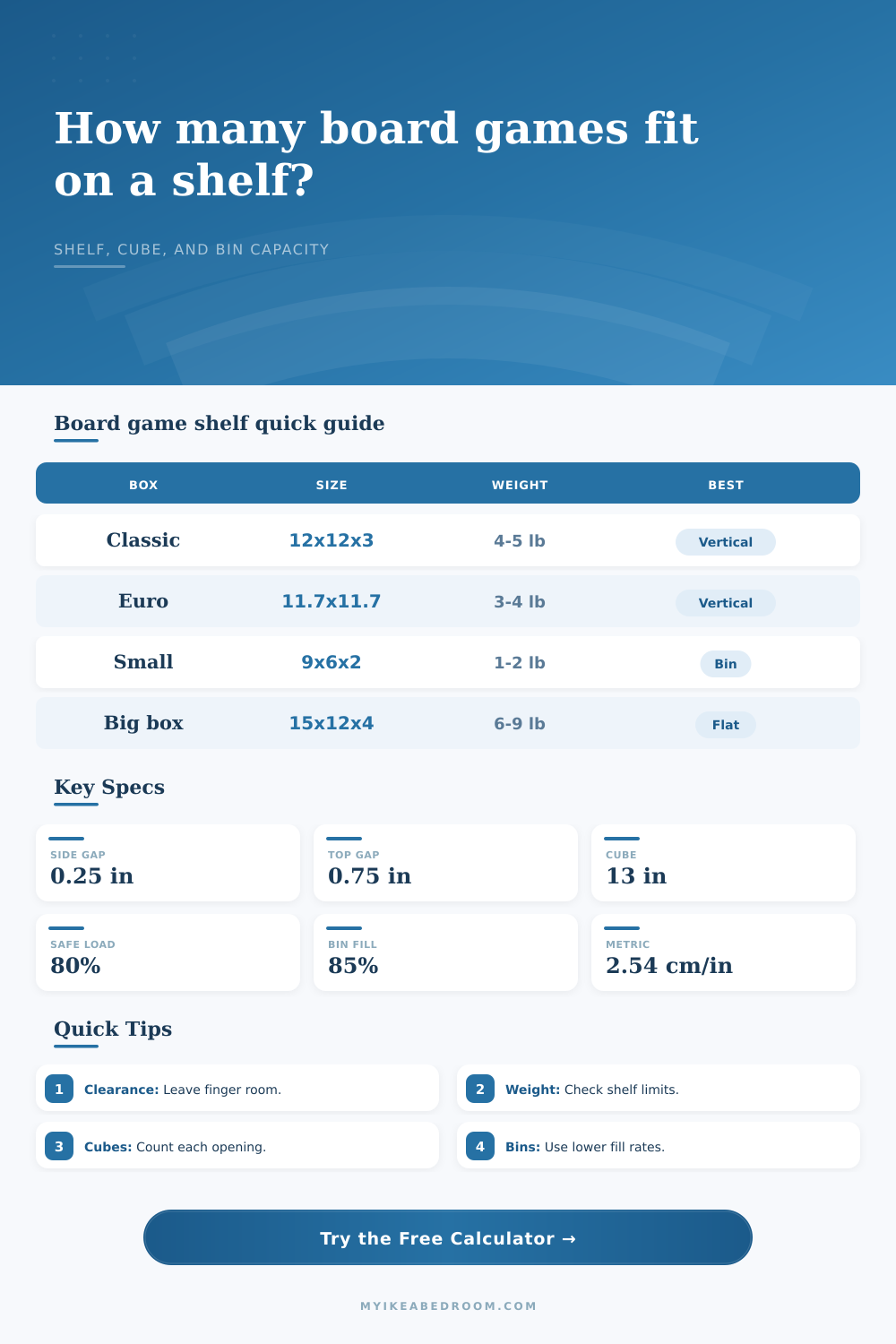
| Small card game | 9 x 6 x 2 in / 23 x 15 x 5 cm | 1-2 lb / 0.5-0.9 kg | Works well in bins or shallow cubes. |
| Family square | 10 x 10 x 2 in / 25 x 25 x 5 cm | 2-3 lb / 0.9-1.4 kg | Can stack flat if shelf height is generous. |
| Classic hobby box | 12 x 12 x 3 in / 30 x 30 x 8 cm | 4-5 lb / 1.8-2.3 kg | Needs about 13 inches of shelf height upright. |
| Euro square box | 11.7 x 11.7 x 2.8 in / 30 x 30 x 7 cm | 3-4 lb / 1.4-1.8 kg | Often fits 13 inch cube openings upright. |
| Big strategy box | 15 x 12 x 4 in / 38 x 30 x 10 cm | 6-9 lb / 2.7-4.1 kg | Usually needs flat stacks or a deep shelf. |
| Long map box | 17 x 12 x 3 in / 43 x 30 x 8 cm | 5-8 lb / 2.3-3.6 kg | Check width before planning spine-out rows. |
| Opening style | Inside width | Inside depth | Inside height |
|---|---|---|---|
| Compact cube opening | 13 in / 33 cm | 13 in / 33 cm | 13 in / 33 cm |
| Wide bookcase shelf | 30 in / 76 cm | 11-13 in / 28-33 cm | 12-13 in / 30-33 cm |
| Deep storage shelf | 30 in / 76 cm | 15-16 in / 38-41 cm | 13-15 in / 33-38 cm |
| Low cabinet shelf | 27 in / 69 cm | 14-15 in / 36-38 cm | 10-12 in / 25-30 cm |
| Pull-out fabric bin | 12 in / 30 cm | 12 in / 30 cm | 11 in / 28 cm |
| Media shelf opening | 22 in / 56 cm | 14 in / 36 cm | 9-10 in / 23-25 cm |
| Orientation | Width consumed | Depth consumed | Main capacity limit |
|---|---|---|---|
| Vertical spine-out | Box thickness plus side gap | Box depth plus back gap | Shelf height must clear the box front width. |
| Vertical turned sideways | Box thickness plus side gap | Box front width plus back gap | Deep shelves only; useful for tall narrow openings. |
| Horizontal flat stacks | Box front width plus side gap | Box depth plus back gap | Stack height and weight create the hard limit. |
| Face-forward display | Box front width plus side gap | Box thickness plus back gap | Great visibility, lowest capacity per shelf. |
| Mixed storage | Blended from vertical and flat results | Uses both row and stack math | Helpful when expansions and big boxes share space. |
| Planning item | Typical allowance | Why it matters | Calculator field |
|---|---|---|---|
| Side clearance | 0.25-0.5 in / 0.6-1.3 cm | Lets boxes slide out without binding. | Side clearance per box |
| Depth clearance | 0.5-1 in / 1.3-2.5 cm | Allows doors, backs, bin lips, and sleeve edges. | Depth clearance |
| Top clearance | 0.5-1.5 in / 1.3-3.8 cm | Prevents upright boxes from scraping. | Top clearance |
| Safe load planning | 70-90% of listed rating | Reduces sag risk on long or adjustable shelves. | Useable load rating |
| Bin fill rate | 75-90% of geometric fit | Bins lose volume to sides, handles, and mixed shapes. | Cube/bin fill efficiency |
| Collection layout | Typical opening count | Best box type | Planning watchout |
|---|---|---|---|
| One display shelf | 1 shelf | Favorite large boxes | Capacity is usually depth-limited. |
| Small cube stack | 4 cubes | Euro squares and family games | Measure dividers inside each cube. |
| Large cube wall | 8-16 cubes | Mixed medium boxes | Weight is spread, but each cube still has a limit. |
| Closed cabinet row | 2-4 shelves | Party and card games | Door hinges can steal side clearance. |
| Heavy strategy shelf | 1-2 shelves | Large or deluxe boxes | Use load-limited capacity, not just geometric fit. |
It’s an illusion: the shelf looks perfectly empty until you start filling it. First, a big strategy game in a chunky box gets added. Then come some card games which are thinner but take more space. Soon, flat stacks pushes into each other and the spines-out rows rub shoulders. Finally, that massive box of your favourite wargame crushes the shelf bracket. That’s what happens if you collect board games. It’s not as much about having lots of them, it’s about cardboard boxes fitting inside fixed wooden dimensions (and limits).
Once you type in your dimension, the calculator does all of the geometry for you, meaning you never has to guess how many game fit between dividers. Sure, maybe you assume a dozen inch cube could hold 4 classic hobby box next to each other? Wrong. Classic hobby boxes is fat. They also need some kind of clearance for your fingers, otherwise you’ll rip the corner right off trying to pull it out. This gap plays into the friction against your box and the calculator allows you to input a side clearance. Most people leave this half inch gap for dead and jam boxes up against each other until they’re stuck. Using this calculator mean planning for that airspace that keeps game playability.
Stop Guessing: Plan Your Game Shelf
A lot of shelving fails because of weight. You may feel comfortabley with a few games on a shelf… One family game box doesn’t weigh much after all! But then you see 20 of them and now that’s a different story on particle board shelf. It will ask how heavy your games are (on average) and what your shelves can hold, then compare them. Say your shelf can handle thirty pounds, and your games has an average of four pounds each, so you’re already at danger zone after putting out seven games on the shelf. The calculator will display that number and prevent the sag you get from assuming a shelf have capacity when it is actualy too weak to hold weight.
How they’re stored makes a big difference. Boxes that are stacked flat save space vertically, at the cost of depth and more weight in one spot. Boxes that are stored upright use their width most effectively but require height instead. You can switch back and forth with the tool, which displays both cases; how much you’ll be able to fit spine-out vs. It also shows how much you can fit in a flat pile. In most cases the tradeoff is obvious. If your shelves aren’t very tall, then storing games upright will give you more total storage space. But if your shelves *are* short, you stand to break them if you store your games upright. And if your shelves are tall enough to support taller stacks, then you might as well get even more efficient use out of height by just stacking things flat! This breaks the typical pattern though so keep an eye on that.
There’s also a reference table on the page showing the same thing for various different kinds of boxes, including how a long map game messes things up. And then there are the cubes and bins. A cube is not just a box. It’s a box with thickness and divider walls. The tool takes these into account so you can specify how full you want your game cube to be. Even more space goes to waste in bins due to the bin’s handle and the fabric sides, meaning you could fit more games on an open shelf than you would in a pull-out basket. Even though the basket might appear larger on the exterior. The tool accounts for that wasted space in its calculations so you don’t plan for games that won’t physically fit into the container.
And speaking of which: If you don’t feel like measuring out every millimeter, no worries, there are presets. Choose between a regular cube or a deep shelf for a bookcase and go from there, tweaking dimensions around to match. Maybe your shelves are a bit narrower. Maybe you have those deluxe edition games that weigh more because of the wood pieces inside. That’s fine; the beauty is in the flexibility and shifting you from guessing to actualy planning out things.
It’s not about cramming one more game on there. It’s about creating something that will last. You can pull it off the shelf and play with ease. It holds your collection safely and proudly for years. And the way you do that is by using the tool. You feed it the info that helps you make those decisions. You turn a guesswork situation into a numbers game.
Feed it the games you’ve got. Feed it the space where they’ll go. The calculator does the rest. It tells you the truth about what fits. Then you choose what you like.