Bench Seat Fabric Calculator
Estimate upholstery fabric for bench cushions, boxed edges, banquette backs, skirt drops, repeat matching, and welt cord strips.
Fabric Yardage Breakdown
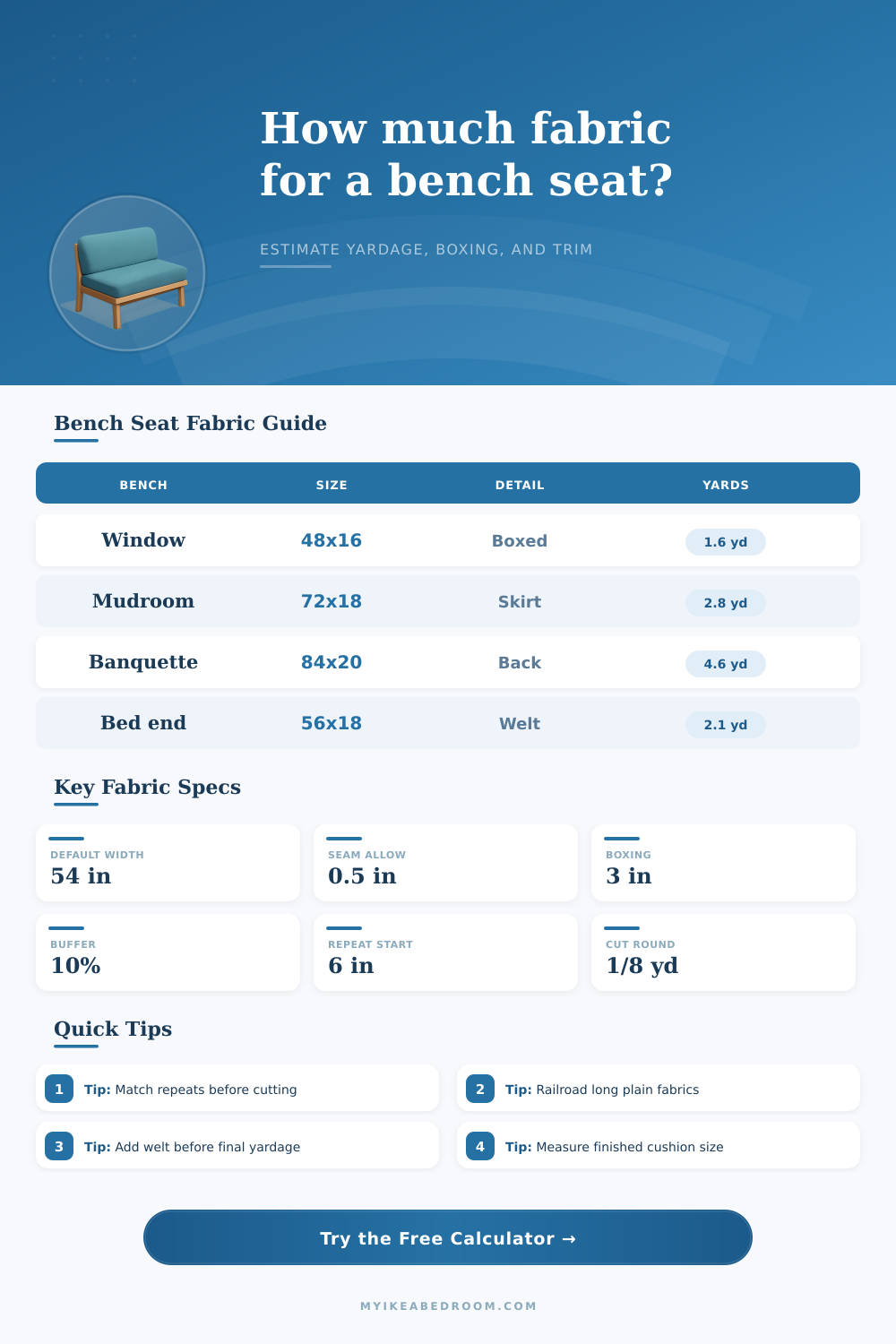
| Bench project | Finished seat size | Common details | Typical 54 in fabric need |
|---|---|---|---|
| Small window seat pad | 42 in × 15 in | Flat or 2 in boxed edge | 1.1 to 1.5 yd |
| Mudroom cubby bench | 60 in × 18 in | 3 in boxing, top welt | 2.0 to 2.7 yd |
| Dining banquette seat | 84 in × 20 in | Boxed seat plus back panel | 4.0 to 5.6 yd |
| Bed foot bench | 56 in × 18 in | Wrapped top, bottom welt | 1.8 to 2.5 yd |
| RV dinette cushion | 44 in × 22 in | Boxed removable cushion | 1.7 to 2.4 yd |
Ranges assume a plain 54 in upholstery fabric, moderate seam allowance, and no oversized motif placement.
| Usable width | Best use on bench seats | Layout note | When to add seams |
|---|---|---|---|
| 45 in | Small pads and narrow benches | Depth usually fits across width | Long or deep banquette backs |
| 54 in | Most upholstery bench cushions | Standard for boxed tops and backs | Seats wider than fabric width |
| 60 in | Railroaded plain fabrics | Can reduce long-bench yardage | Directional prints may not rotate |
| 118 in | Extra-wide or seamless panels | Rare for upholstery weight goods | Check stability before use |
| Vertical repeat | Planning effect | Suggested buffer | Bench-seat caution |
|---|---|---|---|
| 0 to 2 in | Minimal matching loss | 5% to 10% | Still square stripes to the front edge |
| 3 to 6 in | Panels may round up one repeat | 10% | Check boxing strip alignment |
| 7 to 13 in | Noticeable motif placement | 10% to 15% | Center the top panel before cutting |
| 14 in or more | Large repeat planning required | 15% to 20% | Back panels may need extra length |
| Bench detail | Fabric pieces added | Typical extra | Calculator input to adjust |
|---|---|---|---|
| Boxed cushion | Continuous side band | Perimeter strip | Cushion thickness |
| Front skirt | Drop panel below cushion | Length plus hem | Skirt drop and coverage |
| Banquette back | Face panel behind seat | Length by height | Back panel height |
| Covered welt | Bias or straight strips | 2 in strip width | Welt cord plan |
In order to calculate the amount of fabric needed for a bench seat, it is necessary to measure the finished dimensions of the cushion. People often make the mistake of measuring the wooden frame of the bench to obtain these measurements, but the cushion will be thicker and include layer of foam and batting. The measured dimensions will include the thickness of the foam and batting layers to determine how much fabric is necesary to cover the entire bench seat.
The fabric calculator require three different measurements from the finished cushion to determine the amount of fabric necesary to sew the bench seat. The length and depth of the seat will determine the size of the top panel of the seat, but the thickness of the seat will determine the length of the boxing strip that will cover the side of the seat. If the thickness of the seat are changed, the perimeter of the bench will change, which will alter the amount of fabric required for the boxing strip.
How Much Fabric You Need for a Bench Seat
Another factor that must be considered is the type of fabric that you will utilize for the bench seat. Many fabrics has a pattern repeat; the distance between the same motif in the design of the fabric. If you are to position the pattern of the fabric in such a way that it aligns with the boxing strip on the bench, it will be necessary to purchase additional fabric to allow for the pattern to be accounted for in the cut of the fabric.
The calculator accounts for the pattern repeat of the fabric by lengthening each piece of fabric to the distance to the next repeat of the pattern, and it displays the total length of the fabric roll that is required. The type of fabric that you will use can influence the amount of fabric that is required to create the bench seat. Fabric types like velvet or boucle have a nap, which is the direction in which the fibers of the fabric lay.
The direction of the nap of the fabric can change the amount of fabric that is required. Similarly, vinyl and faux leather will have a more different seam allowance than linen blend fabrics. The type of fabric selector included with the calculator allow for the addition of a percentage of fabric to provide for these different fabric types.
Finally, additional component to the bench will increase the total amount of fabric that will be required to complete the bench. The addition of a front skirt will increase the amount of fabric needed to cover the drop length of the skirt. The addition of a banquette back will require an additional panel of fabric to that be added to the total amount of fabric required.
If the back of the bench will feature the same pattern as the bench seat, an additional amount of fabric will be required for the back to ensure that the pattern can be accounted for. Welt cord is an additional strip of fabric that you will use to edge the seat. The addition of welt cord will increase the amount of fabric required for the project.
The length of the welt cord can be accounted for in the calculator. Another decision that must be made is whether to include an underside treatment for the cushion. A full fabric bottom panel will require more fabric than a partial dust cover.
Each of these underside treatments can be accounted for in the calculator to determine the total amount of fabric required for the project. The reference tables included in the article can provide an idea of the amount of fabric required for common sizes of benches. The tables include the amount of fabric required for standard sizes of benches (54 inches in width), and the interaction of the pattern repeat of the fabric with the width of the fabric roll.
These tables are useful in forming an idea of the amount of fabric that will be required for the bench, but the calculator will provide the precise amount of fabric necessary for the project. Finally, it is always necessary to purchase in addition to the amount of fabric that is calculate by the calculator. It is always a good idea to purchase an additional safety margin for the fabric to ensure that there is enough to complete the project.