Spacing safety, mattress support, and sag risk
Bed Slat Spacing Calculator
Check whether a fixed slat layout leaves safe clear gaps for memory foam, latex, hybrid, innerspring, futon, bunk, adjustable, or air mattresses.
A small clear gap usually matters more than a large slat count because foam, latex, and thin mattresses can bridge poorly over wide openings.
Calculation Breakdown
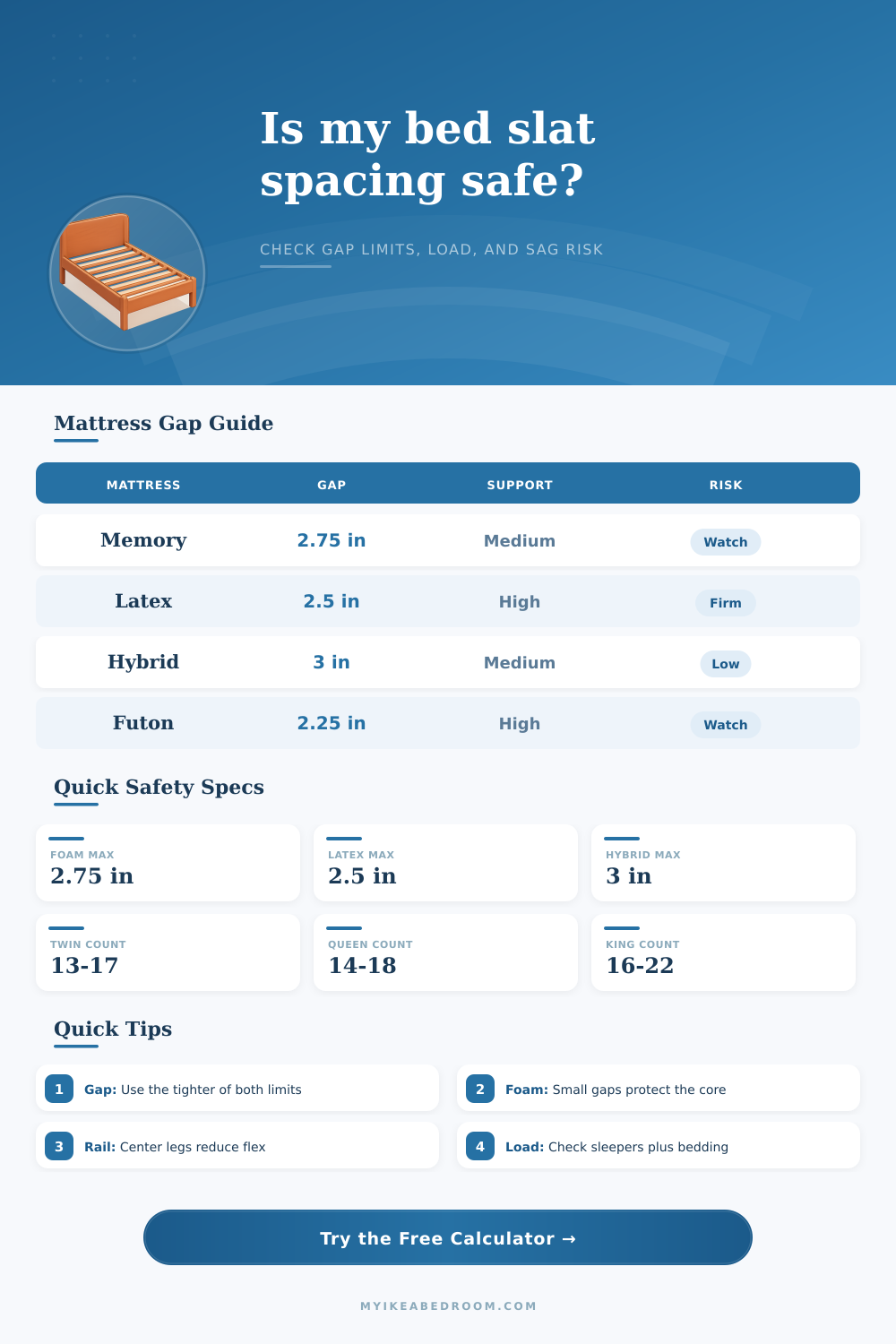
| Mattress type | Max recommended clear gap | Why it matters | Use this check when |
|---|---|---|---|
| Memory foam or boxed foam | Up to 2.75 in | Foam can dip into wide openings and lose edge-to-edge support. | All-foam mattresses, rolled mattresses, and soft comfort layers. |
| Latex foam | Up to 2.5 in | Latex is resilient but heavy, so tight spacing helps control bounce and flex. | Natural latex, synthetic latex, or layered latex builds. |
| Hybrid foam and coils | Up to 3 in | Coils bridge better than foam alone, but top foam still needs even support. | Pocket-coil hybrid mattresses and medium-firm beds. |
| Traditional innerspring | Up to 3.5 in | Coil units tolerate wider openings when the border wire is well supported. | Guest beds, older spring mattresses, and lower-profile coil beds. |
| Futon or thin mattress | Up to 2.25 in | Thin mattresses show slat gaps quickly because there is less fill above the frame. | Futon frames, daybeds, and thin guest mattresses. |
| Kids foam or bunk mattress | Up to 2 in | Shorter, thinner mattresses need tight spacing for a flatter sleep surface. | Bunk beds, loft beds, trundles, and kids foam mattresses. |
| Adjustable-base foam | Up to 2.25 in | Bending sections need consistent support so the mattress does not crease into gaps. | Flexible slat bases, articulated decks, and foam over moving sections. |
| Air mattress on slats | Up to 1.5 in | Inflated chambers can bulge between slats unless a deck or bunkie board is used. | Temporary air beds, camping-style inserts, or guest setups. |
| Slat detail | Lower support range | Better support range | Spacing note |
|---|---|---|---|
| Slat width | 1.5 to 2 in | 2.25 to 3.5 in | Wider slats reduce open area and spread load under foam. |
| Slat thickness | 0.5 to 0.625 in | 0.75 to 1 in | Thicker slats resist flex when sleeper load is concentrated. |
| End reveal | 0.25 to 0.5 in | 0.75 to 1.25 in | Small end reveals increase usable span but may crowd the rail ends. |
| Open-area percent | Over 45% | Under 40% | Lower open area usually means the mattress is better supported. |
| Load per slat | Over 40 lb | Under 30 lb | High load per slat makes thickness and center support more important. |
| Center support style | Score value | Load effect | Best fit |
|---|---|---|---|
| No center support | Low | Full slat span carries the load. | Twin beds, light loads, and short slats. |
| Center rail without floor legs | Medium | Helps align slats but transfers load to the frame. | Full beds and light queen frames. |
| Center rail with floor legs | High | Shortens effective span and reduces slat flex. | Queen beds, foam mattresses, and shared sleepers. |
| Double center rail or split king support | Very high | Shares load across multiple support lines. | King beds, high loads, and heavy latex mattresses. |
| Platform deck below slats | High | Supports the mattress under the slat openings. | Air mattresses, very thin foam, and adjustable sections. |
| Example setup | Typical clear gap | Likely score | Safety interpretation |
|---|---|---|---|
| Queen foam, 15 slats, 2.75 in wide | About 2.8 in | 70 to 85 | Close to the foam limit; center legs help the score. |
| Latex full, 16 slats, 2.5 in wide | About 2.25 in | 80 to 90 | Usually safe when slats are thick and evenly seated. |
| Daybed foam, 12 slats, 2.5 in wide | About 3.8 in | 45 to 60 | Wide gaps can create a sag warning even with moderate load. |
| King hybrid, 18 slats, split center rail | About 2 in | 85 to 95 | Good spacing and strong center support keep risk low. |
| Air mattress, open slat base | Over 1.5 in | Variable | A deck or bunkie board is often the safer support surface. |
The number one mistake most people make when purchasing a bed frame: they don’t measure the gap between the slats. Why does this matter? All mattresses require a support surface to be placed upon, so as long as there is something under them, it should work, right? Wrong. The distance between those wood strips are the biggest determining factor for how many years your mattress warranty remains intact, not to mention if you’ll wake up feeling like someone punched you in the back. Two inches can be the difference between sleeping like a baby for five years versus waking up to a saggy, hip-dip, I-could of had a V8!
That’s where the math comes in. You’ll notice that we’re using a calculator (above) to do the work for us, but knowing what the numbers mean makes you confident in the answer. First, this thing wants to know your mattress material: every one reacts differently when taut. A memory foam mattress will conform to the surface below it; it’s soft. It doesn’t work well with a big gap because it will sink into the hole instead of crossing over it. Denser latex is springier and more resilient, but only so far before it begin to stretch too much. Coils in hybrid mattresses is good at bridging the divide, but they also have a comfort layer made off some kind of foam, which won’t fare as well with unevenness beneath them.
Why You Must Measure Bed Frame Slat Gaps
That’s why I ask people to consider the Load Per Slat figure as well. It’s total weight (including whatever else you might be sleeping with) divided by slats. So if you’ve got fewer slat, they’re all carrying more weight. And if you’re a big couple or sleeping on a heavy mattress like latex, then those individual slats will bend beyond their flex point if not reinforced from below with some sort of center rail. That center support structure is what our calculator accounts for automatically. So having only a side rail and no center leg for a frame is essentially asking your slats to do way too much work across the entire length of the bed. Legging up that center beam cuts its span in half, which dramatically reduces the amount of bending force on each individual strip.
Please note that “wider” does not necessarily mean “better” support. Sometimes a narrow slat closer together will actualy be stronger than a wide one spaced far apart from its neighbors. The open area percentage lets you know how flexible and airy the system is. Generally speaking, lower open area = less opportunity for the mattress to sag into a hole. For most mattresses, foam ones especially, they suggest a gap of under two and three quarter inches between slats. Some take it further by recommending only two inches or less. This is best for thinner mattresses, like a kid’s bunk bed mattress or a futon, where flatness and safety are especially important.
And then there’s the slat thickness. Yes, folks: people forget about this detail. That pretty half-inch wide pine strip may be lovely at the show room, but it’ll buckle when your backside weighs down 300 pounds upon it. Width and thickness contribute to rigidity, so the calculator takes them into account by adjusting their support score.
Don’t despair if your existing configuration has a high chance of sagging; you don’t always have to swap out all the furnitures. In fact, sometimes just throwing down a piece of plywood or even a bunkie board can fix the issue immediately. It provides a rigid surface and imitates perfect spacing, for no extra cost. Another issue is the end reveals, which are the little spaces along the top and bottom of the bed where there are no slats. Those can be wasted space, too, if you make them too big because the rest of the gaps has to expand to make up for it. It is a little thing, but it is not nothing.
The table in the middle of the page shows which mattress types allow for which amounts. That is your baseline. Then plug in your actual numbers.) All in all, it boils down to the same thing: how does this mattress maintain support consistantly from edge to edge? Do you want something supportive but not so much that it creates pressure points? Do you want something that doesn’t let the core of the material wear out too soon? Checking for these things is just a matter of measuring your frame (takes about 10 minutes) and comparing the gaps to these guidelines. Doing this may end up saving you the several hundred bucks it would cost to replace your mattress sooner then expected. Paying a bit of attention to spacing preserves your investment.