Foot of Bed Bench Size Calculator
Calculate a balanced bench length, practical depth, bed-height match, side underhang, foot gap, and walking aisle from your measured bed and bedroom clearance.
Pick a common foot-of-bed setup, then adjust the exact bed, clearance, aisle, height, and storage needs.
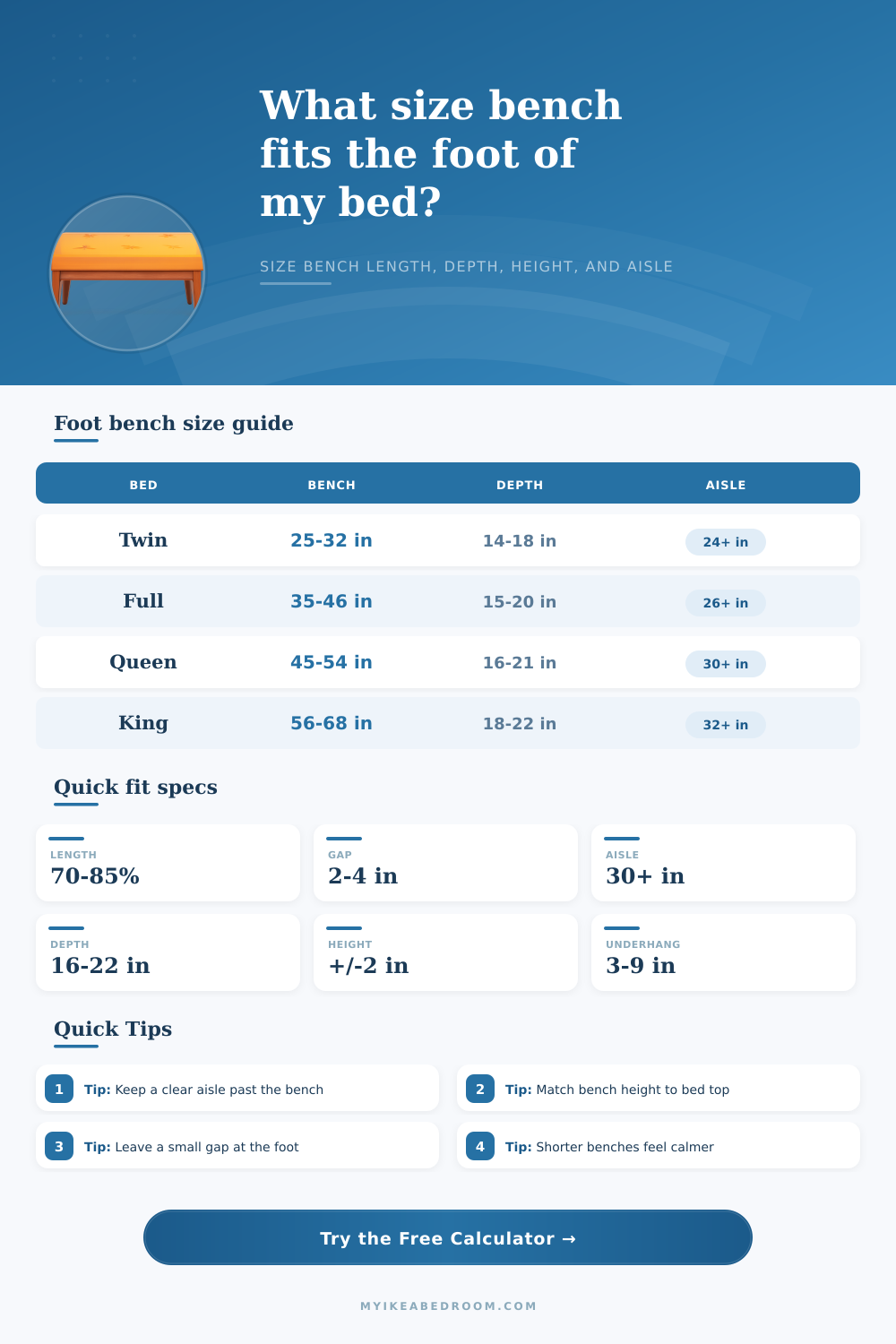
| Bed size | Typical bed width | Compact bench | Balanced bench | Substantial bench |
|---|---|---|---|---|
| Twin | 38 in / 97 cm | 25 in / 64 cm | 27-30 in / 69-76 cm | 31-33 in / 79-84 cm |
| Twin XL | 38 in / 97 cm | 25 in / 64 cm | 27-30 in / 69-76 cm | 31-33 in / 79-84 cm |
| Full | 54 in / 137 cm | 35 in / 89 cm | 39-43 in / 99-109 cm | 44-48 in / 112-122 cm |
| Queen | 60 in / 152 cm | 39 in / 99 cm | 43-48 in / 109-122 cm | 49-54 in / 124-137 cm |
| King | 76 in / 193 cm | 49 in / 124 cm | 55-61 in / 140-155 cm | 62-68 in / 157-173 cm |
| California king | 72 in / 183 cm | 47 in / 119 cm | 52-58 in / 132-147 cm | 59-64 in / 150-163 cm |
| Bench purpose | Useful depth | Best room condition | Fit warning |
|---|---|---|---|
| Decorative perch | 14-18 in / 36-46 cm | Small rooms, guest rooms, low traffic | Can feel narrow for long sitting |
| Daily seating | 16-20 in / 41-51 cm | Putting on shoes, reading, shared bedrooms | Needs a real aisle beyond the bench |
| Storage bench | 18-22 in / 46-56 cm | Blanket storage and larger primary bedrooms | Can crowd dressers or closet paths |
| Tray surface | 15-19 in / 38-48 cm | Blankets, pillows, breakfast tray, books | Keep the height stable and level |
| Low visual weight | 12-16 in / 30-41 cm | Tight walkways and platform beds | Not as comfortable for adult seating |
| Clear aisle beyond bench | Room feel | Works for | Adjustment if short |
|---|---|---|---|
| Less than 24 in / 61 cm | Pinched | Only rarely used guest rooms | Use no bench or a very shallow stool |
| 24-29 in / 61-74 cm | Tight but usable | Compact rooms and narrow benches | Reduce depth before reducing length |
| 30-35 in / 76-89 cm | Comfortable | Most bedrooms and shared paths | Keep gap modest at 2-4 in |
| 36 in+ / 91 cm+ | Generous | Closet routes, door swings, larger rooms | Deeper storage benches can work |
| Scenario | Bed width | Good bench size | Clearance target | Design note |
|---|---|---|---|---|
| Small guest room | 38-54 in | 28-42 x 14-17 in | 24-30 in aisle | Favor a slim bench or backless stool shape. |
| Queen apartment room | 60 in | 43-50 x 15-18 in | 28-32 in aisle | Keep storage depth modest to protect circulation. |
| Primary queen bedroom | 60 in | 48-54 x 17-20 in | 30-36 in aisle | A padded bench can sit slightly below mattress height. |
| King bedroom | 76 in | 58-66 x 18-22 in | 32-40 in aisle | Wider benches look natural but need a longer wall path. |
| Bed with footboard | Any | 70-80% width | 30 in+ aisle | Add gap so fabric and footboard posts are not crowded. |
Best range: about 70% to 85% of bed width.
Shorter feels lighter. Wider feels more built-in, but it should not stick past the bed frame unless the room is very wide.
Best range: 16 to 22 in for most adult seating.
If the aisle is tight, reduce depth first. A shorter bench length rarely fixes the path at the foot of the bed.
Best range: within 2 in of the mattress top.
A lower bench can still work visually, but a much higher bench may interrupt bedding and feel awkward for sitting.
Best range: 30 in or more beyond the bench.
Use 36 in or more when the bench sits on the route to a closet, bathroom, dresser, or door swing.
Measure the made bed. Comforters, quilts, and footboards can add visual thickness. Measure the real outer width that the bench will sit in front of.
Protect the walking path. The key clearance is the space left after the bench depth and bed gap are subtracted from the foot-of-bed zone.
Use underhang deliberately. A few inches of bed showing on both sides frames the bench and keeps the foot of the bed from looking blocked.
Check cushion height. If you add a loose cushion, include it in the seat height so the bench does not end up taller than expected.
A foot of bed bench are a type of furniture that is placed at the foot of a bed. A foot of bed bench must be of the correct size for the bedroom so that it doesnt obstruct the movement of the people at the bedroom. If a foot of bed bench is too long, it will crowd the sides of the bed.
If a foot of bed bench is too deep, it will take up too much of the walking path in the bedroom. If a foot of bed bench is too high or too low, it may be uncomfortabley to use. Therefore, you must consider the length, depth, and height of a foot of bed bench to ensure that it will function correctly at the bedroom.
How to Choose a Bench for the Foot of Your Bed
The length of the foot of the bed bench should be based off the width of the bed. A foot of bed bench that is between seventy to eighty-five percent of the width of the bed will stay connected to the bed without overcrowding the sleeping area. A foot of bed bench that is too wide may make it difficult for people to move in and out of bed comfortably.
Additionally, you should consider the depth of the foot of bed bench. The depth of the foot of bed bench will determine the amount of walking space in the bedroom. A deeper foot of bed bench will hold more blankets but leave less walking space at the bedroom.
The height of the foot of bed bench is another measurement that you should consider when buying a foot of bed bench. A foot of bed bench close to the height of the bed will coordinate well for the bed. However, if a foot of bed bench is much lower than the bed, it may look like a decorative foot of bed bench rather then a piece of furnitures that people can use to sit on when walking into the bedroom.
If you plan to use the foot of bed bench to put on shoes or to fold laundry, you need make sure that the height of the foot of bed bench is appropriate for these tasks. If the foot of bed bench includes cushions, you will need to take into account the height of the cushions in your calculations of the total height that the foot of bed bench will occupy. The width of the foot of bed bench could be determined by measuring the distance from the foot of the bed to the nearest wall in the room, and then subtracting the distance that the foot of bed bench and the walking aisle will occupy.
The remaining distance after these two measurements are subtracted from the distance from the foot of the bed to the wall is the maximum depth that the foot of bed bench can have. Thus, if you want to have a wide walking aisle in the bed’s room, you will have to purchase a foot of bed bench with a shallower slope than if you wanted the foot of bed bench to provide more storage for your laundry or shoes. Finally, you should also measure the actual dimensions of the room with a tape measure to ensure that the foot of bed bench will not become an obstruction for other items in the room.
The dimensions of the room can be affected by other pieces of furnitures in the room, such as nightstands or closets. Therefore, while the calculator can help you find the correct measurements for your foot of bed bench, verifying those measurements in the room is also necessary. If you correctly determine each of these measurements for your room, the foot of bed bench will be a functional piece of furniture in your bedroom.