Bean Bag Size for Room Calculator
Estimate the bean bag diameter, lounger footprint, clearance zone, open floor left, and room-scale fit before placing a compact chair, oversized lounger, floor cushion pair, or sofa-style bean bag.
Start with a realistic room setup, then fine tune the dimensions, style, quantity, and clearance for your own layout.
How the fit score is judged
Bag footprint is the settled chair footprint, adjusted by style and fill softness.
Clearance envelope adds walking and access space around the bean bag, then multiplies it for pairs or groups.
Open floor share compares the clearance envelope with floor area left after other furniture. A comfortable bean bag zone is usually under 30% of the open floor.
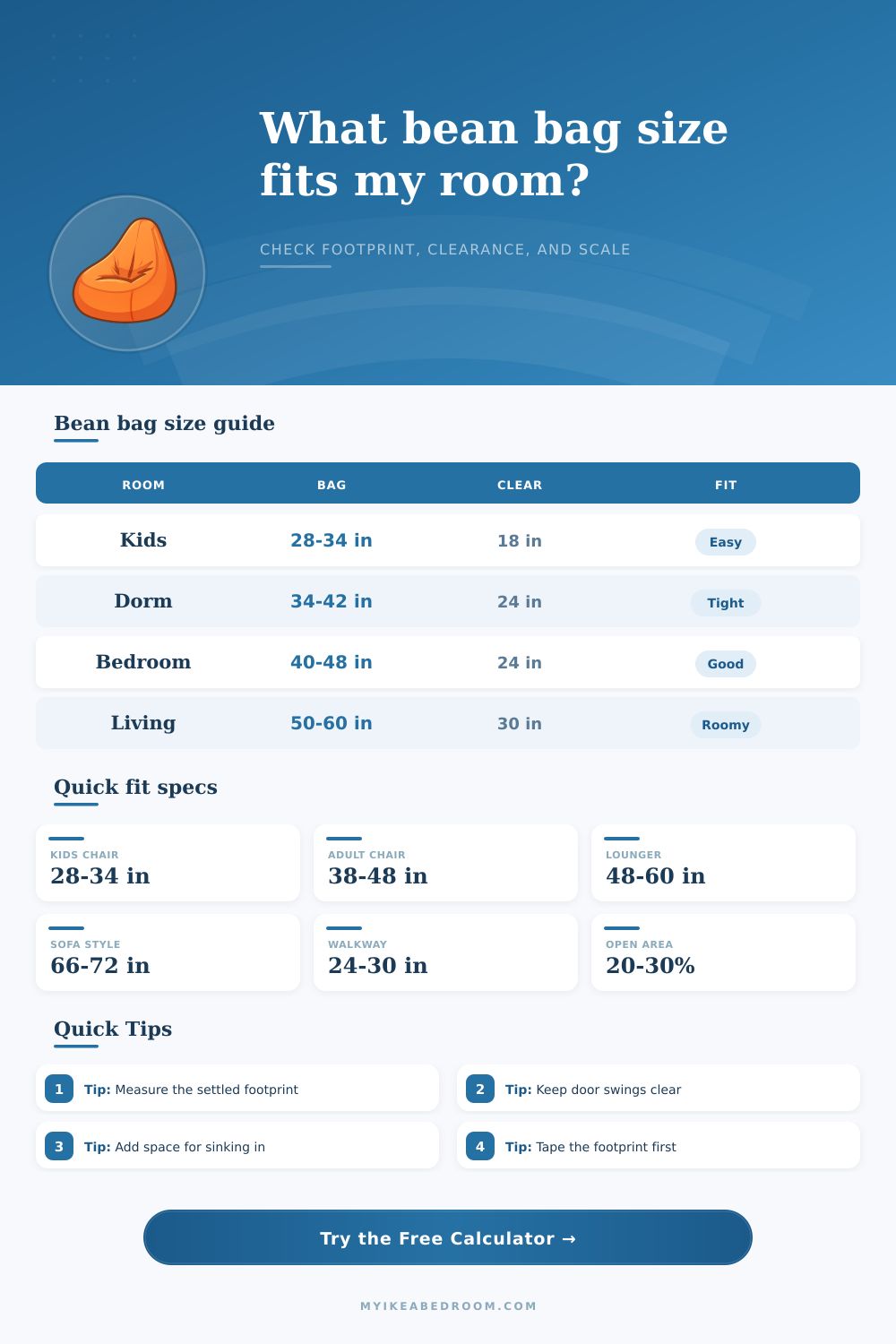
| Size family | Typical footprint | Comfortable room area | Best use | Seat count |
|---|---|---|---|---|
| Kids bean bag | 28-34 in round | 80-120 sq ft | Reading corner, playroom, small nook | 1 child |
| Teen or dorm chair | 34-42 in round or pear | 100-150 sq ft | Gaming, study break, compact bedroom | 1 teen or small adult |
| Adult chair | 42-48 in round | 130-190 sq ft | Bedroom, office, apartment living room | 1 adult |
| Large lounger | 48-60 in wide | 180-260 sq ft | Movie room, nap-friendly lounge, TV zone | 1 sprawled adult |
| Sofa-style bag | 66-72 in wide | 240-340 sq ft | Family room or media room seating | 2 adults or 3 kids |
| Placement | Rear gap | Side access | Front path | When to use |
|---|---|---|---|---|
| Tucked corner | 3-6 in | 12-18 in | 18-24 in | Kids room, quiet reading corner |
| Along a wall | 6-10 in | 18-24 in | 24-30 in | Bedroom, dorm, office |
| Floating layout | 18-24 in | 24-30 in | 30-36 in | Living room or open-plan zone |
| Doorway or main path | 12-18 in | 30-36 in | 30-42 in | Shared rooms and high-traffic areas |
| Lounger or sofa bag | 12-24 in | 24-30 in | 30-36 in | Full-body lounging and media rooms |
| Room scenario | Room area | Good bean bag range | Open floor goal | Watch item |
|---|---|---|---|---|
| Kids bedroom | 100-130 sq ft | 28-36 in | Keep 55%+ open | Toy storage and door swing |
| Dorm room | 110-140 sq ft | 34-42 in | Keep 45%+ open | Desk chair pull-out space |
| Bedroom corner | 140-190 sq ft | 40-48 in | Keep 40%+ open | Dresser drawers and bed path |
| Living room | 180-260 sq ft | 48-60 in | Keep 35%+ open | Coffee table and TV walkway |
| Family room | 260-340 sq ft | 60-72 in | Keep 30%+ open | Shared paths between seats |
| Bean bag style | Typical size | Approx fill volume | Settling behavior | Room effect |
|---|---|---|---|---|
| Round chair | 36-48 in | 9-22 cu ft | Moderate side spread | Balanced footprint |
| Pear chair | 36-48 in | 11-25 cu ft | Taller back, narrower front | Good for wall-side use |
| Lounger | 48-60 x 58-70 in | 25-45 cu ft | Flatter when occupied | Needs strong front clearance |
| Sofa bag | 66-72 x 36-44 in | 30-50 cu ft | Long seat edge | Acts like low sofa seating |
| Cube or pouf | 22-30 in | 4-10 cu ft | Stable footprint | Easy to tuck beside seating |
Round chair
Simple footprint, easy to rotate, and forgiving in bedrooms or kids rooms.
Best all-purpose fitPear chair
Taller back support with a slightly smaller front footprint than a full round bag.
Best for gamingLounger
Comfortable for legs-out lounging, but depth matters more than width.
Best for media roomsSofa-style bag
Works like casual shared seating, so plan it like a low sofa, not a chair.
Best for 2 seatsFloor cushion
Low, wide, and stackable; useful when height is less important than flexible floor seating.
Best for playroomsCube pouf
Smallest footprint, good as a footrest or occasional perch beside a larger chair.
Best add-on pieceOutdoor bag
Needs extra drying and access space, especially on balconies or covered patios.
Best near wallsBean bag pair
Two smaller bags often fit better than one oversized lounger in shared rooms.
Best flexible layoutCheck the occupied footprint. A soft bean bag spreads when someone sits down, so leave clearance around the settled shape, not just the new, upright shape.
Protect daily paths. Keep the main route to doors, wardrobes, beds, desks, and media consoles clear before choosing the largest size that technically fits.
Sure, you love the look of a cozy bean bag so you go buy one. Then, after you bring it home it takes over your bedroom. There’s the chair blocking the way into the closet. After you plop down on it… the beads move around. They expands outward from middle. They settle. So now they form an area that is more significantly wider then the upright shape on the shelf.
The solution is not typicaly that the seat isn’t comfortable. The problem almost always has to do with its footprint. Before you order, allow for how it will spread out. If not, you’ll have a piece of furnitures that doesn’t work well in real life.
Why Bean Bags Need More Space Than You Think
So here’s a calculator that visualizes that. It measure how big the bag will be, and how much clearance area surrounds it. It factors in length and width of your room. It subtracts the space occupied by bed or desks. It also figures if a 60-inch lounger or a 40-inch round chair will fit. This ensures traffic doesn’t get blocked.
When floor space is tight, interior design intuition can fail. You may believe a small den has enough space for a large couch-style bag. The tool shows you that even with necessary clearance area for walking, there’s only ten percent of open floor available. That figure tells you why your room will feel cramped come next week.
What about float versus tucked corners? Imagine trying to sit back into a chair pushed all the way up against a wall. How much clearance do you require behind you? You need plenty of clear space on each side to scoot forward and pull out your legs. A floating setup in a living room mean needing walking space all the way around, an entire envelope on each side. That’s triple the amount of real floor used by seat itself. The tool automatically accounts for this depending on whether you chose a tuck or floating design.
And it accounts for softness of the fill too. A firmer foam bead pack will keep its shape more than a different kind of fill. But super-soft microbeads just sorta spread out and form a shallow pool. People commonly make mistake of not accounting for how the bag settles. Many customers measure the bag when it’s upright. They don’t realize they will need to account for the two-inch spread once someone sits inside.
And then it comes down to room shape. Planning in a rectangular room is easy, how do you fit the furniture into a circular rug zone, or a triangular nook? You cannot simply divide every shape by four to get square footage and assume everything will fit. There’s also the issue of clearance around a curving edge of a round bag. Or a sharpish angle between two wall might make a tight corner feel blocked.
The tool includes tables of references which gives some general guidance on these kinds of shapes. And they demonstrate that the amount of free floor percent needed for a kid’s chair is very different than that needed for an adult lounging around. It’s not about square footage alone; there’s proportion and scale at play here too.
How Do I Pick the Proper Bean Bag Size? The science of bean bags is simple: it’s about circulation and comfort. You want a seat that envelops you without isolating you in your own livig space. Running the numbers based off your particular room size eliminates the guess work. No more regrettable purchases or returns!
Clear the walkway. The idea here is that the chair doesn’t become a hindrance. It’s supposed to be an invitation. Once you know what kind of space a laid out bean bag requires, you’ll realize there are spaces throughout your home for seats that look intentional, open, and welcoming instead of cluttered and haphazard.
You should of checked size first.