Bay Window Curtain Calculator
Plan a three-face bay curtain layout from left, center, and right bay widths, bay angles, returns, bracket offsets, fullness, panel count, drop, fabric width, pattern repeat, overlap, and stackback.
Start with the closest bay shape, then adjust the widths, angles, fabric width, pattern repeat, and return space to match your window.
| Measurement | Where to measure | Calculator use | Common check |
|---|---|---|---|
| Left bay width | Along the left angled or side face | Adds to the bay run before fullness | Measure along the pole or track path |
| Center bay width | Across the main flat window face | Usually the largest part of the run | Exclude decorative trim unless covered |
| Return length | Past the side glass toward the wall | Adds privacy and side-light coverage | Compare with stackback clearance |
| Bracket offset | From each outside end to first bracket | Reduces clear return stack space | Keep fabric away from bracket collars |
| Curtain type | Typical fullness | Stack behavior | Best use in a bay |
|---|---|---|---|
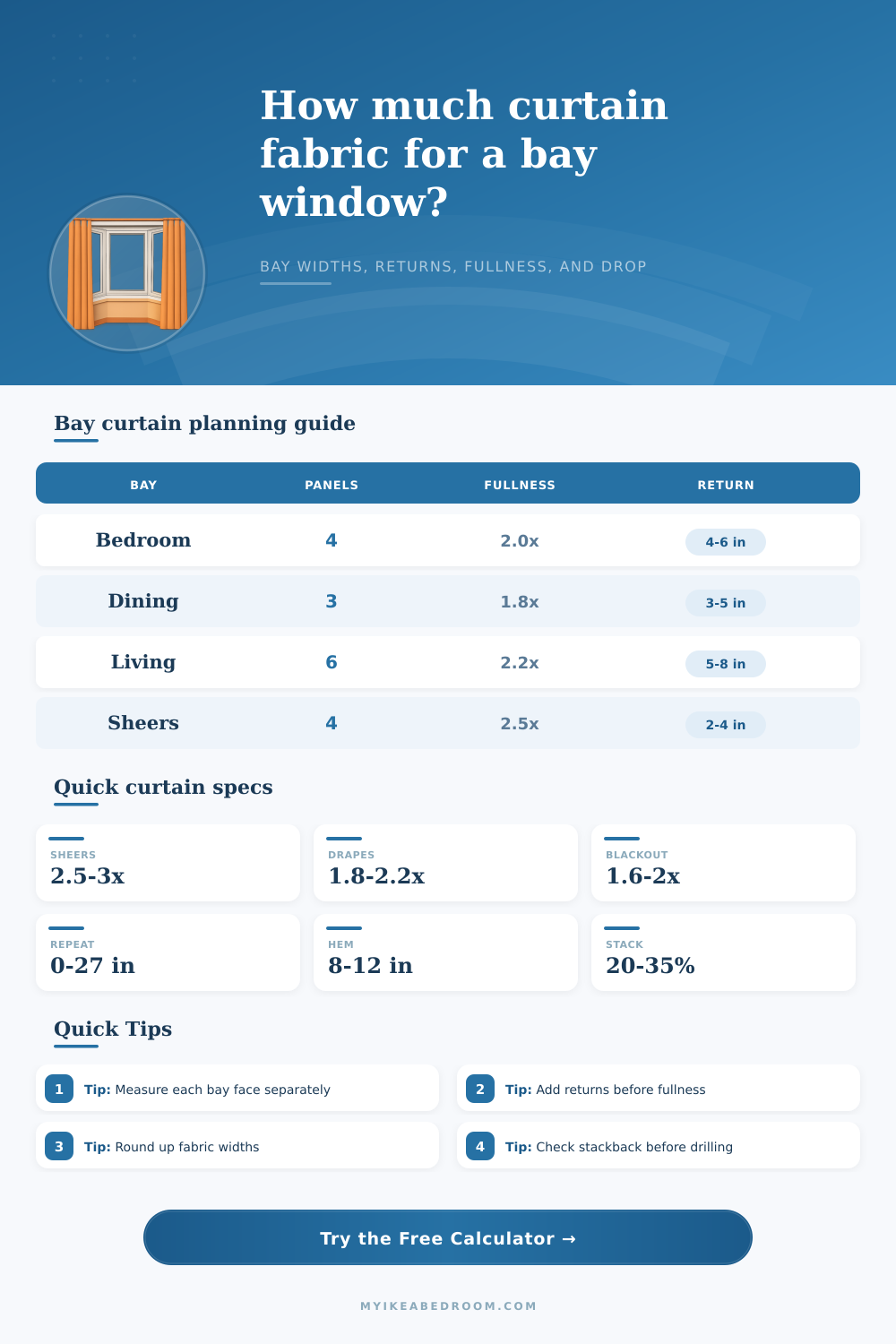
| Sheer panels | 2.5x to 3.0x | Soft but wider when open | Layered privacy over shallow bays |
| Standard lined drapes | 1.8x to 2.2x | Moderate stackback | Bedroom and living room bays |
| Blackout curtains | 1.6x to 2.0x | Bulkier folds | Sleep spaces needing side coverage |
| Ripplefold or wave track | 2.0x to 2.4x | Predictable fold spacing | Ceiling track and contemporary bays |
| Fabric situation | Common width | Repeat entry | Yardage effect |
|---|---|---|---|
| Plain solid fabric | 54 in / 137 cm | 0 | Uses drop plus hem allowance only |
| Small vertical texture | 54 in / 137 cm | 0 to 6 in | Usually a small rounding increase |
| Medium botanical print | 54 in / 137 cm | 12 to 18 in | Each width rounds to the next repeat |
| Large statement pattern | 54 to 60 in | 24 to 36 in | Can add a full repeat to every cut width |
| Layout | Usual stackback | Return target | What to watch |
|---|---|---|---|
| Center split draw | 20% to 30% of covered width | At least 4 to 8 in per side | Side stacks can block narrow bay glass |
| Three bay sections | 18% to 28% per section | Returns plus corner room | Corner brackets may interrupt travel |
| One-way draw | 25% to 40% at one side | Largest clear wall or return side | One side needs most of the parked fabric |
| Grommet panels | 30% to 45% depending on rings | Longer returns help | Grommets stack wider than hooks |
Fit: follows shallow and angled bays.
Good for ceiling mounting and continuous travel around corners.
Fit: straight sections plus corner elbows.
Works when the bay angles are consistent and brackets align.
Fit: each bay face has its own short rod.
Simple to measure, but panels do not glide through corners.
Fit: strong for tall drops and layered curtains.
Allows the fabric to clear deep sills and radiator covers.
Measure the route, not the view. A bay pole or track follows the left, center, and right faces, so straight wall-to-wall measurements will usually understate the required length.
Test the parked fabric. If the stackback clearance is negative, use lighter heading hardware, reduce fullness, split the panels differently, or extend the return before fixing brackets.
Bay windows presents specific challenges for window coverings due to the angled side of bay windows that do not follow a straight line. Each measurement of a bay window follow a path based off the angled sides of bay windows. Additionally, the returns on a bay window add to the length of the window that needs be covered, which a person might forget when cutting the fabric for the window coverings.
A specialized calculator help a person to avoid making any mistake when choosing the correct covering for a bay window. This calculator asks for the width of each face of the bay window, the angle between each face of the bay window, and the length of the returns of the bay window. Based on these measurements, the calculator will provide data for a person regarding the length of the track for the bay window, the yardage of the fabric need for the bay window, and the clearance of the fabric panels that will be stacked on the bay window.
How to Use a Bay Window Calculator
Each of the measurements that a person enter into the calculator has a specific use for the bay window. A person must measure the three widths of the bay window along the track route of the bay window. A person must not measure the widths of the bay window from wall to wall in the room.
The angles between the faces of the bay window determine the length of the returns for the bay window. The returns of a bay window are the returns that wrap past the side glass on the bay window. The returns are provided to prevent light from leaking out of the bay window.
The bracket offset for the bay window is used to determine the amount of space that the hardware will take up on the returns of the bay window. If a person does not account for the bracket offset, the bay windows fabric panels may entirely block the glass from that bay window. Fullness of the bay window’s panels determines how much extra length of fabric a person has to purchase for the panels of the bay window to have proper folds.
The pattern repeat of the fabric for the bay window will force the length of the fabric to be increased to ensure that the design stay evenly repeated on each panel. The outputs of the calculator for the bay window must be read in connection with each other. The calculator calculates the length of the track that account for the returns of the bay window and the amount of space that the track takes up on the bay window.
The calculator measures the yardage of the fabric and includes the cut drop, the top allowances, the bottom allowances, and the pattern repeat. The calculator calculates the flat width of each panel of the bay window, as is the width of each panel of the bay window when the panels is gathered together. The clearance of the gathered bay window panels is the final calculation that a person needs to make for the bay window.
This calculation determines if the gathered panels will fit within the bay window and not come in contact with the glass or any brackets that may surround the window. If a person finds that the value for the bay window’s stackback is negative, it means that the fabric panels will either crowd the bay window’s glass or its brackets. In this case, the return lengths on the bay window will have to be lengthened, or the fullness for the bay window will have to be reduce.
Two tables are provided on the calculator for bay windows. One table explain the fullness of the different types of fabric for bay windows. For instance, sheer fabrics will require more fullness to appear thick within the bay window, while blackout fabrics may appear too bulky if the person uses too much fullness for the bay window.
The other table within the bay window calculator explains how pattern repeats will change the yardage of the bay window’s fabric. Finally, the third table provided for bay windows calculates the bay window’s stackback based upon the different types of hardware that may be used for the bay window. For instance, grommet headings will cause the fabric to have a different amount of stackback compared to ripplefold tracks.
There are a few complications for bay windows that people often ignore that are not aware of the impact of those complication on the bay window. For instance, bay windows that face south may require blackout fabric for the center face of the bay window only. However, the remainder of the bay window may require lighter fabric for those sides.
Additionally, if a bay window has a low sill or a radiator that is placed under the bay window, the bay window panels will have to be cut higher on one side of the bay window compared to the other. Additionally, if a bay window has a higher hem on one side than on the other, the cut drop will have to be changed for each different width of the bay window. Finally, the height of the ceiling in a room may impact the placement of the track for the bay window.
If the track for a bay window is to be mounted to the ceiling, the person will have to purchase a different heading for the bay window then if the bay window is mounted to the wall. These details are complex and require that a person run the calculator for a bay window twice to ensure that the measurements are correct. A few mistake are often made by people before they order the fabric for bay windows.
One of the most common mistakes is to measure from wall to wall on a bay window instead of measuring the three bay window widths on the route of the track of the bay window. Additionally, many people will enter the drop length that they would like to achieve for the finished bay window without adding in the allowance for the hem of the bay window panels. Finally, many people will not account for the possible negative stackback of their bay window when they create the bay window’s fabric order.
The calculator for bay windows is helpful because it displays the impact that each entry into the calculator will have upon the yardage or the bay window clearance calculations. The main goal of the calculator for bay windows is to ensure that the numbers match the bay window in the actual room where the bay window is to be installed. If the numbers are entered correctly, the track will reach the returns on the bay window.
Additionally, if the numbers are entered correctly, the yardage for the bay window will include the length of the pattern and the bay window hem. Additionally, if the numbers are correctly entered into the calculator, the panels of the bay window will clear the glass of the bay window. Finally, if all of the calculations for a bay window are made correctly, the bay window will function as the person has design for it to function.