Battery Backup Runtime Calculator
Estimate how long a battery backup can run routers, laptops, lights, medical devices, refrigerators, and small home loads from capacity, DoD, efficiency, load watts, and surge factor.
▶Load Presets
Choose a common backup scenario or enter your own battery and load values below.
⚙Battery And Load Inputs
Your Backup Runtime
Calculation Breakdown
📊Quick Runtime Factors
🔌Common Load Runtime Table
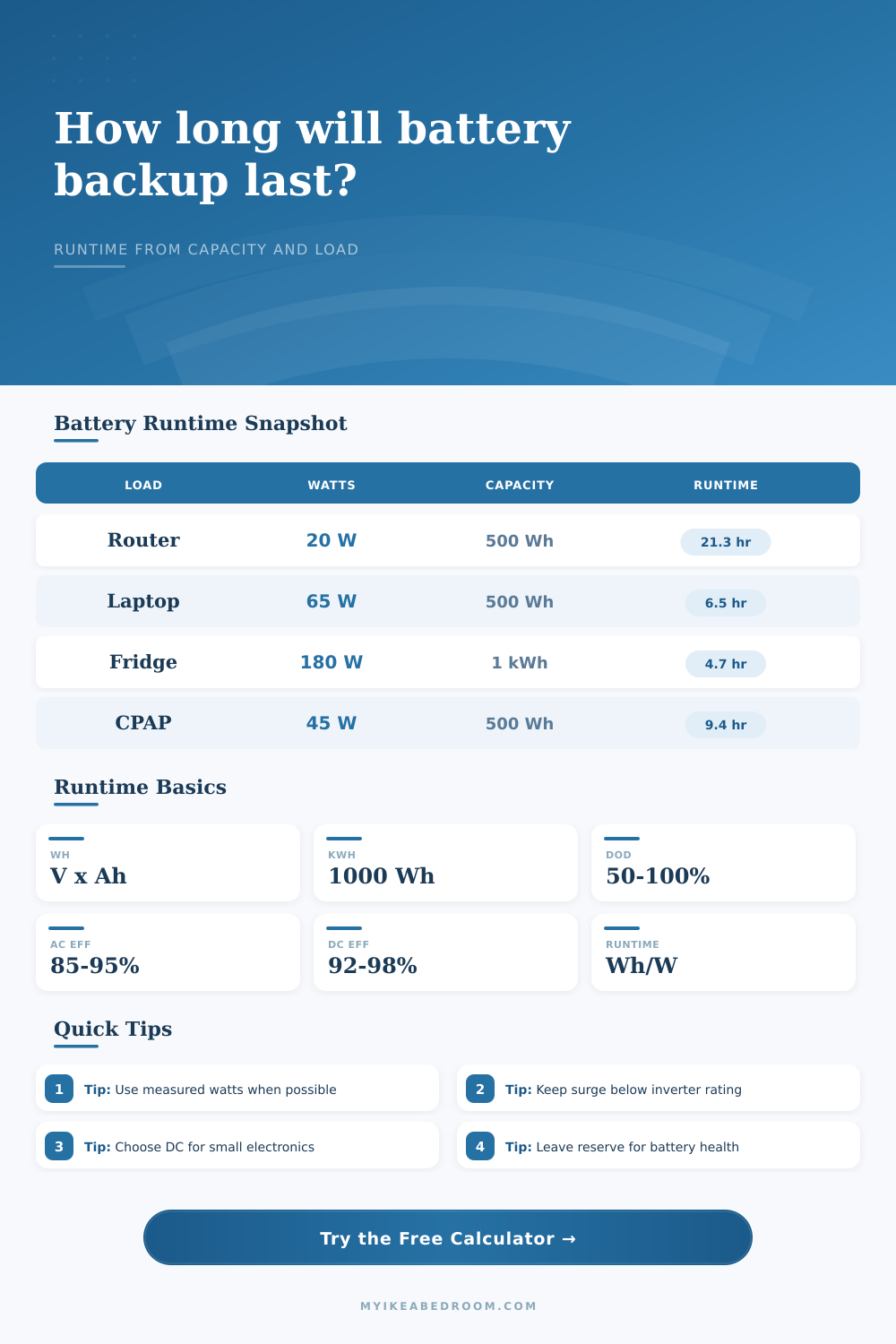
| Load Type | Typical Watts | Surge Factor | 500 Wh Usable Runtime |
|---|---|---|---|
| Wi-Fi router and fiber box | 20 to 40 W | 1.0x | 12.5 to 25 hours |
| Laptop charging and use | 45 to 90 W | 1.1x | 5.6 to 11.1 hours |
| LED task lighting group | 30 to 80 W | 1.0x | 6.3 to 16.7 hours |
| CPAP without heated humidifier | 30 to 60 W | 1.2x | 8.3 to 16.7 hours |
| Modern refrigerator cycling | 120 to 220 W | 2.5x to 4.0x | 2.3 to 4.2 hours |
📐Battery And Efficiency Reference
| Battery Or Output | Typical Setting | Use In Calculator | Runtime Effect |
|---|---|---|---|
| Lead-acid reserve use | 50% DoD | Enter 50% | Protects cycle life |
| LiFePO4 routine use | 80% to 90% DoD | Enter 80 to 90% | More usable Wh |
| AC inverter output | 85% to 95% | Efficiency field | Reduces usable Wh |
| DC regulated output | 92% to 98% | Efficiency field | Often runs longer |
| Motor compressor surge | 2x to 4x | Surge factor | Affects inverter sizing |
📋Capacity Examples
| Battery Label | Nominal Capacity | Usable At 80% DoD, 90% Eff | 100 W Load Runtime |
|---|---|---|---|
| 12 V 50 Ah | 600 Wh | 432 Wh | 4.3 hours |
| 12 V 100 Ah | 1,200 Wh | 864 Wh | 8.6 hours |
| 24 V 100 Ah | 2,400 Wh | 1,728 Wh | 17.3 hours |
| 48 V 100 Ah | 4,800 Wh | 3,456 Wh | 34.6 hours |
| 1.0 kWh station | 1,000 Wh | 720 Wh | 7.2 hours |
ℹRuntime Tips
You pull the plug on the grid during a storm and watch the smart meter spin backward or stop. You’re disconnected from the grid. The router keeps going; the lights is still lit.
How long can that continue? That answer defines difference between a simple gadget and a necessary piece of your survival kit.
Why You Need Real Math for Your Battery
People buy batteries based off what is written on the box: the nominal watt-hours. They reason that a one-kilowatt hour battery will power a hundred-watt device for 10 hours. Wrong! The real world includes such things as inverters drawing energy, depth of discharge limits, and efficiency losses. The labeled capacity isn’t the same thing as the usable energy. Learn the difference.
The calculator strips away the guesswork with whatever you set up. It takes your battery specs and turns them into energy. For example, if you have a lead acid battery, you shouldn’t deplete it to zero because that will damage it. So you use a more conservative depth of discharge, say fifty percent. Or you can use a lithium iron phosphate battery to get 80 or 90 percent out of it.
That’s twice as long on the same exact battery but nothing has changed physically. What it does is take your total capacity and apply a percentage of what you think you want to pull. This gives you a true picture of pool of energy available.
How much do you really need? It is not about how much I have.
The conversion penalty means that when you plug a device into your inverter, you are running it through an AC inverter. Convenient, because you can plug in regular appliances! But it is energetically costly. When inverters convert DC battery power into AC household current, they also produce heat (i.e., waste). You’ll lose five to fifteen percent of your power in that conversion. To avoid that waste, you run all your sensitive electronics directly on DC power. Toggle between AC and DC output paths on the calculator, it adjusts the efficiency factor accordingly. This adds a buffer to your runtime, especially with lower wattage device such as laptops or CPAP machines.
Another thing people often run into is their surge capacity. They may have a light load when everything is up and running but they don’t have much reserve on startup. Sump pump motors draws several times what they do while running, as does a refrigerator compressor. For those few seconds at startup, an inverter will shut down if it doesn’t have sufficient surge capacity. Regardless of how much charge you’ve got left in the backup, it’s over. You’re done.
There’s also a surge factor input on this tool. You can enter surge settings so you know that your system has enough head room to power up these type of heavy motor loads. So again, you’re sizing for peak demand, not simply average.
Static calculations don’t account for added complexity of cold weather. Cold slows down battery chemistry. It raises internal resistance and decreases actualy capacity. At seventy degrees, a battery may be able to give you a kilowatt hour; but at forty degrees it might not be as good. You’ll want some reserve left in your calculation just because of this fact.
Cells age too and hold less charge over time. A new battery is not the same as a three year old. The page’s reference tables contains typical runtimes. Real-world conditions will always vary.
But only if the math adds up do batteries provide a continuation of power. The nominal rating isn’t enough to rely upon. Rely on what’s left when efficiency and reserve factors is applied. How many hours does it keep your lights on during a grid outage? That’s something you need to be able to say with certainty.
Don’t get left in the dark because you planned for the best case; plan for the worst case. It’s not a matter of hope, but rather math and hardwere.